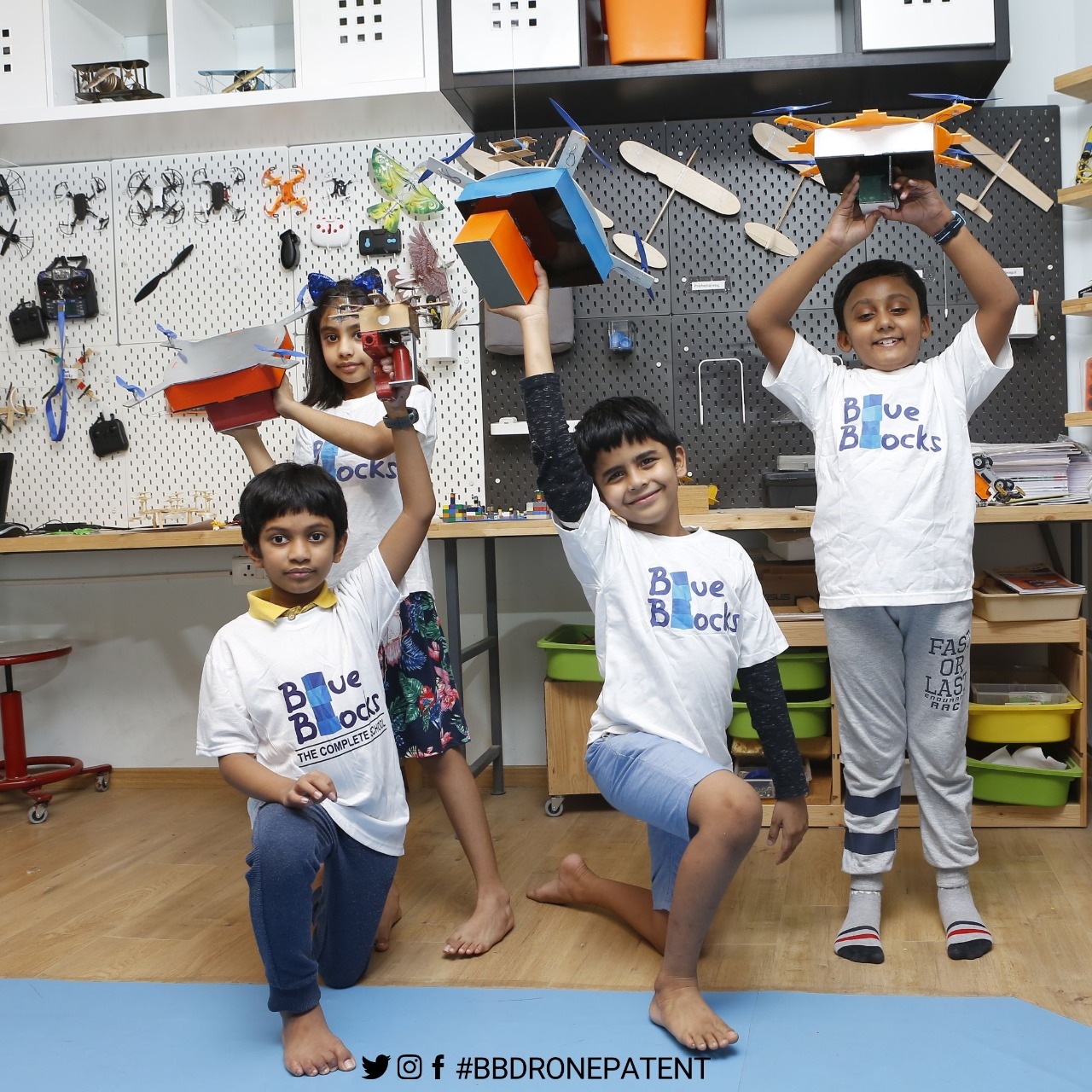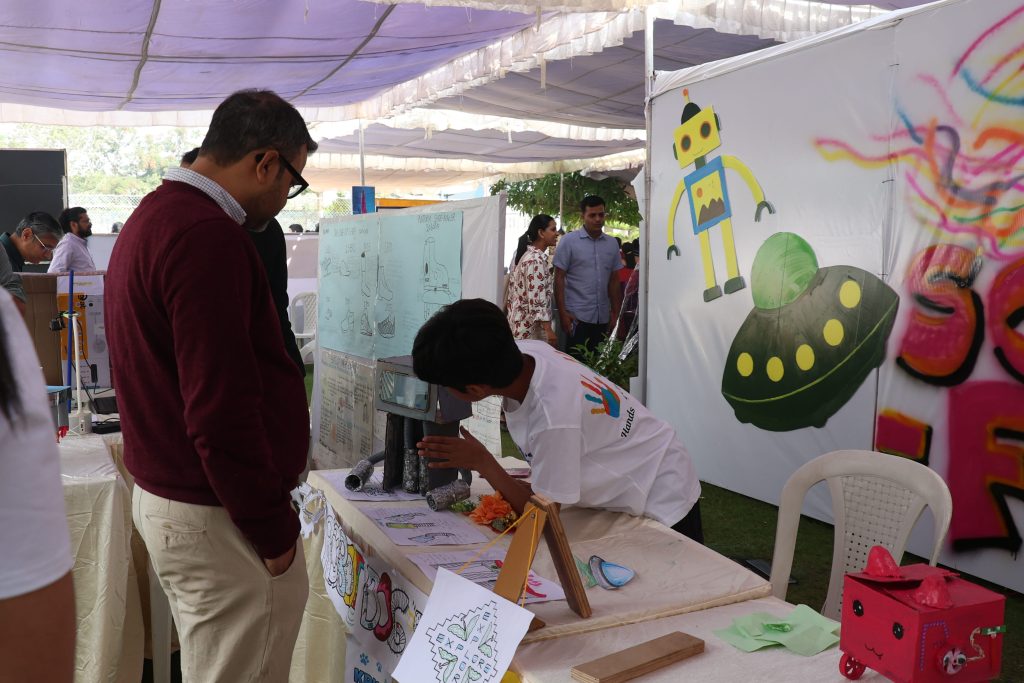
Months earlier, a family in Hyderabad had lost their house key. Locked out for three or four hours, they had to find an alternative way in. Their son watched the whole thing. “It formed some impressions in his mind,” the father told us at our annual school event, Explore Montessori 2025, held on 29 November 2025. “Some long-lasting impressions.” When the school announced the event, the boy built a biometric scanning system for keyless home entry. The father, unprompted, called what he had observed experiential learning. This is what project-based learning Montessori actually looks like in a child’s real life.
That phrase — experiential learning — used by a parent without prompting from the school is the part of the conversation worth dwelling on. It is the clearest sign that what the school does and what the family observes have come to mean the same thing.
What is project-based learning in a Montessori environment?
Project-based learning Montessori is an educational approach in which children build, design, or produce something concrete in response to a real question or problem. The defining feature of project-based learning is not the project itself but the question that drives it. A child who builds a model bridge because a textbook chapter asked them to is doing a school task. A child who builds a biometric scanner because their family was locked out for three hours is doing project-based learning. The difference is not visible in the finished work. It is visible where the question came from.
The most common project-based learning examples in school settings — science fair projects, design challenges, model presentations — often look like project-based learning without quite being it. They are projects, certainly, but the question is usually supplied by the teacher or the syllabus rather than by the child’s own observation. Real project-based learning starts with the child’s question. The school provides the deadline, the resources, and the audience.
What is experiential learning, and how is it different from project-based learning?
Experiential learning is the broader category that contains project-based learning. It describes any learning in which the student does something, reflects on what they did, and applies the reflection to a new situation. Hands-on learning, learning by doing, learning through experience — these are all everyday names for the same idea. The Association Montessori Internationale describes the cycle as experience, exploration, expression — the child engages with a real situation, explores what is happening, and finds a way to express what they have understood.
Project-based learning Montessori is one form of experiential learning, but it is not the only one. A child cooking with a parent is doing experiential learning. A child observing ants in the garden for forty minutes is doing experiential learning. A child noticing that the family is locked out and quietly storing the observation for later — that is also experiential learning, and it is the part of the cycle that most schools do not see. Experiential learning includes the long, quiet phases between the experience and the expression. The biometric scanner at Explore was the expression. The lockout was the experience. The months in between were the exploration that most adult observers cannot see.
What does experiential learning look like in real life?
The father used three phrases in his interview that name something specific.
“Long-lasting impressions.” He was describing what the lockout did to his son’s attention. Not a moment of inconvenience that passed. An impression that stayed long enough — months, by his account — to surface again as a project when the school created the opportunity. That kind of staying-power in a child’s attention is not an accident. It is what experiential learning produces when a child has the cognitive and emotional room to notice what bothers them and return to it later.
“He knows how to create that very useful manner.” The mother used this phrase to describe her son’s working style. “Sometimes children are worried — I don’t have this thing, that thing,” she said. “But he’s not like that.” What she was naming is a specific disposition — making with what is available rather than complaining about what is missing. This is a by-product of years of hands-on learning in a Montessori environment. A child who has had enough small successes with limited materials stops expecting completeness as a precondition.
“Experiential learning.” The father used the term unprompted. He had watched his son go from a household problem to a built solution and concluded, on his own, that this was what experiential learning looked like. When parents adopt the school’s pedagogical vocabulary on their own, after observing their own children, the vocabulary has been earned. When they have to be reminded of what the school calls something, it has not.
This is what project-based learning Montessori looks like in a real child’s life — not as an abstract teaching technique, but as a continuous arc that begins outside the school day and finishes on its grounds.
How does Montessori education support project-based learning?
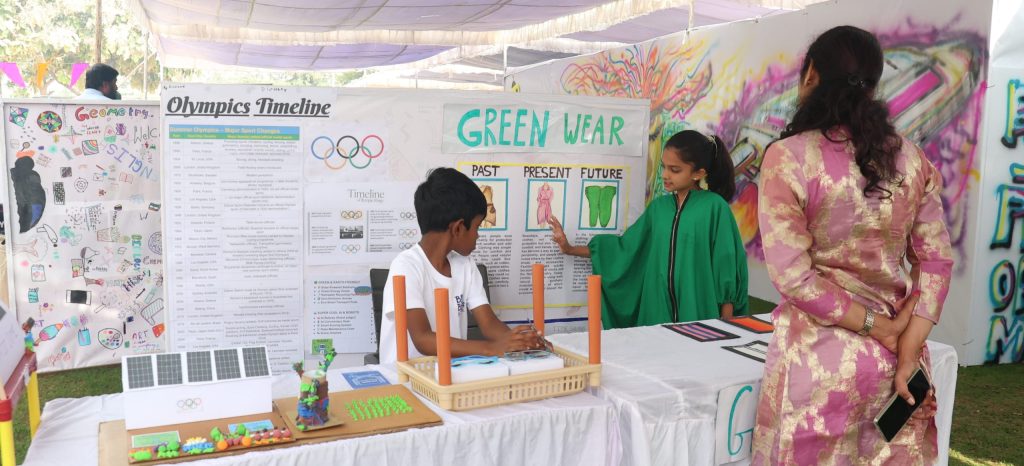
An AMI-guided Montessori classroom is built specifically to support project-based learning at every age. The prepared environment offers children genuine choices about what to work on, when to start, where to sit, and how long to stay. The materials are concrete and self-correcting, so children learn by doing rather than by being told. Older children in mixed-age classrooms take on long-term collaborative projects that resemble adult problem-solving — research, design, presentation, and defense. The whole structure is experiential learning in action.
What an event like Explore Montessori adds to this is a public deadline and a stage. Children spend their school years building the cognitive and emotional capacities that experiential learning requires — attention, persistence, comfort with limited materials, the willingness to fail and try again. A theme like Innovision 2050 gives those capacities something concrete to be expressed through. The biometric scanner project did not happen because the school taught a unit on biometric authentication. It happened because the boy had spent years learning to notice his own observations, hold them long enough to think about them, and finish what he started.
How can parents support experiential learning at home?
Children encounter problems in their daily lives all the time. A lost key. A door that sticks. A cousin who is unfair. A book that ends badly. Most of these observations pass without becoming anything. The child notices, the family moves on, the impression fades.
What turns observation into work is having a stage on which the work can be shown and a deadline by which it must be ready. This is what project-based learning, in its truest form, requires — not a teacher-supplied problem, but a real problem the child has noticed, and a school structure that gives the child somewhere to take it. For parents, the implication is small but real. The household frustrations your child notices — the locked door, the broken thing, the unfair situation — are potentially long-lasting impressions. If the impression stays long enough to become a question, the child needs somewhere to take the question.
For educators, the implication is sharper. The function of an event like Explore is not to display the school’s curriculum. It is to give children’s existing observations a place to be finished. A school that themes its annual event around the future, and asks its students to fill the grounds with their own answers, is offering a public deadline for the projects their lived lives are already nudging them toward. Project-based learning Montessori is not what the school assigns; it is what the child has already noticed, given a place to go.
We saw a biometric scanner at Explore 2025. What it actually was: an afternoon a boy spent locked out of his own home, given the time and the stage to become something he had built.
Author: Pavan Goyal is the Founder of Blue Blocks Montessori School in Hyderabad and Founder and Principal Investigator of Blue Blocks Micro Research Institute. He holds all four AMI Montessori diplomas (0–18) and serves as Trustee of the Indian Montessori Foundation. ORCID: 0009-0009-8840-8505.