Your child is three years old, and you are still holding the spoon. You have tried letting her feed herself. Half the food ended up on the floor. So you went back to helping. This piece is about how to teach your toddler to eat by themselves, and why the environment matters more than the effort.
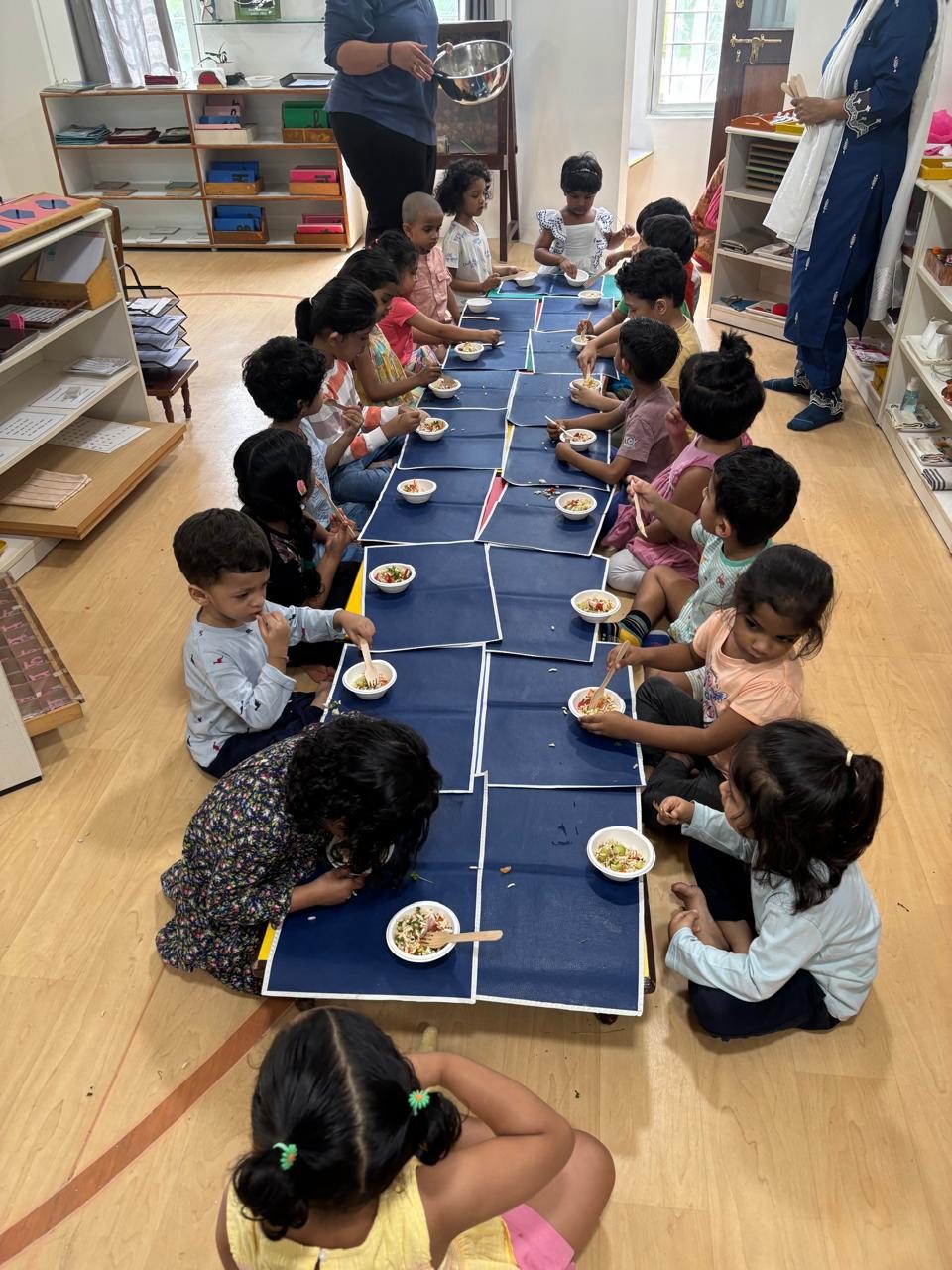
Every day at Blue Blocks, Montessori mealtime for toddlers looks different. Children as young as 18 months pour their own water. Butter their own bread. Carry their own soup to the table. Not because we ask them to. Because the environment lets them.
The question is not whether your child is capable. She is. The question is what the environment around her allows her to try.

What Montessori mealtime for toddlers actually looks like
A small child, not yet two, stands at a low counter. In front of her is a glass jug half-full of water and an empty cup. She lifts the jug with both hands, tips it carefully, and pours. Some water lands in the cup. Some lands on the counter. She sets the jug down, picks up a cloth, and wipes the counter dry. Then she drinks the water she poured.
That is one Montessori mealtime moment. It looks small. It contains everything.
The child chose to pour. She used a real jug, not a spill-proof plastic one. When she spilled, she cleaned. When she was thirsty, she drank what she made. No adult reached in. No one gave permission or applauded the effort. She simply did the work.
This is what a Montessori mealtime for toddlers looks like across the day. Children participating in the whole cycle of eating, not just the eating part. Preparing. Serving. Cleaning. Choosing what to take and how much.

Why children can do more than we think
The idea that children need to be fed until age four or five is a modern one. In most of human history, children began participating in food preparation and self-feeding as soon as their motor skills allowed. Somewhere in the last century, in wealthier societies, we started doing the work for them.
There is a widely-used paediatric feeding framework called the Division of Responsibility, developed by American dietitian Ellyn Satter. It has one core principle. The parent decides what food is offered, when, and where. The child decides whether and how much to eat. Most contemporary paediatric feeding advice sits inside this frame.
Maria Montessori arrived at the same principle by observation, decades earlier. She added one thing. The child also participates in the preparation, the serving, and the clearing. Not as a chore. As a developmental practice.
Our own home-observation research on Montessori children documented that children who were included in food preparation, who served themselves at the table, and whose parents did not intervene, showed noticeably more consistent eating patterns than children who were fed. Independence was the strongest single predictor of steady intake across days.
A companion study on daily rhythm found the same pattern in a different domain. Predictable meal times, familiar seating, and simple daily routine outperformed variety and novelty. Rhythm shapes what a child can do at the table as much as skill does.
The children who serve themselves at Blue Blocks are not different children. They are ordinary children in an environment that lets them try.
How to teach your toddler to eat by themselves
You do not need to remake your kitchen to try this at home. You need to change three things.
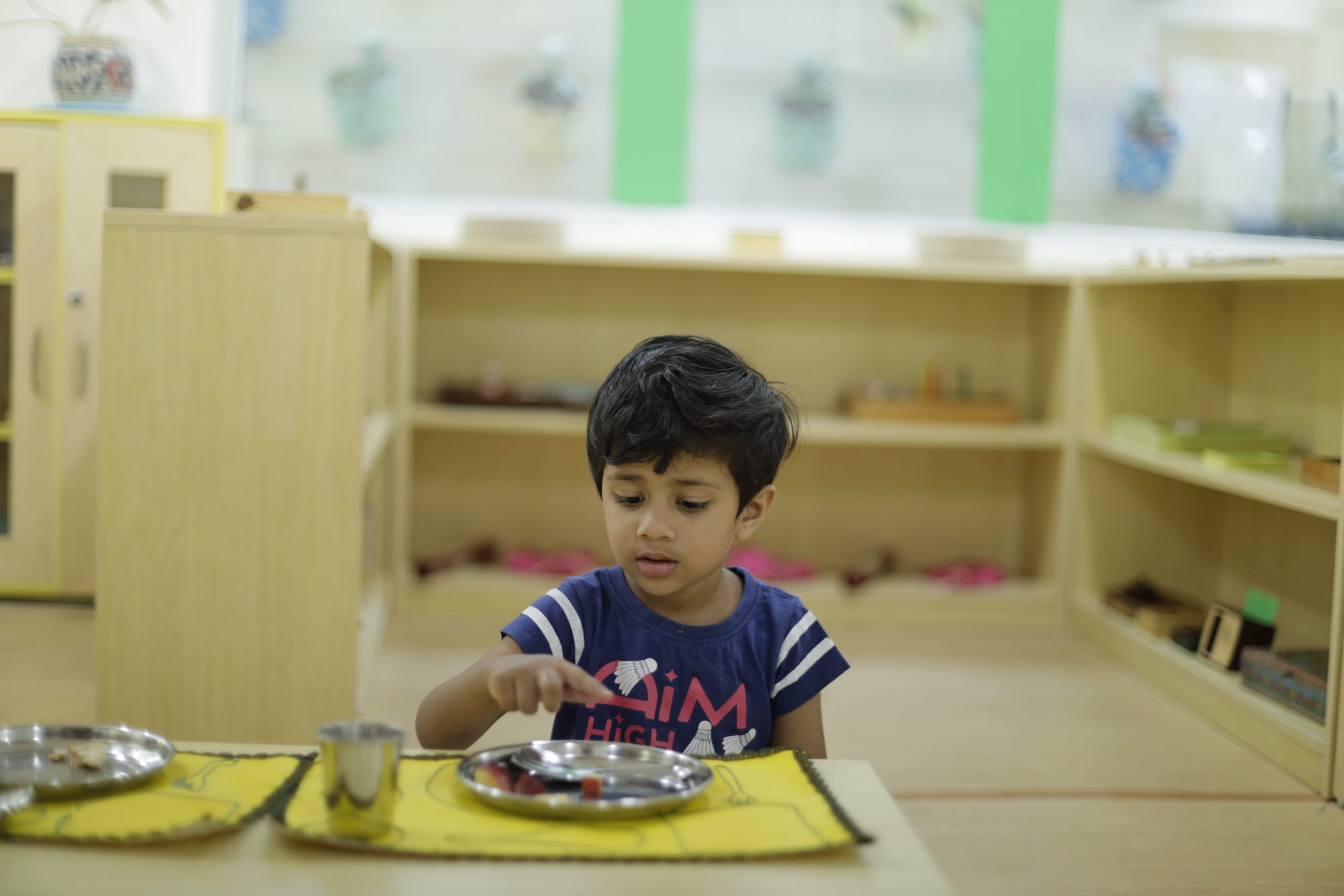
Lower the setting to your child’s height. A small table and chair her feet can rest on. A shelf where a small jug of water and a cup live within her reach. A step stool at the kitchen counter. When adults do the work at adult height, children cannot participate. When the work sits at child height, they can.
Use real materials. A glass jug will break if she drops it. A ceramic bowl will crack. This is not a bug. It is the feature. Real materials teach real care, the way a real tool teaches a real hand. Plastic teaches nothing because it forgives everything. Start with one glass, one small ceramic bowl, one metal spoon. Not the whole kitchen at once.
Slow down and wait. She will spill the first time. She will pour too much the second. By the fourth or fifth try she will find her own rhythm. Your job during this is not to help, not to fix, not to demonstrate. Just to stay present and let the work happen. If she asks for help, help. If she does not ask, do not offer.
None of these three things requires a Montessori classroom. Any parent can do them in any kitchen tomorrow morning.
If you would like to see where your child sits across independence, food personality, mealtime environment, and the other domains our tool measures, our Food Foundations Reflection walks you through in about fifteen minutes. Most parents finish it seeing the child, and the environment around the child, more clearly than when they began.
When you should actually be worried
Everything above assumes a healthy toddler whose eating varies but whose overall development is on track. Some situations do need a paediatrician, not a Montessori shelf.
Speak to your child’s doctor if any of these apply.
- Your child is over three years old and cannot hold a spoon or cup
- Your child cannot chew textured foods by age two
- Your child is losing weight or has stopped gaining for several weeks
- Your child gags or vomits severely at most meals
- Your instinct tells you something is outside normal day-to-day variation
Trust that instinct. The Reflection is designed for the normal range. Your paediatrician is for the rest.
Related reading
- My toddler eats one day and not the next: what is really going on
- How to raise a curious child, and what one Hyderabad mother told us
- How to handle a bored child (and why boredom is a doorway)
Authors:
- Pavan Goyal, Co-founder and Principal Investigator, Blue Blocks Micro Research Institute. Trustee, Indian Montessori Foundation. Holds all four AMI Montessori diplomas. ORCID: 0009-0009-8840-8505. LinkedIn.
- Munira Hussain, Co-founder and Director of Pedagogy, Blue Blocks Montessori School; Secondary Investigator, Blue Blocks Micro Research Institute. AMI Auxiliary Trainer. ORCID: 0009-0003-5904-6206. LinkedIn.