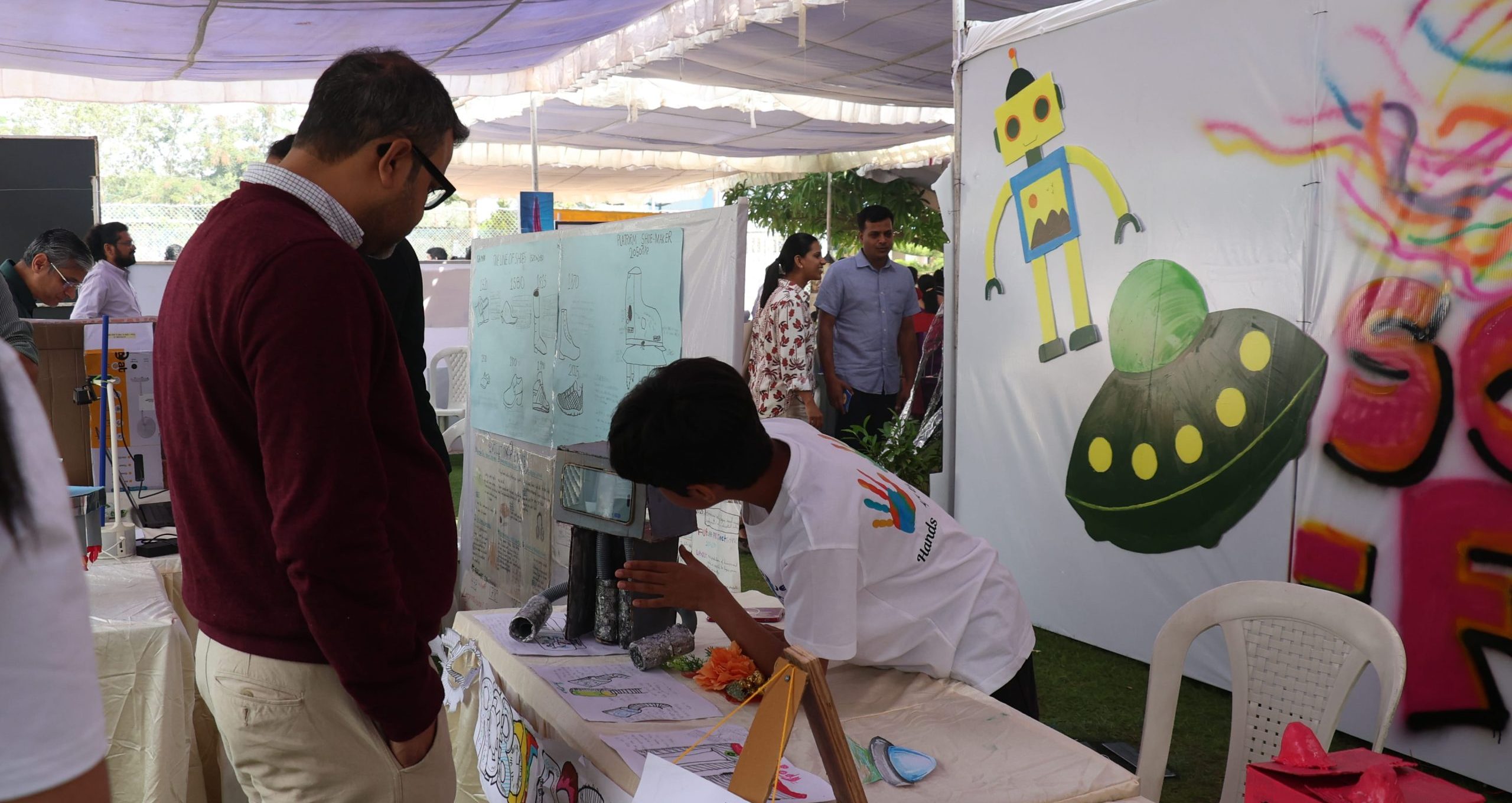
A mother at our annual school event answered three of our questions in three short sentences. Asked what she had learned from supporting her daughter’s project for the day, she said: “Children, when given freedom to explore, think beyond limits and surprise us with their creativity. Learning becomes deeper when it is children-led.” Asked how the day had changed her view of the future, she added: “The future will be more compassionate and accountable.” The interview lasted under two minutes. Her three sentences are the most useful definition of child-led learning Montessori we have heard from a parent.
The mother spoke without using any of the technical vocabulary the school uses. She did not name the prepared environment, the planes of development, the AMI principle of freedom within structure. She named what she had seen at home, watching her daughter prepare for Explore Montessori 2025 — our annual event held on 29 November 2025 — and what that had shifted in her thinking about her child’s future.
The three sentences cover what most parenting and education writing on this topic spends thousands of words trying to explain. This post walks through each one.
What is child-led learning?
Child-led learning is an educational approach in which the child’s own questions, interests, and observations drive what is studied, when, and for how long — within an environment the adults have prepared deliberately. The child does not choose in a vacuum. The adults have already arranged the materials, the space, and the rhythm of the day so that the child’s choices have somewhere productive to go. This is the Association Montessori Internationale definition, and it is the definition this blog uses.
The mother named this without using any of the technical terms. “Children, when given freedom to explore, think beyond limits and surprise us with their creativity.” The first half of the sentence — given freedom to explore — names the prepared environment that adults provide. The second half — think beyond limits and surprise us — names what the child does within that environment. Both halves are necessary. Without the prepared environment, the child has nothing to choose between. Without the child’s own choosing, the environment is just a tidy room.
Child-led learning is not the absence of structure. It is structure designed so that the child’s choices matter.
This pairing is what distinguishes genuine child-led learning Montessori from the caricature critics warn against. The structure is what makes the freedom productive.
Why is child-led learning effective?
The mother answered this in her second sentence, faster than most pedagogical research papers do. “Learning becomes deeper when it is children-led.”
The depth she is naming is well-documented in educational research, but most parents do not need the research to recognise it. When a child works on something they chose themselves, they sustain attention longer, return to the work voluntarily, integrate what they learn with what they already know, and apply it to new situations more readily. These are the behavioural markers of deep learning rather than surface compliance. They show up reliably when the child is the one driving the work.
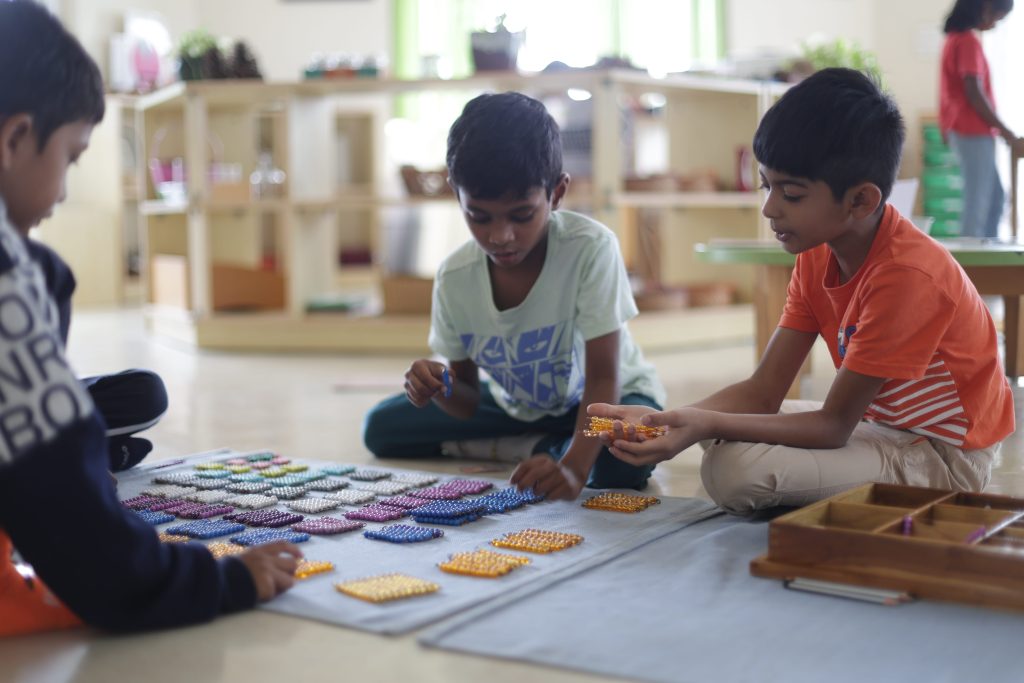
This is why an AMI-guided Montessori environment structures the entire day around the child’s freedom to choose what to work on, when to start, where to sit, and how long to stay with it. The adult prepares the environment, observes carefully, and offers individual lessons when the child is ready. The adult does not direct the work itself. The depth the mother described is the predictable result of years of this practice.
What does child-led learning look like in practice?
The conventional answer is a description of a Montessori classroom — children moving freely between materials, choosing their own work, working alone or in small groups, with the teacher observing rather than leading. All of this is accurate.
What the mother named, though, was not the classroom. It was what happens when a child applies that same freedom to a project they care about. Her daughter prepared for the school event by researching, designing, and presenting work to the visitors who arrived on 29 November. The mother watched the process from home. What she saw was a child given the freedom to drive her own preparation thinking past the limits she had previously shown.
This is the everyday face of child-led learning Montessori that most parents miss when they imagine it. It is not visible only in the classroom. It is visible at the kitchen table, in the late afternoon, when a child returns voluntarily to work she chose, and pushes it further than her adults expected. The classroom is the rehearsal. The home work — and the project work, and the curiosity that follows the child into life beyond school — is the performance.
How does child-led learning shape children’s view of the future?
The mother’s third sentence, asked about how Explore had changed her view of the future, was: “The future will be more compassionate and accountable. Children are thinking about innovation and sustainability. It will lead to a cleaner, kinder and more mindful planet.”
This is the strongest claim of the three, and the easiest to dismiss as parental optimism. We want to take it seriously instead.
Children who learn through their own choosing develop a particular relationship with consequence. They have spent years experiencing that the work they choose is theirs to finish, that the questions they ask are real, that the answers they reach matter. That orientation extends naturally to questions about pollution, fairness, climate, and care. The child who has been trusted to drive her own learning does not see large public problems as somebody else’s responsibility. She has been practicing responsibility, in small ways, for as long as she has been in a child-led environment.
Compassion and accountability are not curriculum subjects. They are by-products of a way of learning that places the child at the centre of her own work.
This is what the mother saw at our event — children explaining their own innovations, taking responsibility for their own ideas, addressing problems the adults had not asked them to address. Her future-tense claim is not optimism. It is observation, projected forward.
What this means for parents choosing a school
If you are choosing a school for your child, the question to ask is not whether the environment looks structured or unstructured. The question is whether the child’s choices matter inside the structure. A school that has decided everything for the child has structure without freedom. A school that has decided nothing for the child has freedom without structure. Neither produces the depth the mother described.
A genuine child-led learning Montessori environment — and a home that takes the same principle seriously — is built precisely so that the child’s choices do real work. That is what makes the learning deep. That is what makes the future, in this mother’s words, more accountable.
Author: Munira Hussain is Co-founder of Blue Blocks Montessori School in Hyderabad, AMI Auxiliary Trainer, and Secondary Investigator at Blue Blocks Micro Research Institute. She is a co-author of Lining the Nest and brings three decades of Montessori practice to the school’s reflection and research work.