




Self-Expression in Montessori: How a Five-Year-Old Speaks to a Stranger Without Help

A five-year-old stood at his stall at our annual school event and explained his project to visitors he had never met before. He had no script. No adult prompted him. The visitors had not been prepared in advance with the right questions. His father, watching from a few feet away, told us afterwards: “He’s just five years of age, and without any help he could speak fluently and clearly explaining his concepts to all the people who have come out.” What we were watching was self-expression in Montessori, in its everyday form.
This is not a precocity story. A five-year-old presenting unaided in a public setting is not a sign of unusual talent. It is the ordinary visible result of three years of small daily practice inside an AMI Montessori environment. Self-expression in Montessori is not a quality children either have or do not have. It is built slowly, across years of being trusted to choose what to say, when to say it, and to whom.
At Explore Montessori 2025 — held on 29 November 2025 — that long process became visible in a way that surprised many of the parents who came to watch. This post is about what those three years actually consist of, and what they build.
What is self-expression in Montessori?
Self-expression in Montessori is the developing capacity of a child to communicate what they think, observe, or feel — through speech, work, gesture, or chosen activity — in a manner that is genuinely their own rather than borrowed from the adults around them. It is not about volume, performance, or charm. A child working silently with a chosen material is expressing themselves. A child explaining their thinking to a guide is expressing themselves. A child standing at a stall and speaking to an unfamiliar adult is expressing themselves. The medium varies. The underlying capacity is the same.
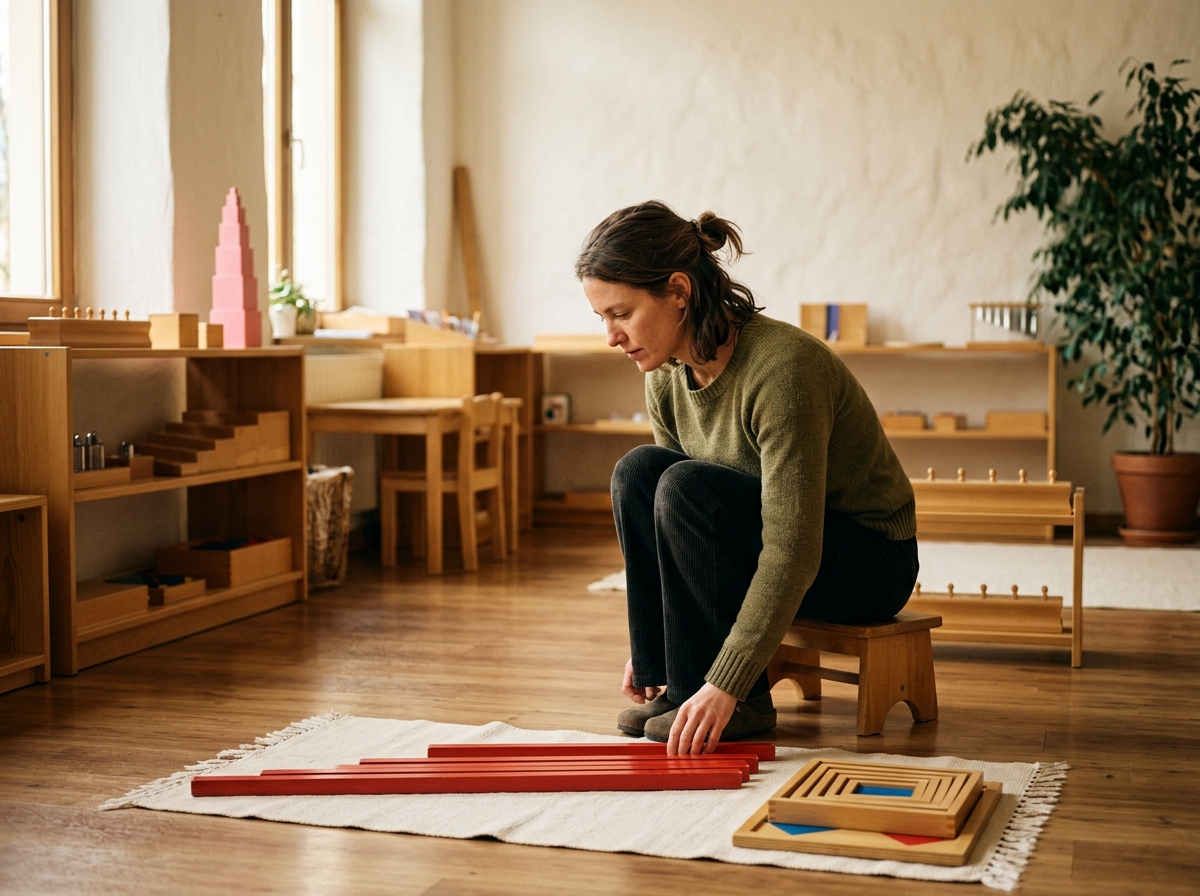
The capacity does not develop in a vacuum. It develops in environments where the child has been trusted, day after day, to make their own choices about what to engage with and how to engage with it. In an AMI Montessori environment, that trust is structural. Children choose their work, their working partners, the duration of their concentration, and the moments when they communicate what they have found. Self-expression is not added on at the end. It is woven through every part of the day.
Why does Montessori build self-expression so reliably?

The mechanism is straightforward, even if the practice takes years. Three features of the prepared environment do most of the work.
The first is genuine choice. Children select their own work from the materials available, return to it as often as they need, and complete it on their own timeline. The choosing itself is the first act of self-expression — long before words are involved, the child is communicating what matters to them by what they pick up.
The second is uninterrupted concentration. Adults in a Montessori environment do not interrupt a working child. The protected stretches of time in which a child stays with chosen work are the conditions in which the child develops a relationship with their own thinking. Without uninterrupted concentration, the child’s thoughts never settle long enough to belong to them. With it, the child gradually becomes the author of their own attention — and from there, the author of their own speech.
The third is mixed-age communication. Younger children watch older children explain, present, demonstrate. Older children become the natural audience for younger children’s discoveries. By the time a child is four or five, they have already heard hundreds of older children explaining their own work, and have begun to do the same with their own.
Self-expression in Montessori is taught by demonstration, not by instruction.
What does self-expression look like at age five in Montessori?
It looks like the five-year-old at our event is standing at a stall and explaining his concept to strangers without rehearsal. It also looks like the other children across the event grounds are presenting projects on subjects the adults had not asked them to address. Children showed visitors their visions of artificial trees that could supply oxygen in a polluted future. Children explained ideas for houses designed to withstand earthquakes. Children walked visitors through their own logic for what 2050 should contain. None of this was scripted. The children had spent weeks preparing the work, but the speaking was their own.
This is what self-expression at age five actually produces — not eloquent recitation, but the willingness and capacity to say what one has thought, to people one does not know, in language one has chosen. The five-year-old did not need help because the help had already been given, slowly, across three years of being treated as someone whose thinking was worth waiting for.
What is the difference between performance and self-expression in Montessori?
A great deal of what is presented as children’s self-expression in mainstream education is actually performance — the child reproducing, with appropriate inflection, what an adult has prepared them to say. Performance has its own value, but it is not the same skill. A child who can recite a poem on stage may or may not be able to explain a project to a stranger. A child who can speak confidently in a context they have rehearsed may freeze in one they have not.
The five-year-old at Explore was not performing. The visitors were not the people his work had been prepared for. He was meeting them for the first time, and he was speaking from his own understanding of what he had built.
That is the difference performance cannot fake. It is also the difference years of Montessori practice does build, reliably, in children who would otherwise be no more or less articulate than their peers in conventional schools.
What this means for parents choosing a school
If self-expression in Montessori matters to you, the question to ask is not whether the school holds public-speaking events or runs presentation competitions. Both are performance settings. The better question is whether the daily structure of the school treats the child’s chosen attention as worth protecting.
Schools that protect chosen attention build self-expression as a by-product. Schools that interrupt it for adult-led activities build performance instead. Both can produce children who speak well in front of an audience. Only the first reliably produces children who can speak from their own thinking in front of strangers.
The five-year-old at our event is what the first kind of school produces.
This piece was prepared by Blue Blocks Micro Research Institute as part of its institutional observation of practice at Blue Blocks Montessori School in Hyderabad.