How fossils form is one of the questions children begin asking very young. The honest answer takes them into chemistry, deep time, and the slow conversation between organic matter and the rocks around it that unfolds over millions of years. Our Research Head, Sreemoyee Chakraborty, recently posted a short report with Professor Dhurjati Prasad Sengupta of the Indian Statistical Institute on a specific fossil that holds a particularly clear answer. This piece is a parent-facing walk through what they found and what it tells children about how the world keeps its records.
The fossil is a partial crocodilian skull. It was recovered from the Nummulites obtusus bed of the Harudi Formation in the Kutch Basin of western India. It is approximately forty to forty-two million years old, from the middle Eocene epoch. It is the first vertebrate fossil ever reported from this specific carbonate horizon, a horizon that had been intensively sampled for decades but had only yielded foraminifera — small shelled marine organisms — until this skull was found. The full short report is available as a preprint on Research Square, posted on 29 April 2026. The findings have not yet been peer-reviewed, so they are best understood as a careful first interpretation rather thanestablished science. The discipline of describing preprint findings honestly is itself part of what children encounter when they look at how research is actually done.
How fossils form when iron does the writing
A fossil is not a stone copy of a bone. It is the original bone after a long chemical conversation with the sediment around it. The conversation has many possible endings. In some fossils, the bone’s original mineral content stays mostly intact and only the soft tissues are lost. In other fossils, every original molecule is gone and what remains is a sculpture made of different minerals that took the bone’s shape over time. The crocodilian skull from the Harudi Formation is closer to the second kind. The bone has been replaced by iron-bearing minerals — likely goethite, haematite, or related iron oxides — that have copied the skull’s architecture in remarkable detail. Bone surfaces, sutural lines, tooth contours: all preserved, but in iron rather than in calcium phosphate.
This kind of preservation is called pseudomorphic replacement. The iron minerals are not the original bone; they took the bone’s place atom by atom over millions of years, inheriting its shape as faithfully as a cast.
A fossil is not a stone copy of a bone. It is the original bone after a long chemical conversation with the sediment around it.
What makes the Harudi Formation skull worth a research paper is not that this replacement happened. Iron replacement of fossil bone is documented at many sites worldwide. What makes this specimen unusual is what did not happen alongside it.
How fossils form when iron writes on bone but ignores its neighbours

The skull was found surrounded by Nummulites obtusus — single-celled marine organisms whose shells form the rock of the bed itself. These shells are packed densely in the carbonate matrix; they outnumber the skull by orders of magnitude. And the iron replacement that copied the crocodile bone so faithfully ignored them completely. The Nummulites shells, sampled from the same matrix, show no iron staining, no replacement, no alteration. The two materials sat next to each other in the same sediment for tens of millions of years. One was rewritten in iron. The other was left exactly as it had been.
This selectivity is what the short report makes its central observation. The proposed mechanism the authors describe is what cosmic education calls a small story with large implications. Vertebrate bones contain a significant fraction of organic matter — collagen, mostly, the same protein that gives skin and tendons their structure. Foraminifera shells do not. They are essentially pure calcium carbonate with almost no organic content.
When the crocodile died and was buried, the collagen in its bones began to decompose through microbial activity. This decomposition consumed oxygen in the local sediment, creating a reducing microenvironment — a small pocket of chemistry where dissolved iron in the pore water became mobile. The mobile iron migrated toward and into the bone, finding the empty spaces left behind by the decaying collagen and the bone’s natural porosity. As the reducing chemistry shifted back toward oxidising conditions at the edges of this microenvironment, the iron precipitated out of solution and crystallised — taking the shape of the bone framework as it did so.
The Nummulites shells, with no organic content to decompose, never generated a reducing microenvironment. The dissolved iron in the pore water moved through and around them but never had a chemical reason to settle. So the shells stayed white. The bone became iron. The difference was not the iron — the iron was everywhere. The difference was the organic matter that was once in the bone and never in the shells.
How fossils form, and what children learn from this

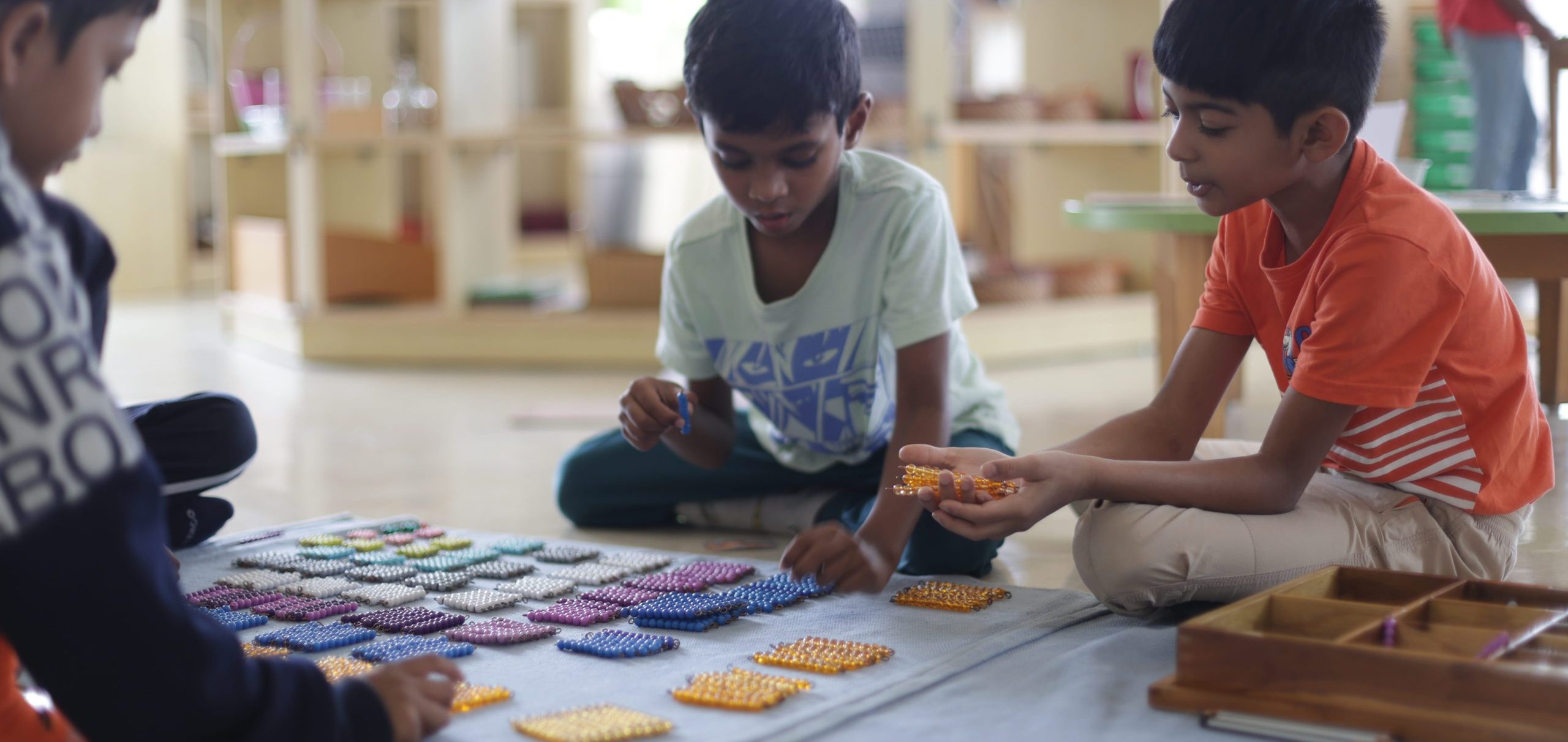
The question how fossils form sits in the middle of what Maria Montessori called cosmic education. The framework treats the universe as a single connected story across very long timescales, and treats the child’s capacity to understand it as something that builds gradually from age six onward. When a six-year-old child first encounters fossils, the right introduction is usually a fossil they can hold — a shell, a leaf impression, an ammonite. The chemistry of replacement is too much. The child needs the basic observation first: this used to be alive, and now it is rock.
By age nine or ten, the child can begin to encounter what the in-between actually involves. Fossilisation is not a single event but a long sequence of small chemical decisions, each governed by what was there when the organism died and what kind of sediment buried it. The Harudi crocodile skull is a particularly clean example of that long sequence because it teaches one specific lesson with one specific contrast: bone preserves differently from shell, because bone carried life-chemistry into its burial and shell did not.
The difference was not the iron — the iron was everywhere. The difference was the organic matter that was once in the bone and never in the shells.
By age thirteen or fourteen — the age at which we have written separately about what genuine adolescent research looks like in our Erdkinder program — the same child can engage with the actual mechanism the paper describes. The reducing microenvironment, the redox chemistry, the role of bacterial activity in early diagenesis, the difference between pseudomorphic replacement and mineral infilling. These are real concepts from the working vocabulary of palaeontology and they are accessible to an adolescent who has built toward them across years of cosmic-education work since age six.
The crocodile skull our Research Head described in her short report with Professor Sengupta is, in its small way, a teaching specimen for how fossils form. Iron, time, and selective replacement are real chemical realities. They produced the rust-coloured cast of a forty-million-year-old animal in carbonate sediment that did not become rust around it. The world keeps its records selectively, and what gets kept tells a chemistry story about what was alive when the records were made.
Authors:
Blue Blocks Micro Research Institute is the research arm of Blue Blocks Montessori School in Hyderabad, India. Our research focuses on Montessori adolescent education, with contributing work across palaeontology, satellite engineering, and developmental psychology.
Contributor: Sreemoyee Chakraborty, Dean of Research, Blue Blocks Micro Research Institute. First author of Taphonomic significance of the selective iron replacement in a crocodilian skull from the Nummulites obtusus bed, Harudi Formation, Kutch Basin, Western India (Research Square preprint, April 2026), with Professor Dhurjati Prasad Sengupta of the Indian Statistical Institute. ORCID: 0000-0001-5180-156X.