


What Teenagers Can Really Do: Our Students Are Building Two Satellites at Once
When parents and educators ask what teenagers can really do, the honest answer requires looking at adolescents who have been given work that can actually fail. Most school programs do not provide this kind of work. Tests with predetermined correct answers, projects whose outcomes are pre-scoped, exhibitions assessed against rubrics rather than against reality — the structural feature these share is that nothing the teenager does can produce an unexpected outcome.
What teenagers can really do is something different, and the difference becomes visible only in two specific situations: when the work fails, and when the work that follows the failure is also real.
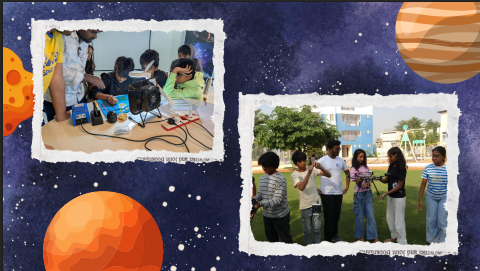
On 12 January 2026, seventeen of our students watched their CubeSat payload, SBB-1, lift off from Sriharikota on an Indian Space Research Organization PSLV-C62 launch vehicle. The mission was lost in a stage-4 anomaly at T+847 seconds. We have written about how the seventeen students processed that loss in real time, and what it meant when the ISRO scientists, whose own much larger satellite was lost in the same anomaly, reached out to ask the children not to get disheartened.
This piece is about what teenagers can really do when the work that follows a failure is also real. The seventeen students are not recovering from January. They are building two satellites at once.
What teenagers can really do when given work that finishes itself
The first satellite is a rebuild of SBB-1. The same design that completed the 18-month qualification campaign, the same hardware that received IN-SPACe authorisation, the same 1U CubeSat form factor — being rebuilt to flight standards for a tentative October 2026 launch. Sanshray Padhy, speaking for the seventeen at the 30th International Montessori Congress in Mexico, was direct about it:
We are Montessori adolescents. We don’t give up. You know what we are sending the same satellite this October.
The rebuild decision is not a redesign. The institute and the children decided to send the same SBB-1 design back to orbit because, as the valorisation paper the seventeen students presented at the 7th National Montessori Conference in Mumbai documents in detail, the hardware had been sound and the qualification was current. The work had been interrupted by a launch vehicle event, not invalidated by anything in the payload itself. Sending the same design back signals to the seventeen adolescents that what they did was real enough to be worth completing, not real enough to be repackaged as a learning experience that obscures what was lost.
What teenagers can really do is something different, and the difference becomes visible only in two specific situations: when the work fails, and when the work that follows the failure is also real.
This part of the answer to what teenagers can really do is hard for most schools to demonstrate, because most schools do not have adolescents carrying work that can be interrupted in flight. The capacity to finish interrupted work — across nine months of rebuilding, requalifying, reauthorising, reintegrating — is built when adolescents are treated as the authors of their own work rather than as participants in projects designed for them by adults.
What teenagers can really do when given genuinely new work
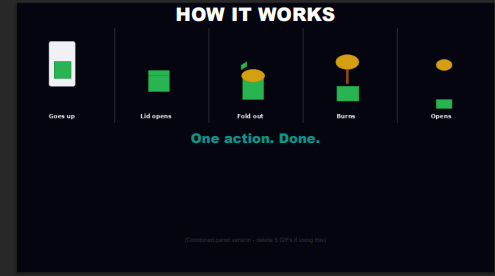
The second satellite is not a rebuild. It is a new design with a different deployment mechanism, also tentatively scheduled for 2026 launch. Saachi Goyal, presenting at the same AMI Congress audience, described the new design directly:
What if we could take something BIG, fold it SMALL, launch it cheap, and then open it up in space? Fold small. Launch cheap. Deploy large.
The new design’s premise is structural — launch cost scales with payload volume, and a satellite that can fold small for launch and deploy large in orbit reduces the launch cost dramatically. The mechanism, as Saachi described it for the Mexico conference audience: the satellite launches in a folded configuration; the lid opens once in orbit; a thread burns to release the fold; the fold unfolds completely; and the deployed configuration is many times larger than the launch configuration.
What the seventeen students named openly at the AMI Congress is that the new design has four unsolved engineering problems they are still working on:
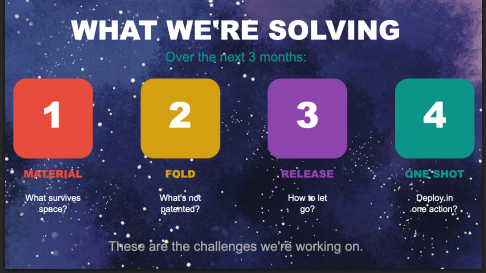
- Material. What survives -150°C in shadow and +150°C in sunlight, folds without cracking, and stores energy to spring open
- Fold pattern. A fold that is not already patented and that opens reliably from a folded launch state
- Release. A mechanism that holds the fold closed under launch vibration and then lets go gently in orbit
- One-shot reliability. The deployment has to work the first time; there is no second attempt in space
What teenagers can really do, when working on this kind of problem, is name what is hard about it honestly. Saachi said it for the Mexico audience: these are real problems, and we are working on them. Not solved problems. Not promised solutions. Real unsolved engineering, articulated by a thirteen-year-old at a Montessori conference. The children’s discipline on this is genuine — they do not overclaim. They describe what is hard, and they continue the work.
What this means for parents asking the question
If you are evaluating a school for a teenager, the question to ask is not what kinds of projects the school runs. The question is what happens at that school after a project ends — whether the project succeeded or failed. Does the school complete the interrupted work? Does the school give the same adolescents new, harder, genuinely unsolved work in parallel? Or does the school move on to the next showcase, leaving the adolescents to learn that real work is something other people do?
The honest answers to these questions tell you what your teenager will become at that school. Sending SBB-1 back to finish what was interrupted, and building SBB-2 to solve genuinely new engineering problems alongside it, is the answer the seventeen students and the school chose. It is the answer parents asking what can teenagers really do deserve to see.
Both satellites are tentatively scheduled for launch later this year. The children are working on both, in parallel, alongside the adults who treat them as colleagues. That is what teenagers can really do, given the right conditions and the right adults around them, across many years.
Authors:
Pavan Goyal, Co-founder, Blue Blocks Montessori School; Founder and Principal Investigator, Blue Blocks Micro Research Institute. Holder of all four AMI Montessori diplomas (0–18) and Trustee of the Indian Montessori Foundation. ORCID: 0009-0009-8840-8505. LinkedIn.
Munira Hussain, Co-founder and Director of Pedagogy, Blue Blocks Montessori School; Secondary Investigator, Blue Blocks Micro Research Institute. AMI Auxiliary Trainer and co-author of Lining the Nest. Three decades of Montessori practice. ORCID: 0009-0003-5904-6206. LinkedIn.