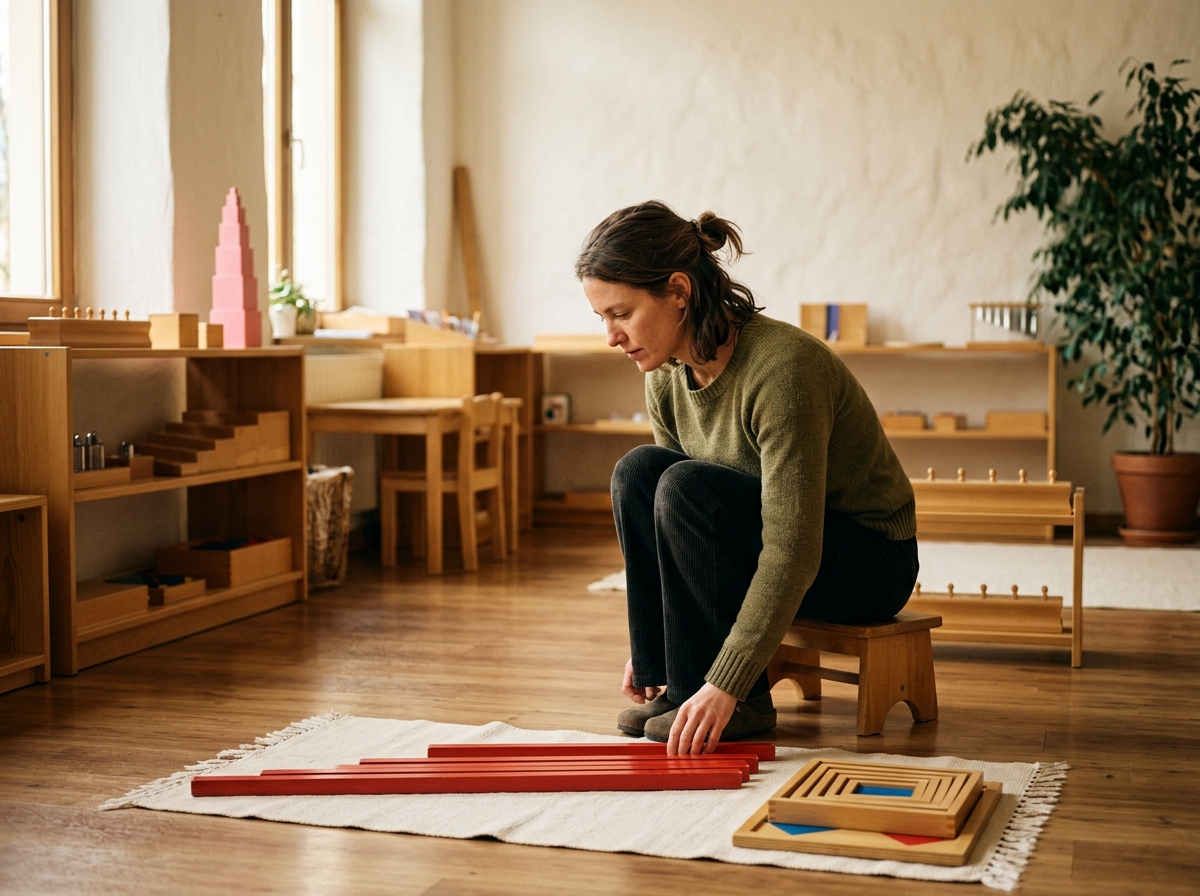
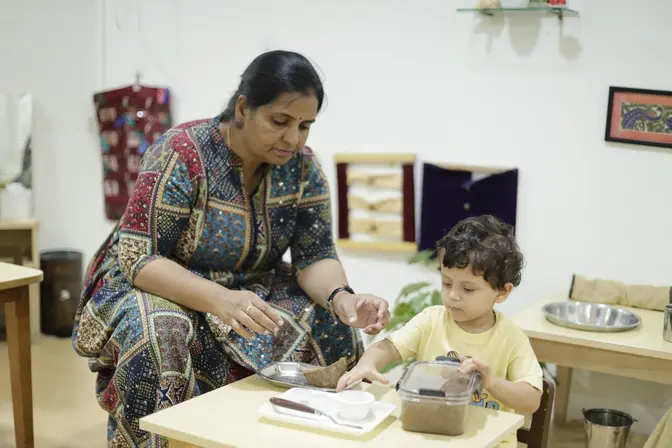
Montessori classroom at Blue Blocks School Hyderabad

What Is Montessori Education?

“One test of the correctness of educational procedure is the happiness of the child.”

Dr Maria Montessori

A Timeless Method for the Future Human

What Is Montessori Education?

Dr Maria Montessori was a physician and a scientist. Through rigorous observation of children, she discovered that traditional education, built on instruction and forced compliance, obstructs natural human development. She did not invent a teaching method; she discovered the exact environmental conditions under which children naturally teach themselves.

The child is not an empty vessel to be filled. The child is the architect of their own intelligence.

“Never help a child with a task at which he feels he can succeed.” Dr Maria Montessori

New to Montessori? Explore our programmes: Nursery (0 to 3) | Pre-Primary (3 to 6) | Primary (6 to 12) | Secondary (12 to 16)

How Does Montessori Work?

Traditional education: the teacher holds knowledge, the child receives it. Montessori inverts this. AMI-trained Guides prepare a precise environment with scientifically designed materials. Children choose their own work, repeat it until mastered, correct their own mistakes, and move on when genuinely ready.

This is not unguided play. It is purposeful independence.

The Prepared Environment

Every material and routine has a specific developmental purpose. The environment teaches; the adult steps back.

The AMI-Trained Guide

A trained observer who knows when to introduce a new material and, equally important, when to wait.

The Uninterrupted Work Cycle

Two and a half to three hours each morning. No bells, no forced transitions. Concentration cannot form when constantly interrupted.

The Mixed-Age Community

Children of different ages share the same environment. Younger children learn by watching older ones. Older children consolidate their understanding by helping younger ones. Leadership is not taught as a subject; it emerges naturally from a community that lives it.

The Four Planes of Development

Dr Montessori identified four distinct phases of human development, each requiring a completely different environment and a different role from the adult. Blue Blocks serves the first three planes, from 15 months to 16 years.

First Plane : The Absorbent Mind (0 to 6 years)

"Help me to do it myself."

The child absorbs the environment without conscious effort. Language, movement, order, and culture become part of the self before the child is aware of learning. The adult's job is to protect concentration and resist the urge to interfere.

Explore: Nursery programme (0 to 3) | Pre-Primary programme (3 to 6)

Second Plane — The Reasoning Mind (6 to 12 years)

"Help me to understand for myself."

The child needs to understand everything, not just experience it. This is the age of imagination, moral awakening, and the passionate sense of justice. The curriculum begins not with the immediate environment but with the universe. Nothing is taught in isolation.

Explore: Primary programme (6 to 12)

Third Plane — The Social Mind (12 to 18 years)

"Help me to think with society."

Dr Montessori called the adolescent a social newborn. The primary need is Valorization: discovering one's own worth through real, consequential work. At Blue Blocks this is the Micro-Economy, the Innovation Labs, and the student-built CubeSat.

Explore: Secondary School programme (12 to 16)

Fourth Plane — The Moral Adult (18 to 24 years)

Inner command: "Help me to find my place in the world."

The fourth plane is university and early adulthood: the period of finding one's civic and moral role in society. Blue Blocks does not serve the fourth plane directly, but everything the first three planes build is preparation for it. The concentration, the self-direction, the ethical compass, and the love of learning that arrive at adulthood intact.

Montessori Glossary — Terms Every Parent Should Know

These are the concepts that underpin everything that happens inside a Blue Blocks classroom. Each term was coined by Dr Montessori from her clinical observation of children. They are precise, not decorative.

Absorbent Mind

The child's capacity from birth to age six to absorb the environment unconsciously and without effort. The child does not learn by being taught; they construct themselves from what surrounds them.

Sensitive Periods

Time-limited windows when a child is drawn intensely to specific learning: language, order, movement. Learning during these windows is effortless; once the window closes, it requires conscious effort.

The Prepared Environment

A space where every material, surface, and routine has a specific developmental purpose. The environment itself teaches; the adult prepares it and steps back.

Control of Error

Every Montessori material shows the child whether they have succeeded, without teacher intervention. The child sees the mistake and corrects it themselves.

The Work Cycle

The uninterrupted morning period of two and a half to three hours during which children choose and repeat their own work at their own pace. No bells, no forced transitions.

Cosmic Education

The Primary curriculum (ages 6 to 12) that begins with the universe and works inward. The story of the cosmos comes before geography or history, nothing is taught in isolation.

The Three-Period Lesson

The guide's core teaching technique: Period 1 naming, Period 2 recognition, Period 3 recall. Always given individually or in small groups, never to the whole class.

Valorization

The adolescent's need to prove their worth through real, consequential work, not through praise, but through genuine contribution that matters beyond the classroom.

Planes of Development

Dr Montessori's four distinct phases of human development, each requiring a different environment. First Plane (0 to 6), Second Plane (6 to 12), Third Plane (12 to 18), Fourth Plane (18 to 24).

The Guide

The Montessori term for the teacher. A guide observes, prepares the environment, introduces materials at the right moment, and steps back. The most active person in the room is always the child.

Grace and Courtesy

The deliberate teaching of social behaviour through precise demonstration: greeting, interrupting politely, resolving disagreement. Practiced until it becomes the child's own.

The Erdkinder

Literally "children of the earth." Dr Montessori's vision for adolescents: real economic work in a genuine community. At Blue Blocks: the Micro-Economy, Innovation Labs, and the CubeSat programme.

Deviations

Behaviours that appear when a child's developmental needs are not met: aggression, withdrawal, poor concentration. Not character flaws, symptoms of an environment that are not serving the child.

Blue Blocks, AMI, and the Indian Montessori Foundation

Blue Blocks has practised authentic AMI Montessori in Hyderabad since 2009, continuously from 15 months to 16 years. Every lead guide holds the AMI diploma for their age group.

Our founder Pavan Goyal holds all four AMI diplomas (0 to 3, 3 to 6, 6 to 12, and 12 to 18) and serves as a Trustee of the Indian Montessori Foundation, the national body advancing authentic Montessori practice across India.

Blue Blocks also operates the Blue Blocks Micro Research Institute: a longitudinal research programme embedded within the school, tracking how innovation capacity develops across the full 0 to 18 developmental arc. Seventeen years of continuous observation. Findings re-enter the classroom. Observation generates research; research changes practice.

Blue Blocks Micro Research Institute

Considering becoming a Montessori guide? See our complete guide to AMI Montessori teacher training in India.

Montessori for Success

“We both went to Montessori school, and I think it was part of that training of being self-motivated, questioning what's going on in the world, doing things a little bit different.”

Larry Page — Co-founder, Google

Source: ABC News interview with Barbara Walters, 2004

“I benefited from Montessori education, which in some ways gives the students a lot more freedom to do things at their own pace, to discover. Some of the credit for the willingness to go on your own interests, you can tie that back to that Montessori education.”

Sergey Brin — Co-founder, Google

Source: Interview with Evan Williams, 2004

“I remember having a little special board that you can use to practice tying your shoes. I have these very clear visual images of tracing out letters on sandpaper.”

Jeff Bezos — Founder, Amazon

Source: Interview with journalist Steven Levy, Wired Magazine

“Montessori gave me a lot of confidence at a young age. I used to love it when I came to school because there was something new I was going to learn every single day.”

Stephen Curry — NBA Champion, Golden State Warriors

Source: Video interview with the Montessori School of Lake Forest

“I do not believe there is a method better than Montessori for making children sensitive to the beauties of the world and awakening their curiosity regarding the secrets of life.”

Gabriel Garcia Marquez — Nobel Laureate in Literature

Source: Quoted in multiple literary biographies and Montessori alumni documentation

“I like the Montessori method. It teaches through play. It makes learning a pleasure. It follows the natural instincts of the human being. The present system casts the brain into a mould. It does not encourage original thought or reasoning.”

Alexander Graham Bell — Inventor, Telephone

Source: Public statement, documented in AMI historical records

“If we are to achieve real peace in the world, we shall have to begin with children.”

Mahatma Gandhi

Source: Spoken at a Montessori Teacher Training Centre, London, 1931

“For thousands of years people have been talking about improving teaching, to no avail. Montessori actually did it.”

Peter Drucker — Founder of Modern Management

Source: Documented in Montessori advocacy literature

Frequently Asked Questions

Is Montessori only for pre-primary or nursery children?

No. The Montessori method spans birth to adulthood across four distinct planes of development. At Blue Blocks, authentic AMI Montessori is practised continuously from 15 months through to 16 years: Infant and Toddler, Pre-Primary, Primary, and Secondary School. The method does not stop at age 6; it deepens.

Is Montessori better than traditional school?

The Montessori method and traditional schooling are built on different assumptions about how children learn. The research evidence, including longitudinal studies, consistently shows Montessori children develop stronger executive function, academic outcomes, and social skills.

What age should my child start Montessori?

The earlier the better, within each plane's readiness. The Infant and Toddler environment accepts children from 15 months. The Pre-Primary environment from 2.5 years. A child who starts at 2.5 gains three full years in the first plane, the most sensitive window of human development. A child joining at 5 gains one year. Both benefit; the outcomes differ.

Does Montessori prepare children for board exams and traditional universities?

Yes. Blue Blocks is affiliated with Cambridge International for Grades 7 through 10, and our children consistently meet or exceed the requirements of all major boards in India. Parents regularly hear from receiving schools that Blue Blocks children are the only ones who can work independently for a sustained period.

How do Montessori children adjust to traditional high schools or universities?

Exceptionally well. Because they have spent years developing executive function, adaptability, and a genuine love for learning, they view new environments and testing structures simply as new systems to master, rather than threats to fear. They enter the world as capable, self-advocating learners.

What does Authentic AMI mean, and why does it matter?

Not all schools calling themselves Montessori are equivalent. AMI, the Association Montessori Internationale, is the body Dr Montessori founded to protect the integrity of her method, requiring AMI-trained guides and AMI-standard materials. At Blue Blocks, every lead guide holds the AMI diploma for their age group.

Is Montessori too unstructured? Will my child learn discipline?

The discipline developed in Montessori is internal, not imposed. A child who chooses their own work, sets their own pace, and sees it through to completion has built the only kind of self-discipline that persists into adulthood.

See It for Yourself

The most accurate way to understand Montessori is to watch it. Sit quietly in the corner of a Blue Blocks classroom and observe. The concentration, the calm, the children moving with purpose. These cannot be described as well as they can be seen.