
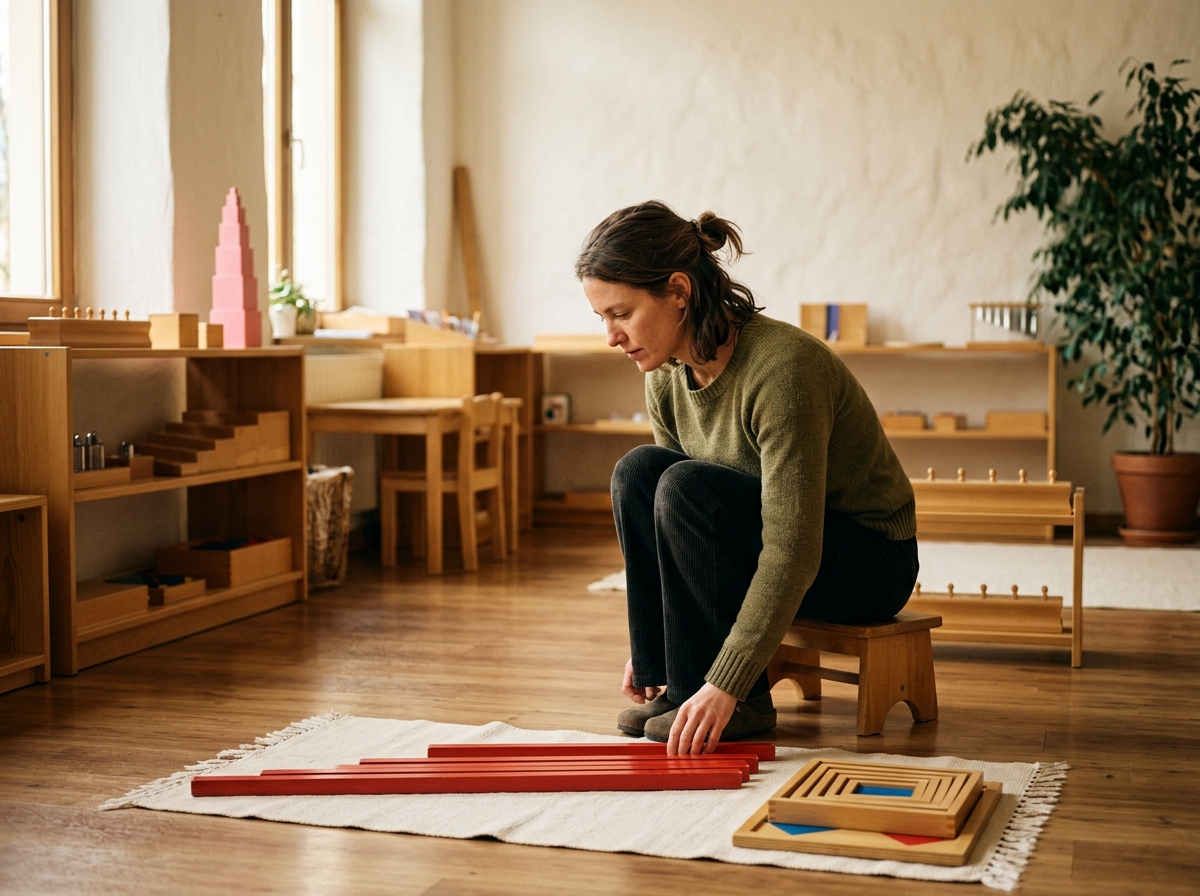


Montessori Elementary 6-12 | Class 1 to Class 6, Ages 6 to 12
Blue Blocks runs Montessori Elementary in Hyderabad for children in Grade 1 to Grade 6. An AMI-certified curriculum and AMI-certified guides, in a mixed-age community, across a continuous six-year cycle, no external curriculum until Grade 7. Every subject is learned through Montessori materials and direct experience. Between ages 8 and 12, our children have filed five drone patents, designed twenty original bird nests, and built a seed bank of 80–85 varieties.
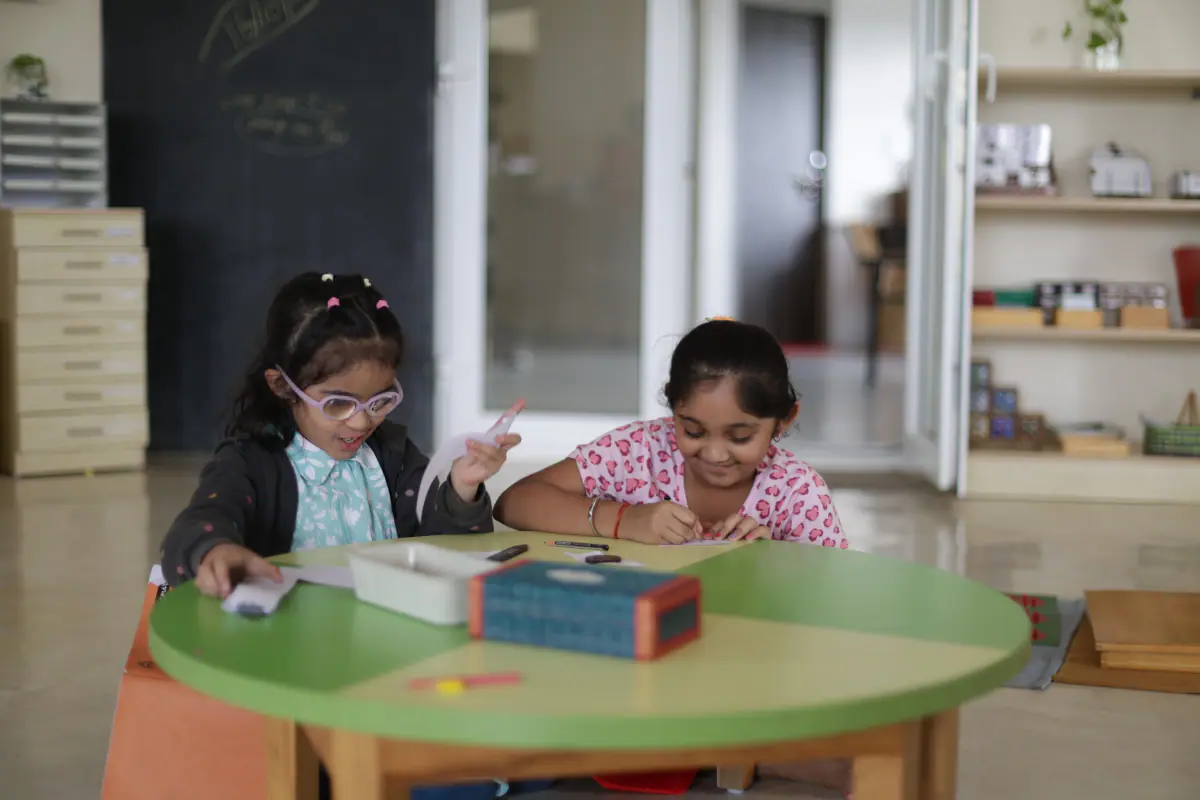

Five Drone Patents Filed
Filed with the Government of India by children ages 8–12. One question, 'What do you want your drone to do?', produced five patent applications.
Twenty Original Bird Nests
Biomimicry Hive lab. Twenty original bird nest designs in a single cycle. Nature as a design teacher.
Student Seed Bank
80–85 seed varieties, student-initiated and student-maintained. Procured, solar-dried, stored. Ongoing.
Foundation of the SBB-1 CubeSat
Space Lab work at Elementary feeds directly into the Erdkinder-built CubeSat that flew on ISRO's PSLV-C62.
AMI-Guided Since 2005
Blue Blocks operates entirely under AMI standards. Full birth-to-eighteen programme since 2017.
Research-Backed Programme
Elementary children are participants in peer-reviewed research published by the Blue Blocks Micro Research Institute.
PARENT VOICES
What Your Child Studies
Every subject : mathematics, geometry, science branching into botany and zoology, English, Hindi, Telugu, history, geography, is taught through physical materials and direct experience. Children don't read about circuits; they build them. They don't memorise the periodic table; they conduct experiments. They don't study geography from a textbook; they build landforms, trace river systems, and plan their own research expeditions.
Research is not a separate activity. It percolates into every subject, biology, mathematics, languages, culture, history. Application and research-based work is what children are guided into across the entire curriculum.
Explore Sciences & History
Biology & Botany Details
Classify living organisms, study plant and animal anatomy through hands-on specimens, maintain a plant garden as a year-long responsibility, and explore ecosystems through observation and field research. Biology branches into Botany and Zoology as distinct areas of inquiry.
Assessment & Progress
There are no board exams at this level. So how do you know your child is learning? In the AMI Elementary tradition, assessment is continuous and observation-based, not periodic and test-based. The AMI-certified guide maintains detailed records of every presentation given, every material worked with, and every stage of mastery reached by each child. This is not anecdotal. It is systematic.
How progress is tracked:
- •Guide's Record-Keeping: The guide maintains a detailed record of presentations given to each child and work completed, tracking which concepts have been introduced, which are being practised, and which have been mastered.
- •Child's Work Journal: Children maintain their own work logs, recording what they chose, what they completed, and what they want to pursue next. This builds metacognitive awareness alongside academic progress.
- •Portfolio of Work: Completed work, research reports, mathematical operations, maps, timelines, creative writing, art, is collected and reviewed as evidence of development over time.
- •Individual Conferences: The guide meets with each child regularly to discuss their work, their interests, and their challenges. This is the primary feedback mechanism.
- •Parent Communication: Progress is shared with parents through structured observation-based reports and parent-guide conferences, not through grades or rankings.
What Children Build
Children don't just study science. They apply it. These labs are guided activities where children work on their own ideas and explore their curiosity.
Innovation Lab
Sketches to working prototypes. Wood, metal, electronics, recycled materials. Children build prototypes and 3D models from their learning and use the lab to enrich their subject understanding.
Biomimicry Hive
Nature as design teacher. Biodiversity mappings, observations, mimicking models found in nature, nests, homes, shelters. Children learn to see different parts of nature as architects, engineers, and leaders. Twenty original bird nest designs in one cycle. Builds the skillset of a naturalist.
Seed Bank
Children initiated and maintain a seed bank: procuring, solar drying, and storing 80–85 varieties of seed samples. Ongoing, used for learning and research across biology, botany, and ecology.
Drone Research Lab
One question, 'What do you want your drone to do?', produced five patent applications filed with the Govt. of India. Ages 8–12.
Space Lab
Foundation for the satellite programme. Sensor science and engineering that Erdkinder adolescents carry into real payload design.

How Learning Happens
Hands-On Materials
Abstract concepts are built, touched, and manipulated. Every mathematical operation has a material form. A child working with Bead Frames understands multiplication physically before writing it. A child building geometric solids understands volume intuitively. The transition from sensorial to abstract understanding happens through the materials, not through explanation.

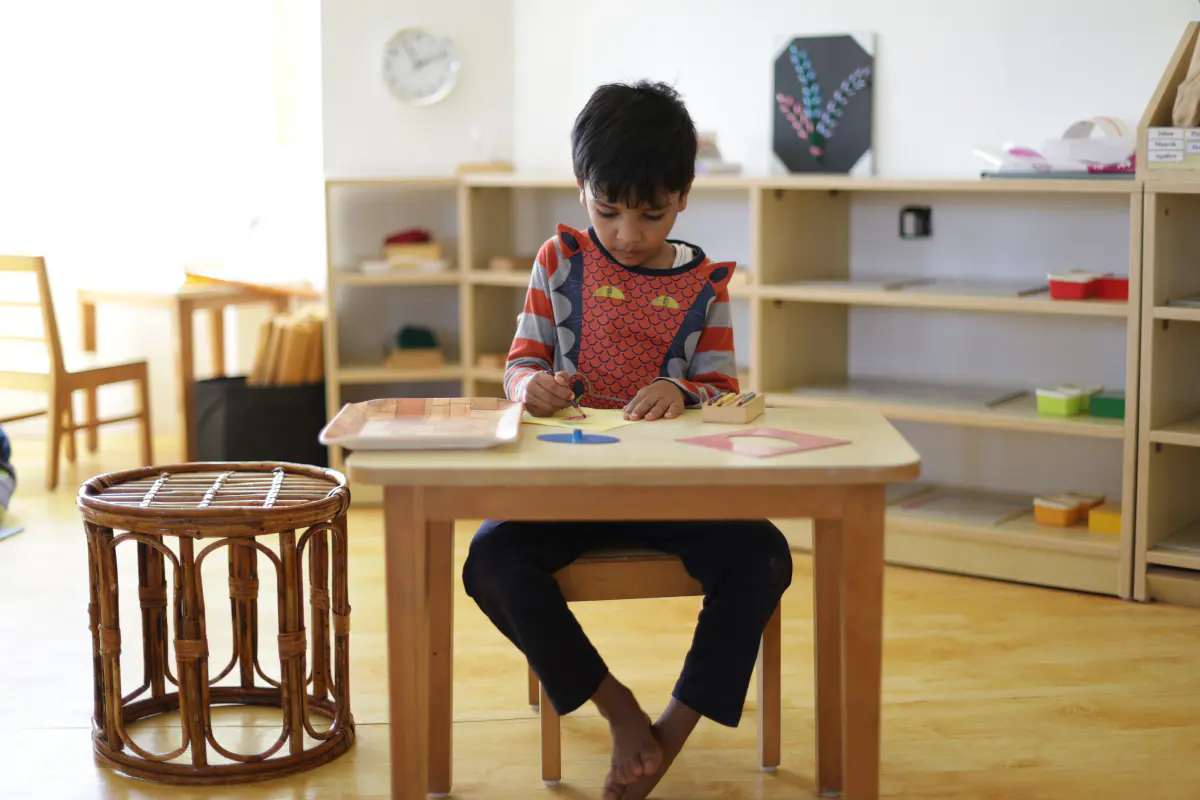
Mixed-Age Community
Children aged 6 and 12 work in the same environment. A six-year-old watches a ten-year-old work with the Pythagorean theorem and absorbs, without instruction, what it means for area and measurement, concepts of volume, size, and spatial reasoning becoming visible years before they formally study them. A twelve-year-old explains a concept to a seven-year-old and discovers they understand it more deeply than they thought. Natural leadership, empathy, and collaboration.
The Guide's Role
The AMI-certified Elementary guide at Blue Blocks is not a lecturer. They present, provoke curiosity, and step back. The child investigates, discovers, and builds. Ratio: 1:15.
Physical Development
Physical activity is part of the daily rhythm, not a squeezed period.
Going Outs
When a child's question outgrows the classroom, they plan a Going Out, a small-group expedition to museums, experts, field sites, or community organisations. Children plan the route, prepare questions, manage logistics, and report back. Not a school trip. A child-planned research expedition.

Elementary Campus Gallery
Elementary Mentors
Every Elementary guide and mentor at Blue Blocks is an AMI-certified diploma-holder or subject specialist, trained in the Montessori observation tradition. They watch before they intervene. They ask before they tell.
Kriti Khare
Maths- B.Sc. Maths
- MCA
Dr. Shobha Ediga
Biology- Ph.D. Plant Biotech, UoH
- AMI Elem. Asst.
Kiranmayi R S S
Chemistry- M.Sc. Chemistry
- AMI Elem. Asst.
Mousam Mondal
Physics- M.Sc. Theoretical Physics (Gold Medal)
- M.Sc. Astrophysics, Hertfordshire
Ranjan Kumar
Drones- B.Tech Aeronautical Engineering
Poulomi Bose
English- M.A.
- B.Ed.
- TESOL
- Waldorf
- IC CBSE, ICSE, ISC
Shailaja Chimpanna
Telugu- B.Sc., B.Ed.
- AMI Elem. Asst.
Praveena Reddy Vanga
Hindi- B.Sc., M.Sc. Computers
- AMI Elem. Asst.
Protiti Mookherjee
Dance- M.A. Bharatnatyam
- 30+ years performing
Ravinder Kumar Hanshi
Karate- 7th Dan Karate
- International Referee
- 44+ years
Joseph
Sports- M.P.Ed.
- 4+ years
Frequently Asked Questions
Related Research
Canonical institutional sources for the work referenced above. Links point to research.blueblocks.in landing pages; DOIs are included for citation. Elementary-age publications marked with age range.
| Publication | Where to Read |
|---|---|
Automated Security UAV Patent (ages 8–12) DOI: 10.5281/zenodo.18610003 | research.blueblocks.in/patents/automated-security-uav |
Borehole Rescue UAV Patent (ages 8–12) DOI: 10.5281/zenodo.18610200 | research.blueblocks.in/patents/borehole-rescue-system |
Contactless Delivery UAV Patent (ages 8–12) DOI: 10.5281/zenodo.18610450 | research.blueblocks.in/patents/contactless-delivery-system |
Medical Assistance UAV Patent (ages 8–12) DOI: 10.5281/zenodo.18610847 | research.blueblocks.in/patents/autonomous-medical-assistance-system |
Health Monitoring UAV Patent (ages 8–12) DOI: 10.5281/zenodo.18628995 | research.blueblocks.in/patents/autonomous-health-monitoring-system |
Biophilia Drawing Study (ages 6–16) | research.blueblocks.in/publications/biophilia-drawing-study |
Meerkat Bio-Leadership (ages 6–10) | research.blueblocks.in/publications/meerkat-bio-leadership |
SBB-1 → SBB-2 Announcement (Space Lab foundation) | research.blueblocks.in/missions/sbb-1-to-sbb-2 |
Blue Blocks Micro Research Institute — Publications Index | research.blueblocks.in/publications |
See It for Yourself
The Elementary environment is a room full of investigation and discovery. To understand what happens when children own their learning, you need to see it.
Read
Is Montessori Right for Your Family?
A practical guide for parents evaluating Montessori education, developmental independence, and home-school alignment.
Montessori vs Traditional Education: What the Research Shows
Understanding how self-directed work and multi-age classrooms build lifelong focus, critical thinking, and intrinsic motivation.
How to Keep Children Connected to Nature: Six Small Habits at Home
Simple, daily habits parents can introduce at home to foster a deep connection to nature and sensorial learning.
What Do Children Draw When Asked About Life? Trees and the Sun
Observations from our art and cosmic education environments on how children perceive the living world.