


Nursery, PP1, PP2 Curriculum
Blue Blocks runs a Montessori preschool in Hyderabad for children aged 2.5 to 6, the Nursery, PP1, and PP2 years. The programme spans five areas of learning across a three-year continuous cycle in a mixed-age classroom, guided by AMI-certified diploma-holders. There are no worksheets, no bells, and no whole-class lessons. Each child chooses their own work, repeats it as often as they need, and moves on when ready. Children write before they read, count with hands before they see numerals, and build independence through real tasks like dressing themselves, preparing food, caring for the classroom.
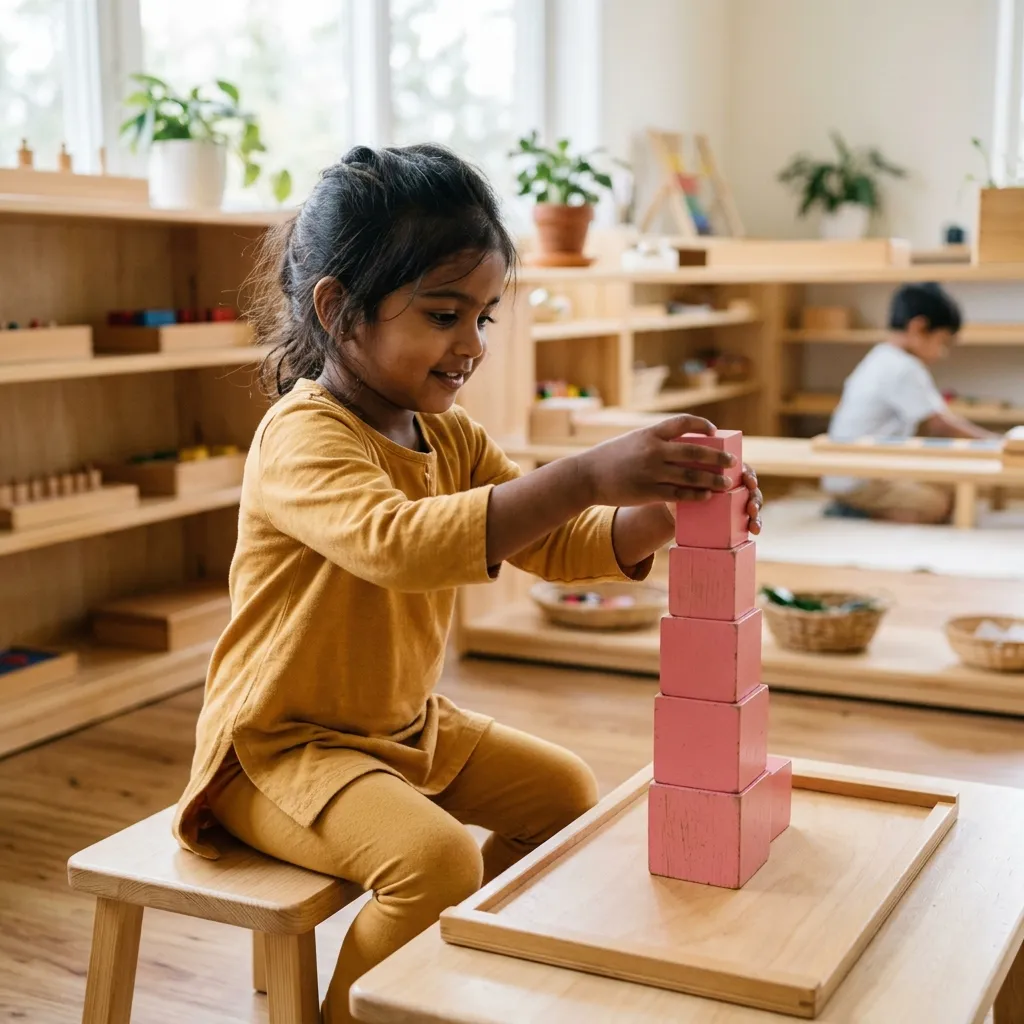
Independent 3-Year-Olds
Children dress themselves, prepare food, and care for the environment through real, purposeful daily work.
20+ Minute Concentration
Sustained, self-chosen focus. What next schools notice first when a Blue Blocks child arrives.
Writing Before Reading
Sandpaper Letters, Moveable Alphabet. The 'explosion into reading' unfolds naturally.
Maths Through Materials
Golden Beads, Stamp Game, Number Rods. Children hold a thousand before they write it.
AMI Primary Diploma Guides
The internationally recognised Montessori qualification for ages 3–6, awarded by Association Montessori Internationale.
Three-Year Continuous Cycle
Nursery, PP1, PP2 in one prepared environment. Mixed-age community. Individualised pacing.
"Watching our daughter prepare her own snack, clean her work table, and write stories in cursive at age 5 has been a revelation. Montessori at Blue Blocks isn't just school; it is life preparation."
— Parent of PP2 Child"The concentration and calm my child has developed is remarkable. He will sit with a math material for 30 minutes, completely absorbed. It's the best investment we've made in his future."
— Parent of PP1 ChildInformed by published research from the Blue Blocks Micro Research Institute. Explore →
MONTESSORI PRE-PRIMARY
What Your Child Learns
Our Montessori preschool in Hyderabad serves children aged 2.5 to 6 across five areas of learning. Everything is hands-on. There are no worksheets and no rote memorisation. Children work through a three-year programme at their own pace, guided by AMI-certified Montessori guides.
Five Areas of Learning
| Area | What It Builds |
|---|---|
| Everyday Life | Independence, self-discipline, coordinated movement through real daily tasks. |
| Sensorial | Ordered mind, clear perception, the groundwork for logical thought and mathematics. |
| Mathematics | Concrete-to-abstract number sense, from 1 to 1,000 held in the hand. |
| Language | Writing before reading; the 'explosion into reading' unfolds naturally. |
| Culture & Science | Geography, botany, zoology, time, and the world beyond the classroom. |
Everyday Life & Independence
| Activity | What Children Do |
|---|---|
| Dressing Frames | Buttons, zips, buckles, laces; mastered through practice on purpose-built frames. |
| Care of Environment | Scrub tables, sweep floors, water plants, arrange flowers. |
| Food Preparation | Cut fruit, make sandwiches, squeeze juice, set and clear the table. |
| Grace & Courtesy | Greeting people, asking to join a group, resolving disagreements. |
| Silence Game | Group stillness exercise; builds remarkable concentration in a child as young as three. |
Learning to Observe, Sort, and Think
| Material | What It Trains |
|---|---|
| Pink Tower & Brown Stairs | Size, dimensional order, and spatial reasoning. |
| Geometric Cabinet & Solids | Shape recognition; plane and three-dimensional. |
| Colour Tablets | Colour identification and grading from darkest to lightest. |
| Baric, Thermic, Fabric Tablets | Weight, temperature, and texture discrimination through touch. |
| Sound Cylinders & Bells | Sound matching and musical pitch discrimination. |
| Stereognostic Bag | Object identification by touch alone. |
How Montessori Teaches Maths
| Material | What It Teaches |
|---|---|
| Number Rods & Sandpaper Numbers | Counting 1 to 10; symbol recognition through touch. |
| Golden Bead Material | Decimal system - 1, 10, 100, 1,000 held in the hand. |
| Teen & Ten Boards | Building the numbers 11 to 99. |
| Stamp Game | Addition, subtraction, multiplication, division with concrete tokens. |
| Bead Chains | Multiplication tables and skip counting made visible. |
| Fraction Circles | Halves, thirds, tenths; an early meeting with fractions. |
How Montessori Teaches Language
| Material | What It Builds |
|---|---|
| Sound Games | Hearing individual sounds inside words; the foundation of phonemic awareness. |
| Sandpaper Letters | Sound-to-symbol connection through tracing letters with two fingers. |
| Metal Insets | Pencil control and the precise hand movement writing requires. |
| Moveable Alphabet | Building words and sentences before writing by hand. |
| Grammar Symbols | Colour-coded understanding of nouns, verbs, adjectives; grammar as a game. |
Science, Geography & The World
| Area | What Children Explore |
|---|---|
| Geography | Continents and countries via puzzle maps; world flags; cultural exploration. |
| Land & Water Forms | Islands, lakes, peninsulas; felt through tactile water trays. |
| Botany | Leaf identification, real flower dissection, plant anatomy. |
| Zoology | Animal classification; parts of a fish, a bird, a frog. |
| Science Experiments | Magnets, floating and sinking, colour mixing. |
| Time | Days of the week, seasons, personal timeline from the child's own birth. |
Assessment & Progress Tracking
| Mechanism | Detail |
|---|---|
| Guide's Observation Records | Systematic tracking of presentations given, materials chosen, and concepts mastered. |
| Daily Dismissal Observation | A brief specific note shared with parents at pickup on what the child worked on. |
| Termly Parent Observations | Booked classroom observation slots each term to see the child at work in the environment. |
| Parent–Guide Conferences | Structured conversation reviewing the child's specific work, choices, and next-cycle direction. Held twice a year in an individualized format. |
| No Grades or Rankings | Progress documented in specifics, not comparisons. A detailed child developmental log is maintained. |
DAILY SCHEDULE
A Typical Day
The morning work period of 2.5–3 hours is the core of the day. No bells. No group transitions. Each child chooses their own work, repeats it as many times as they need, and moves on when they are ready.
Daily Schedule Details
| Time | What Happens | Detail |
|---|---|---|
| 9:00 AM | Arrival & Settling in | Child is greeted by their guide, puts bag away, chooses their first piece of work. |
| 9:15 AM - 12:00 PM | Morning Work Cycle | 2.5–3 hours. Child-led. Guide observes and introduces new materials individually or in small groups when ready. No whole-class lessons. |
| 10:30 AM (Flexible) | Snack | Child decides when to take snack. Self-served from the snack table. Not a group activity. |
| 12:00 PM | Group Time | Songs, movement, brief gathering. The Silence Game. Walking on the Line. |
| 12:30 PM | Dismissal & Pickup | Guide shares a brief observation of what the child worked on. Termly classroom observation slots available for parents. |
Why the 3-Year Cycle Matters
A Montessori preschool works as a three-year cycle, not a single year. A child joins at 2.5 to 3 and stays through to 6. In the first year the child orients, learning the environment, the materials, and how the community works. The real intellectual work accelerates in years two and three. A child who leaves after one year has only experienced the beginning. Each stage develops something different: the youngest child learns by watching the older ones, the middle child consolidates by doing, and the oldest child deepens their understanding by teaching the younger ones, consistently the most powerful form of learning there is.
Joining from Another Preschool
Children joining our Hyderabad campus from a conventional preschool or playschool are warmly welcomed at any stage. Most three-year-olds settle into the full session within two weeks. Our AMI-certified guides are experienced in supporting this transition gently, without rushing it.
OUTCOMES
What Your Child Gains in Three Years
Three years in a Montessori preschool gives a child something a single year cannot. These are the four changes parents notice most, at home, with other children, and when their child moves on to primary school.
Sustained Concentration
Sits with one task for twenty minutes or more, not because an adult asks, but because they chose it. Parents regularly hear from their child's next school that theirs is the only one who can work independently for a sustained stretch.
Genuine Independence
Starts and finishes tasks without being reminded. Works out what needs to happen, in what order, and sees it through.
Controlled Movement
Hands and mind working together. Handling things gently and with purpose.
Social Grace
Kindness and patience with children of different ages, developed through daily life in a mixed-age community where older children naturally look after younger ones.
"I put my son in thinking he'd learn numbers and letters. What I didn't expect was the phone call from his next school telling me he was the only child in the class who could work independently for more than ten minutes. That's what three years here actually gave him."
— Parent, Blue BlocksPREPARED ADULTS
Our AMI-Certified Montessori Guides
A Montessori guide's job is not to teach from the front of a room. It is to know each child well enough to introduce the right material at the right moment, and then to step back and let the child's own intelligence do the work. In our Hyderabad Montessori preschool, the most active person in the room is always the child.
Our guides hold the AMI Primary Diploma (3–6), the internationally recognised Montessori qualification for this age group, awarded by the Association Montessori Internationale. They are trained in the scientific observation of the child, knowing precisely when to introduce a new material and, equally precisely, when to wait.
Internationally Standardized Pedagogy
Operated entirely under AMI standards, which provides authentic child-led guidelines.
Guide Team
| # | Qualifications | Role |
|---|---|---|
| 1 | Guide to be confirmed AMI Primary Diploma (3–6) | Lead Guide |
| 2 | Guide to be confirmed AMI Primary Diploma (3–6) | Guide |
| 3 | Guide to be confirmed AMI Primary Asst. / Diploma | Guide |
Frequently Asked Questions
Related Research
Canonical institutional sources for the pedagogy and framework referenced above. Links point to Blue Blocks Micro Research Institute and Association Montessori Internationale (AMI) canonical pages.
| Source & Citation | Where to Read |
|---|---|
AMI Talks: From the Absorbent Mind to the Innovative Mind Hosted on AMI canonical domain; discusses the 0–6 absorbent mind foundation. | montessori-ami.org/events/ami-talks-absorbent-mind-innovative-mind |
Blue Blocks Micro Research Methodology (v1.0) DOI: 10.5281/zenodo.18584816 Defines the birth-to-eighteen research framework Pre-Primary sits inside. | research.blueblocks.in/publications/methodology-v1 |
Blue Blocks Micro Research Institute: Publications Index Research Publications portal. | research.blueblocks.in/publications |
Association Montessori Internationale: AMI Primary Diploma (3–6) External authority reference for the AMI Primary Diploma credential. | montessori-ami.org/training-programmes |
See It for Yourself
The best way to understand our Montessori preschool in Hyderabad is to see it. Sit quietly in the corner and watch the concentration, the calm, and the children moving with purpose.
Free, unhurried, and held at our Hyderabad campus.