


Blue Blocks SBB-1 Secures Historic IN-SPACe Authorization and Lifts Off Aboard ISRO’s PSLV-C62
NEWS UPDATE | Aerospace Education | Blue Blocks
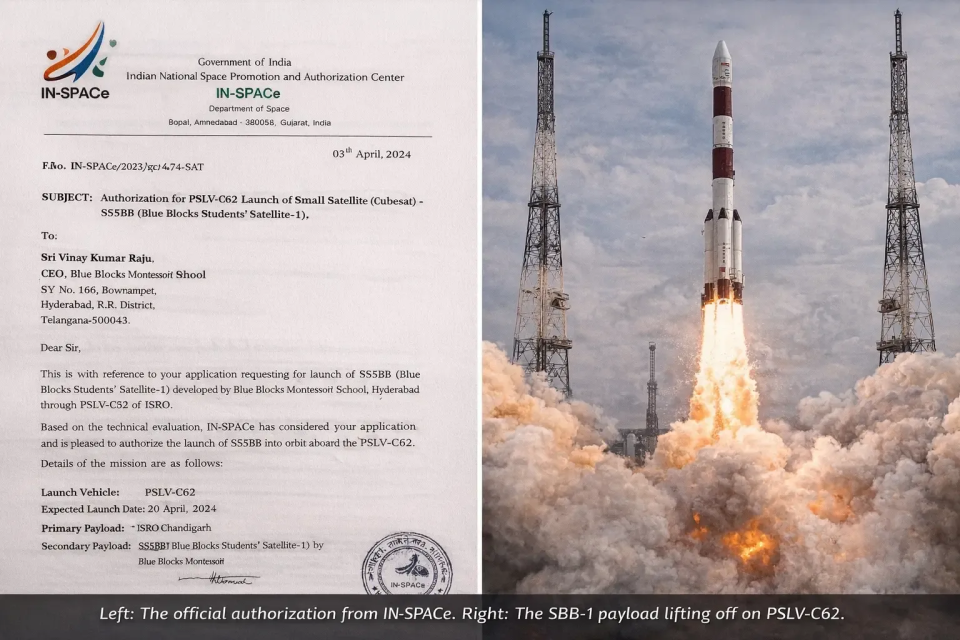
HYDERABAD / SRIHARIKOTA —In a landmark breakthrough for secondary education in India, the student engineering team at Blue Blocks Montessori School secured formal flight authorization from the Indian National Space Promotion and Authorization Centre (IN-SPACe) for their student-built payload. The Blue Blocks SBB-1 officially took flight as a hosted payload aboard the MOI-1 spacecraft on the Indian Space Research Organisation’s (ISRO) PSLV-C62 mission on January 12, 2026. This incredible event at the Satish Dhawan Space Centre in Sriharikota followed the receipt of official flight authorization, validating the immense technical rigor of the 17-member student team.
Left: The official authorization from IN-SPACe. Right: The SBB-1 payload lifting off on PSLV-C62.
The Official IN-SPACe Seal of Approval
The path to the launchpad began long before the launch countdown. The crucial turning point for the mission was the issuance of the official authorization letter from IN-SPACe, the single-window nodal agency for space activities in India.
This document served as far more than just a permission slip for a school project. It was a rigorous technical validation. It confirmed that the Blue Blocks SBB-1 payload, designed entirely by students aged 12 to 15, met the stringent safety, structural, and communication standards required for professional spaceflight.
Securing this authorization places Blue Blocks among a highly select group of educational institutions globally that are capable of meeting true aerospace industry standards.
An Engineering Triumph on the PSLV-C62
The payload was successfully integrated onto the ISRO launch vehicle after passing every demanding pre-flight qualification test. These tests included extreme vibration simulations, pressure validations, and intense thermal cycling.
On launch day, the student engineering team watched their classroom concepts take actual flight. The PSLV-C62 flawlessly cleared the tower, and the student-built hardware endured the intense g-forces and maximum dynamic pressure of the early flight stages.
While the rocket’s first and second stages performed perfectly, ISRO reported that the launch vehicle encountered a critical anomaly during its third stage. This unfortunate event resulted in the loss of the launch vehicle and its payloads before they could reach their targeted orbit.
Despite the mission’s premature end, the students’ engineering work was an undeniable, historic success. Their hardware was built to professional specifications and successfully survived the violent ascent of a real-world rocket launch up until the external vehicle anomaly occurred.
“Receiving the IN-SPACe letter was the moment reality set in. It meant that professional space agencies did not just see us as kids; they saw us as engineers.”
— Student Representative, Blue Blocks Engineering Team
The Technical Engineering Behind Blue Blocks SBB-1
The mission was not merely a symbolic educational exercise. The Blue Blocks SBB-1 was engineered and fully qualified as a hosted payload integrated into the MOI-1 spacecraft. Rather than flying as an independent satellite, the students had to prove their hardware could meet the strict mechanical and electrical interfaces of the host spacecraft.
It served as a highly technical demonstration of adolescent capability in:
-
Hosted Payload Integration: Engineering miniaturized components to interface seamlessly with the MOI-1 spacecraft architecture.
-
Thermal Management: Designing hardware meant to survive the extreme temperature fluctuations of a real-world space mission.
-
Systems Engineering: Meeting the zero-margin-for-error safety requirements mandated by IN-SPACe and ISRO for orbital flight.
What This Means for the Future of Aerospace Education
With the launch of the Blue Blocks SBB-1, Blue Blocks has effectively moved the goalposts for school-level STEM education.
Our Innovation framework has transitioned from a theoretical concept to a proven methodology. It demonstrates that with the right environment, middle-school students can engineer complex hardware capable of flying on national-level scientific missions. That the mission ended in a vehicle failure does not diminish the achievement, the students met professional aerospace standards, and then faced a real mission outcome beyond their control.
Media Resources
For high-resolution images of the launch or a copy of the IN-SPACe authorization for press use, please verify through our official channels.