





Dinner in your house. The television is on in the corner. Your phone sits next to your plate. Your toddler is pushing rice around. You have said “one more bite” three times already. Your partner is scrolling. No one is looking at each other. This is what most mealtimes look like in most homes. And it is one of the biggest reasons children eat the way they do.
If you want to know how to create a positive mealtime environment for your child, the answer is not about what is on the plate. It is about what is around it.
At Blue Blocks, we watch children eat every day. What we see, and what decades of peer-reviewed research confirm, is that the environment surrounding a meal shapes how a child eats more than the food itself.
Changing the environment is often the single biggest thing a family can do to shift how mealtimes feel for everyone.
This blog has four simple steps to create a positive mealtime environment. Read on to find out.
Why the mealtime environment matters more than the food itself
Ask most parents what makes a difficult mealtime, and they will talk about the food. Fussy about vegetables. Refuses to eat fruits. Won’t try anything new. Would only eat plain rice or something they have been stuck on.
Ask a paediatric researcher, and they will tell you the food is often the last thing to look at.
Dianne Neumark-Sztainer at the University of Minnesota has been running Project EAT, one of the largest and longest-running studies of adolescent eating behaviour, for nearly two decades. Her team has followed thousands of children into young adulthood, tracking not just what they ate but how, where, and with whom.
The consistent finding across her published work: children who share regular family meals show better dietary intake, lower rates of disordered eating, and better mental health outcomes as adults. The frequency of family meals in adolescence predicts eating quality in adulthood.
The interesting part is what does not predict outcomes. Not the food group balance on the plate. Not the strictness of the eating rules. Not the parent’s own dietary preferences. What predicts a healthy long-term eater is the environment around meals in the early years.
Our own home-observation research on the family environment reinforces this. Where children sit, what materials they use, who else is present, and what devices are visible mattered more for eating patterns than the specific foods offered.
The environment is doing most of the work. Adults just tend to notice the food.
Screens off, phones away: what the research on family meals shows
Two mealtime patterns have been studied extensively in the last twenty years, and both are worth looking at directly.
Screen time during meals. Multiple peer-reviewed studies have found that eating with screens on, whether television, phones, or tablets, reduces awareness of internal satiety cues in children and adults alike. Children eating in front of a screen tend to eat past the point of fullness. Conversation during meals drops. Chewing time reduces.
The whole rhythm of the meal accelerates, the way a conversation accelerates when nobody is listening.
Over months and years, this consistently correlates with children who cannot read their own hunger and fullness signals accurately. It is not that an occasional screen will damage a child. It is that a habit of screen-during-meals shapes how the child eats for years.
Family meals as a ritual. Project EAT and the broader literature on family mealtime rituals is one of the strongest bodies of evidence in child public health.
Children who eat regularly with their family, sitting together, sharing the same food, show better outcomes across nearly every metric researchers have tested.
Not because family dinner is magical. Because sitting together over food is when children learn what a meal is for.
Conversation. Rest. Sharing. Watching adults enjoy food they might one day try themselves.
You do not need to hit a perfect number. Even three or four family meals a week, at consistent times, with everyone present, shifts the pattern.
What matters is that the meal is a shared act, not a supervised feeding.
4 Steps to Create a Positive Mealtime Environment
You do not need to overhaul your kitchen. Just four steps.
Step 1: Screens off.
No television, no phones, no tablets. If mealtimes have been screen-times for months, expect the first few days to feel awkward. That awkwardness is the environment resetting. Children begin to talk when the screen goes off. So do parents.
Step 2: Real materials at child height.
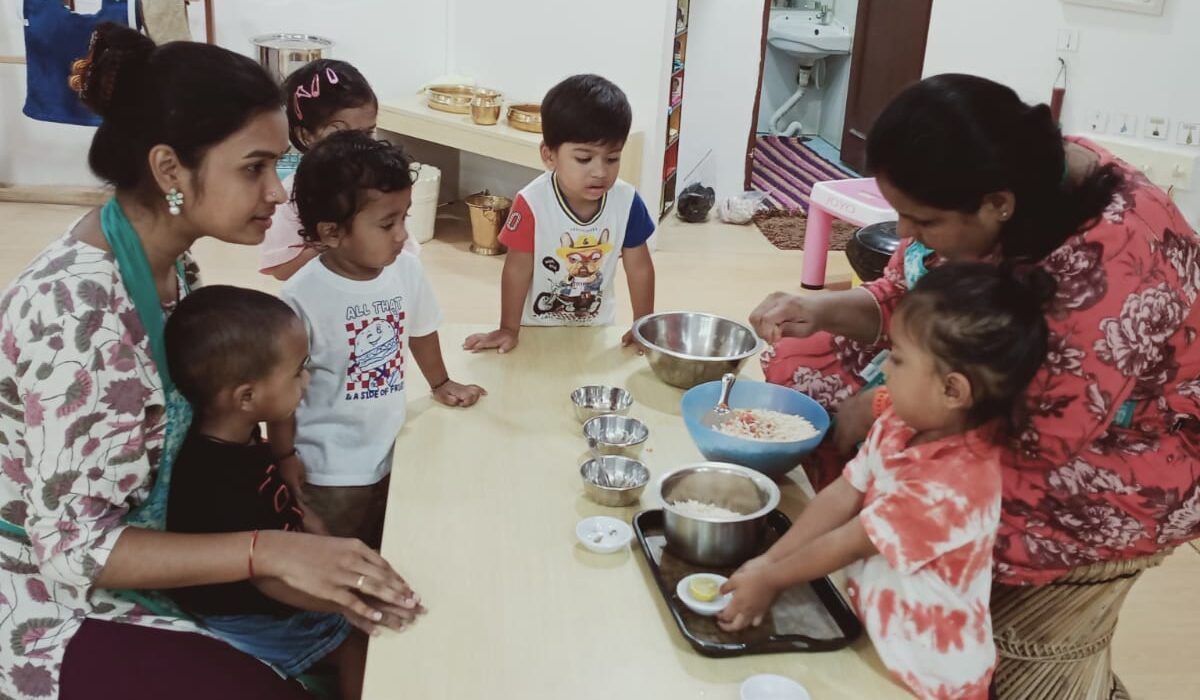
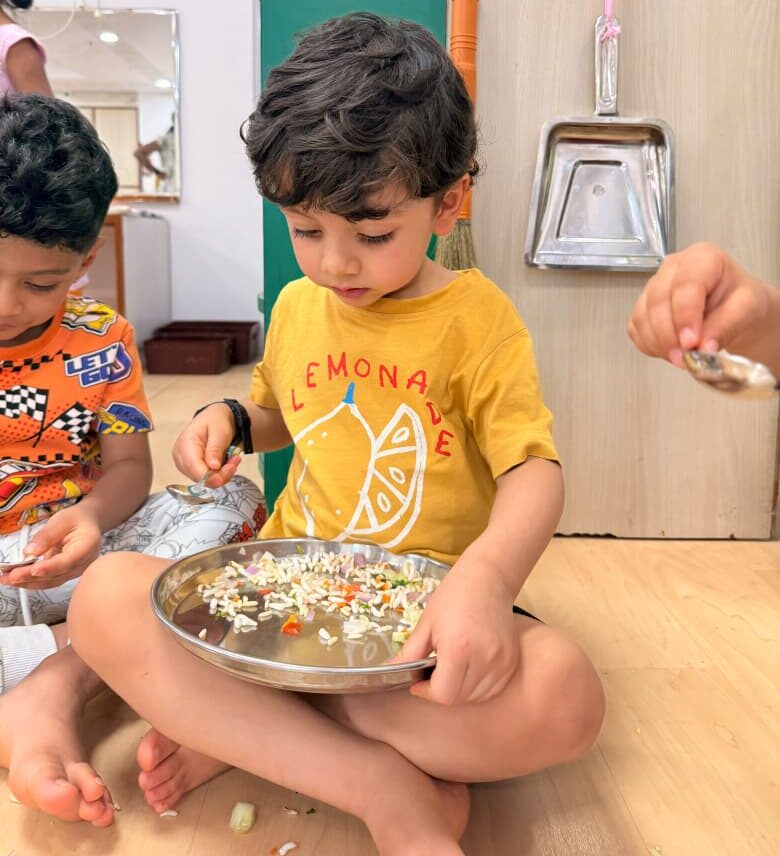
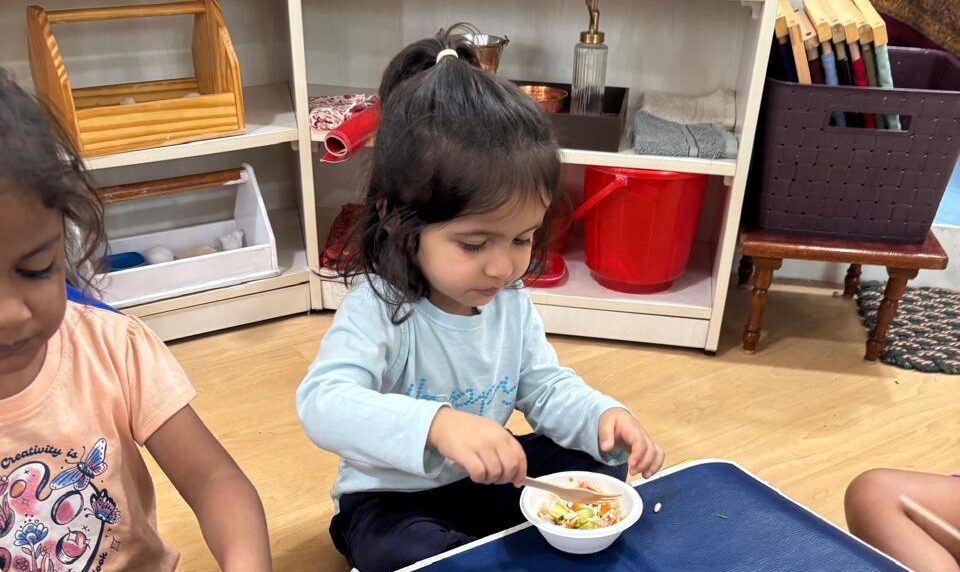
A small ceramic bowl. A real brass glass. A metal spoon your child can hold. Plastic teaches children that materials do not matter. Real materials teach care. If a drops a real steel glass, she cleans up a real spill. This is how independence begins at the table.
Step 3: A shared table.
Whether your child sits at a low table or at the family table with a booster, what matters is that everyone eats at the same surface at the same time. Children eating separately from adults miss the social learning that meals are meant to carry.
Step 4: Adults eating the same meal.
If the child gets rice and dal while the adults eat something else, the meal stops being shared. Children learn what to try by watching the adults they trust eat it themselves. Our research on food participation at home documented that modelled eating, adults visibly enjoying the same food, is one of the most powerful influences on a child’s food acceptance.
If you would like to see where your child sits across the ten domains our tool measures, including mealtime environment, food personality, and independence, our Food Foundations Reflection walks you through in about fifteen minutes. Most parents finish it seeing not just the child but the environment around the child more clearly than when they began.
When you should actually be worried
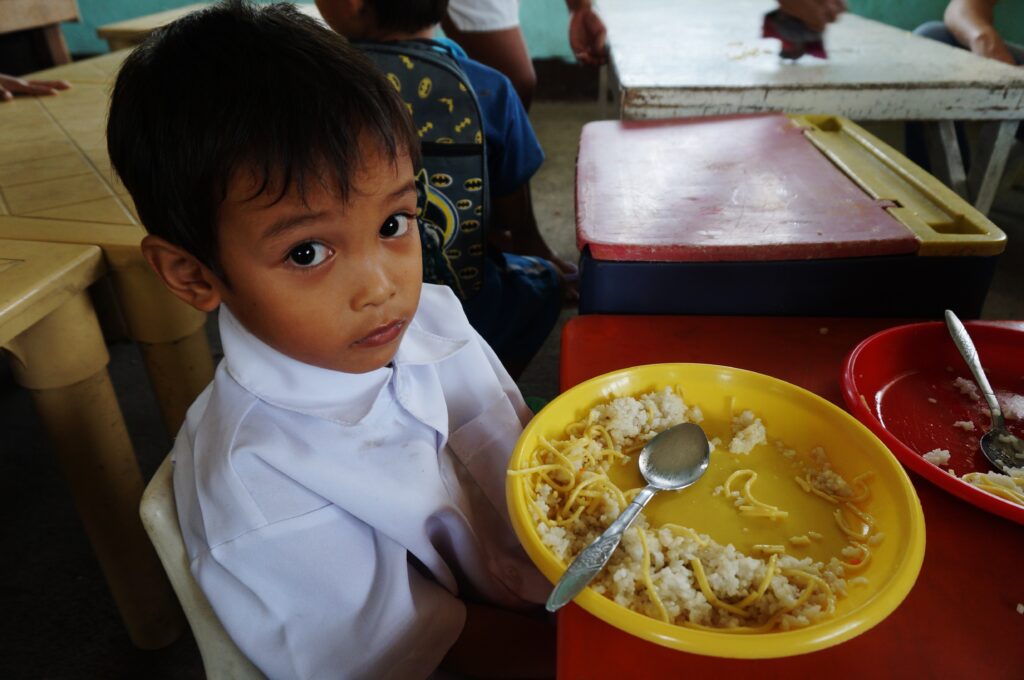
The environmental changes above assume a healthy child whose eating varies but whose overall development is on track. Some situations do need a paediatrician, not an environmental reset.
Speak to your child’s doctor if any of these apply.
- Your child’s weight has dropped or stopped increasing for several weeks
- Your child gags or vomits severely at most meals
- Your child cannot swallow or chew textured food by age two
- Your child shows extreme sensory reactions to a wide range of textures
- Your instinct tells you something is outside normal day-to-day variation
Trust that instinct. The environmental work is for the normal range. Your paediatrician is for the rest.
Related reading
- My toddler eats one day and not the next: what is really going on
- How to teach your toddler to eat by themselves: the Montessori way
- Catching up to your child: a parent guide to staying relevant
Authors:
Pavan Goyal, Co-founder and Principal Investigator, Blue Blocks Micro Research Institute. Trustee, Indian Montessori Foundation. Holds all four AMI Montessori diplomas. ORCID: 0009-0009-8840-8505. LinkedIn.
Munira Hussain, Co-founder and Director of Pedagogy, Blue Blocks Montessori School; Secondary Investigator, Blue Blocks Micro Research Institute. AMI Auxiliary Trainer. ORCID: 0009-0003-5904-6206. LinkedIn.