








How to Stop Force Feeding Your Toddler (and What to Do Instead)
How to stop force feeding your toddler is one of the most common questions we hear from parents at Blue Blocks, and the answer is not what most parents expect.

If you have ever chased your toddler around the room with a spoon, bribed her with a screen to finish her plate, or negotiated one more bite before she could leave the table, you are not alone. Most parents of young children do some version of this, and they do it with love. But the research on how to stop force feeding your toddler tells a consistent story that surprises most parents when they first hear it.
Pressure at mealtimes produces the opposite of what we hope. Children who are pressured to eat learn to distrust their own hunger. Children who are trusted to decide how much they need are the ones who eat well.
At Blue Blocks, we watch this pattern in nearly every family we work with. The parent’s intent is protection. The child’s response is exactly what the parent wanted to avoid. This piece is about how that happens, why it happens, and what to do instead.
Four small changes stop force feeding for good. Our Food Foundations Reflection shows where your child stands today.
The three patterns most parents fall into
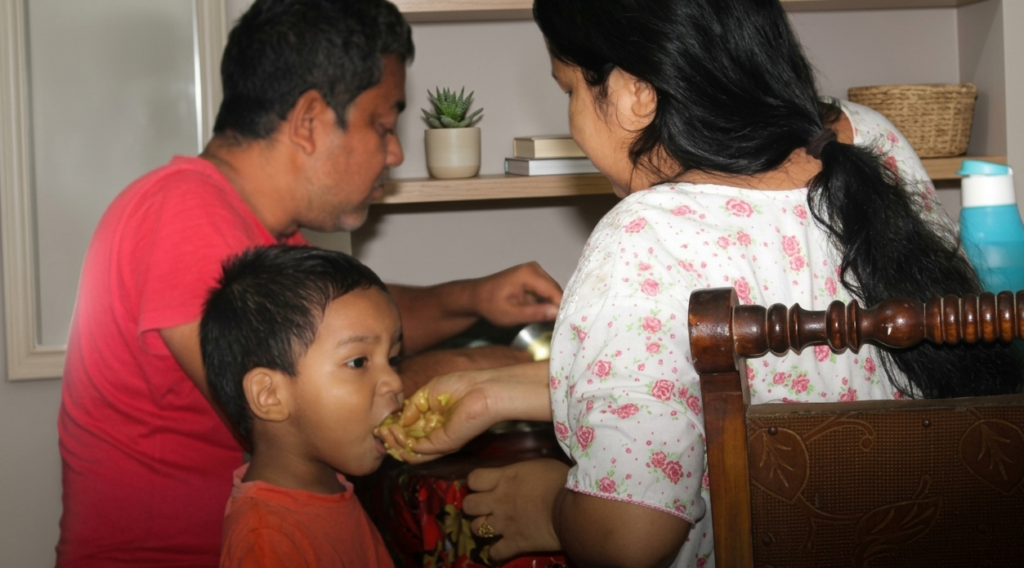
Most force feeding does not look like force. It looks like three patterns parents recognize the moment they are named.
The first is chasing. The parent follows the child around with a spoon, offering a bite whenever she slows down, stretching the meal across an hour.
The second is bribing. A screen, a sweet, a toy, or extra playtime in exchange for bites. The food becomes a currency the child learns to trade rather than nourishment her body needs.
The third is distracting. The screen goes on, a song plays, the parent narrates a story, and a spoon slides in while the child’s attention is elsewhere.
None of these is unkind. All are common. All have a developmental cost.
Why we do this, and why it is not our fault
The worry that a child is not eating enough is one of the strongest anxieties in early parenting. When a toddler refuses a meal, a parent’s mind moves quickly to growth, immunity, energy, sleep. When the toddler refuses the next meal too, the anxiety compounds. When a grandparent or paediatrician then asks whether the child is eating properly, the pressure to intervene becomes almost impossible to resist.
Chasing, bribing, and distracting are what parents do when they need to feel like they are helping. Each behaviour comes from love. What young children actually need at mealtimes is not more food but more trust in their own regulation.
What the research on pressure feeding shows
Multiple decades of peer-reviewed studies, including work by Myles Faith and colleagues on parental feeding practices, have found the same pattern with striking consistency. Children whose parents use pressure to eat, whether through direct urging, rewards, or repeated encouragement, tend to become pickier eaters over time. They eat less variety, take longer to accept new foods, and lose the ability to read their own hunger and fullness signals accurately.
The framework that has held up most consistently is Ellyn Satter’s Division of Responsibility in Feeding. Parents decide what food is offered, when meals happen, and where. Children decide whether they eat and how much. When parents cross into deciding how much, the child’s own regulation is overridden.
Our own research on parental response at mealtimes documents the same pattern in Blue Blocks families. Where parental intensity around eating is high, children eat less confidently. Where parents step back and trust the child’s cues, children develop clear appetite regulation earlier and eat a wider range of foods sooner.
The reframe: your job and the child’s job are different
The most useful shift for most parents is not a new technique but a role change. Your job is to decide what nutritious food is offered, when meals happen, and where the family eats. The child’s job is to decide whether she is hungry today and how much of what you have offered she wants to eat.
This is not neglect. It is trust in what her body already knows how to do.
4 Ways to Stop Force Feeding Your Toddler
If you are wondering how to stop force feeding your toddler in practice, the answer is not a new routine. It is stopping four specific things.
Step 1: Stop chasing. Meals happen at the table. If she gets down, the meal is over. This is her first opportunity to learn that hunger and mealtime are connected.
Step 2: Stop bribing. No screens for eating. No sweets for finishing. No rewards for bites. Bribing teaches her that food is a currency, not nourishment.
Step 3: Stop distracting. Screens off, songs paused, no automatic bites while she looks the other way. Awareness of hunger and fullness is what we are trying to build.
Step 4: Stop negotiating. No “three more bites.” No “one for daddy.” Serve a small amount, offer more if she wants, and let her decide when she is done. Our research on parental awareness shows that children whose parents step back learn to signal fullness clearly within weeks.
If you want to see where your current mealtime patterns sit across the ten domains our tool measures, our Food Foundations Reflection walks you through in about fifteen minutes.
When you should actually be worried
The advice above on how to stop force feeding your toddler assumes a healthy child whose eating varies but whose overall growth and development are on track. Some situations do need a paediatrician, not a change in parenting approach.
Speak to your child’s doctor if any of these apply.
- Your child’s weight has dropped or stopped increasing for several weeks
- Your child gags or vomits severely at most meals
- Your child cannot swallow or chew textured food by age two
- Your child shows extreme sensory reactions to a wide range of textures
- Your instinct tells you something is outside normal day-to-day variation
Trust that instinct. The patterns above are for the normal range. Your paediatrician is for the rest.
Related reading
- My toddler eats one day and not the next: what is really going on
- How to create a positive mealtime environment for your child
- How to teach your toddler to eat by themselves: the Montessori way
Authors:
Munira Hussain, Co-founder and Director of Pedagogy, Blue Blocks Montessori School; Secondary Investigator, Blue Blocks Micro Research Institute. AMI Auxiliary Trainer. ORCID: 0009-0003-5904-6206. LinkedIn.