







How to Find North with the Saptarishi: A Night-Sky Activity for Families
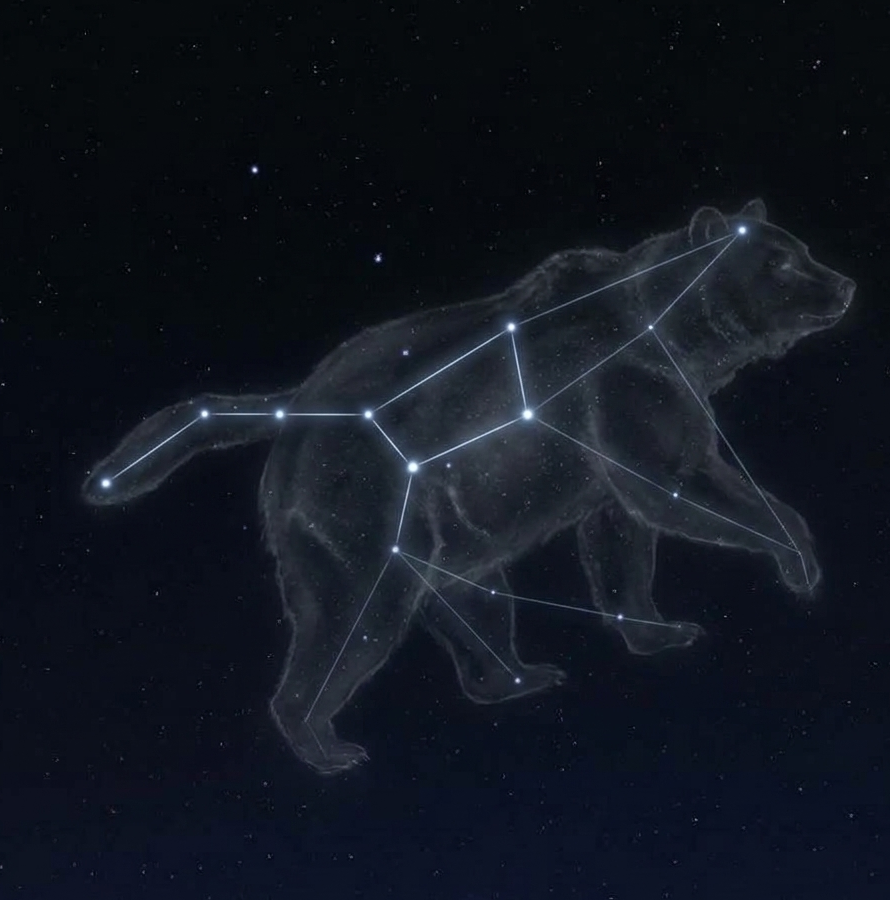
On any clear night in India, seven bright stars in the shape of a ladle sit high in the northern sky. In Indian tradition, they are known as the Saptarishi (the seven stars). In Western astronomy, they are called Ursa Major, and the central ladle-shape is often called the Big Dipper. For a child, these seven stars open one of the oldest lessons in astronomy: how to find north with the Saptarishi.
It is a method human navigators have used for thousands of years, and any child of any age can learn it in one clear evening. No equipment. No app. Just a patch of sky, a parent, and a child.
What the Saptarishi actually looks like
The Saptarishi is a group of seven bright stars that form the shape of a ladle, a large question mark, or a plough. Different cultures have called it different things across centuries of astronomical writing.
The constellation is one of the easiest to identify because its shape is distinctive. Four bright stars form the bowl of the ladle. Three more form the handle, curving slightly outward. The whole pattern sits in the northern part of the sky. Once your child can spot it, everything else about how to find north with the Saptarishi follows quickly.
From most parts of India, the Saptarishi is visible almost every clear night for much of the year, though its position rotates around the North Star across the seasons. In the evening hours from March to September, it sits high in the north-northwest sky, easy to find. In winter months, it appears lower and further to the north-northeast.
Once your child sees it, she will always be able to find it again.

How to find north with the Saptarishi
This is the method navigators, geologists, and traditional way finders have used for at least three thousand years. It is documented in navigation guides used by field scientists today, including a recent open-access teaching guide from the Blue Blocks Micro Research Institute on field navigation for young geologists (Chakraborty, 2026).
Before you begin: All seven stars of the Saptarishi are visible to the naked eye on any clear night, after dark. No telescope, no binoculars, no app. You can spot them from a terrace or an open balcony in most Indian cities. The darker your location, the sharper the pattern will be, but even moderate city light will not hide these seven stars because they are among the brightest in the entire night sky.
Step 1: Find the pointer stars. Look at the ladle’s bowl. The two stars at the outer edge, furthest from the handle, are the pointer stars. In standard astronomy, they are called Dubhe (Alpha Ursae Majoris) and Merak (Beta Ursae Majoris), their official Bayer designations. Point them out to your child.
Step 2: Draw an imaginary line. Trace a line from Dubhe through Merak, moving outward from the bowl, away from the handle.
Step 3: Extend it five times. Continue the line about five times the distance between the two pointer stars. Follow it steadily. Do not get distracted by other stars along the way.
Step 4: Find Polaris. At the end of that line sits a single moderately bright star, alone. That is Polaris, the North Star.
Step 5: Face north. Face Polaris. You are now facing true north. Your back points south. Your right shoulder points east. Your left shoulder points west.
That is the entire method. It works because Polaris happens to sit almost exactly above the Earth’s North Pole. It does not move across the sky. The other stars rotate around it through the night. Polaris stays put.
This is one of the oldest astronomy lessons in the world, and one of the most reliable. Anyone who learns how to find north with the Saptarishi can find their bearings on any clear night, in any part of the northern hemisphere, forever. It is the same technique fishermen, farmers, and pilgrims used long before compasses existed.
Why this is worth doing with a child
Three reasons why learning how to find north with the Saptarishi matters for a child.
Attention. The Saptarishi does not reveal itself in three seconds. A child has to look up, hold her gaze on the sky, let her eyes adjust to the dark, and pick out the pattern. Night-sky watching is one of the gentlest ways to build sustained attention.
Environmental psychology research on attention restoration theory, first developed by Rachel and Stephen Kaplan at the University of Michigan, describes the specific way that unforced observation of natural environments rebuilds a child’s capacity to focus.
Cultural rootedness. The Saptarishi carries centuries of Indian astronomical writing alongside its Western designation as Ursa Major. When a child learns both names for the same seven stars, she is holding two knowledge traditions at once. Neither replaces the other. Both belong to her.
A sense of place. A child who has found north from a star has located herself on the planet, using nothing but her own eyes and the sky. That is a small thing that becomes a large thing over time.
Environmental educators have long argued that direct experience of the natural world develops what Richard Louv, in Last Child in the Woods, calls nature-deficit recovery: a child who can orient herself by the sky is a child less likely to feel adrift in the wider world.
What to expect when you try it
Give the first attempt fifteen to twenty minutes. Take your child somewhere away from bright streetlights, with an unobstructed view of the northern sky. Let her eyes adjust to the dark first.
Show her the Saptarishi. Then the pointer stars. Then Polaris. Some children find it on the first try. Others need three or four evenings before the sky clicks. Both are fine.
She may ask questions you cannot answer. Why is Polaris fixed? Why does the sky change through the year? Say you do not know. Say you will find out together. That is a better answer than a wrong one.
Tonight, if the sky is clear
Go outside with your child. Face north. Find the seven stars of the Saptarishi. Locate the two pointer stars at the outer edge of the bowl. Draw the imaginary line five times the distance between them. Find Polaris. Say its name aloud. Then turn around slowly and orient yourselves to south, east, and west from where you stand. That, in five minutes, is how to find north with the Saptarishi.
Do this once, and your child will know how to find north with the Saptarishi for the rest of her life. Do it three or four times across a year, and the sky becomes hers. She will always be able to look up and locate herself.
The Saptarishi has been there every clear night since long before any of us were born. It will be there for her children, and theirs. The sky is one of the few things in this world that stays.
Related reading
- What Do Children Draw When Asked About Life? Trees and the Sun
- How to Keep Children Connected to Nature: Six Small Habits at Home
- How to raise a curious child
Authors:
Pavan Goyal, Co-founder and Principal Investigator, Blue Blocks Micro Research Institute. Trustee, Indian Montessori Foundation. Holds all four AMI Montessori diplomas. ORCID: 0009-0009-8840-8505.
Munira Hussain, Co-founder and Director of Pedagogy, Blue Blocks Montessori School; Secondary Investigator, Blue Blocks Micro Research Institute. AMI Auxiliary Trainer. ORCID: 0009-0003-5904-6206.