






Maria Montessori built her method to be given away.
In 1929, she founded the Association Montessori Internationale (AMI) in Amsterdam to protect its integrity through training rather than through legal control. The name itself was never trademarked. She wanted the method to reach children wherever they were.
A century on, that openness has produced 15,000 to 20,000 schools in 154 countries, and a challenge she could not have anticipated: commercial demand for the Montessori name has outpaced the training infrastructure meant to maintain its integrity.
Our global review of Montessori versus Traditional Education documents what this means in practice. Implementation fidelity is the single strongest predictor of Montessori outcomes in every national context studied. A classroom using the name but diluting the materials performs no better than a conventional classroom.
The resolution is also hers. The structural features that define authentic Montessori school are observable. The credential systems she set in motion are verifiable. This piece walks you through the six features, one study that proves the difference matters, what to observe when you visit, what to ask the admissions team, how the question becomes more complex at the secondary plane, the one study that proves fidelity matters, and why this is harder to answer in India than almost anywhere else.
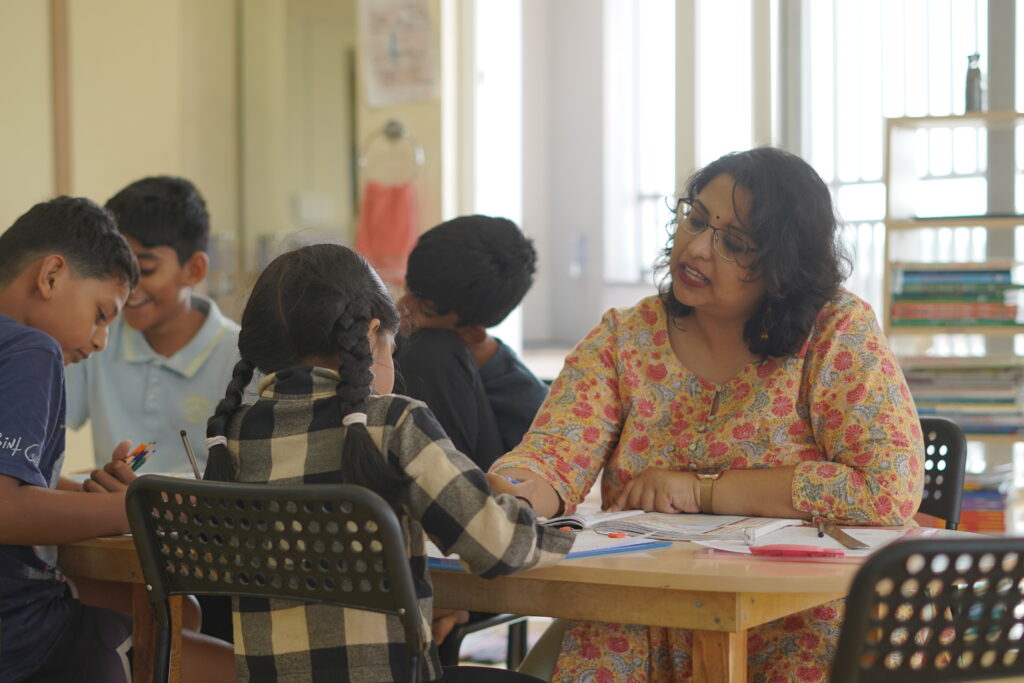
The Montessori sign is not the Montessori method
Teacher training follows a clear hierarchy, with each body offering a recognized path to authentic Montessori practice:
- Association Montessori Internationale (AMI). Founded by Maria Montessori herself in Amsterdam in 1929, AMI is the original guardian of the method and holds the gold standard for teacher training. AMI primary training runs a full academic year under certified trainers, and remains the most direct line to Maria Montessori’s own instruction.
- American Montessori Society (AMS). Founded in 1960, AMS is the second major international body and offers rigorous training with a slightly broader interpretation of the method.
- National associations. The Indian Montessori Foundation (IMF) and other national bodies operate alongside the international organizations, often affiliated with AMI or AMS, carrying Montessori training into regional contexts and languages.
A teacher’s credential tells you where in this lineage she trained. The classroom at work tells you how that training lives in daily practice.
The sections that follow walk through both: the credentials that identify real training, and the tell-tale signs that confirm the method is actually being practiced today.
What makes a Montessori classroom authentic: six structural features
Authentic Montessori is defined by six structural features, each identified by Dr. Montessori through decades of observation and preserved in the method ever since.
- Multi-age classrooms grouped by developmental plane. AMI organizes Montessori education around four developmental planes, each with its own distinct classroom environment: 0-3 (Nido and Infant Community), 3-6 (Children’s House), 6-12 (Elementary), and 12-18 (Adolescent). Within each environment, children of the full age range work together. The older model work for the younger. The younger see what they will become. The planes do not intermix. A three-year-old is never in the same classroom as a seven-year-old.
- Three-hour uninterrupted work periods. No bells, no transitions, no scheduled interruptions. The child chooses her work and stays with it until she is done. This allows the sustained concentration Dr. Montessori called the gateway to real learning.
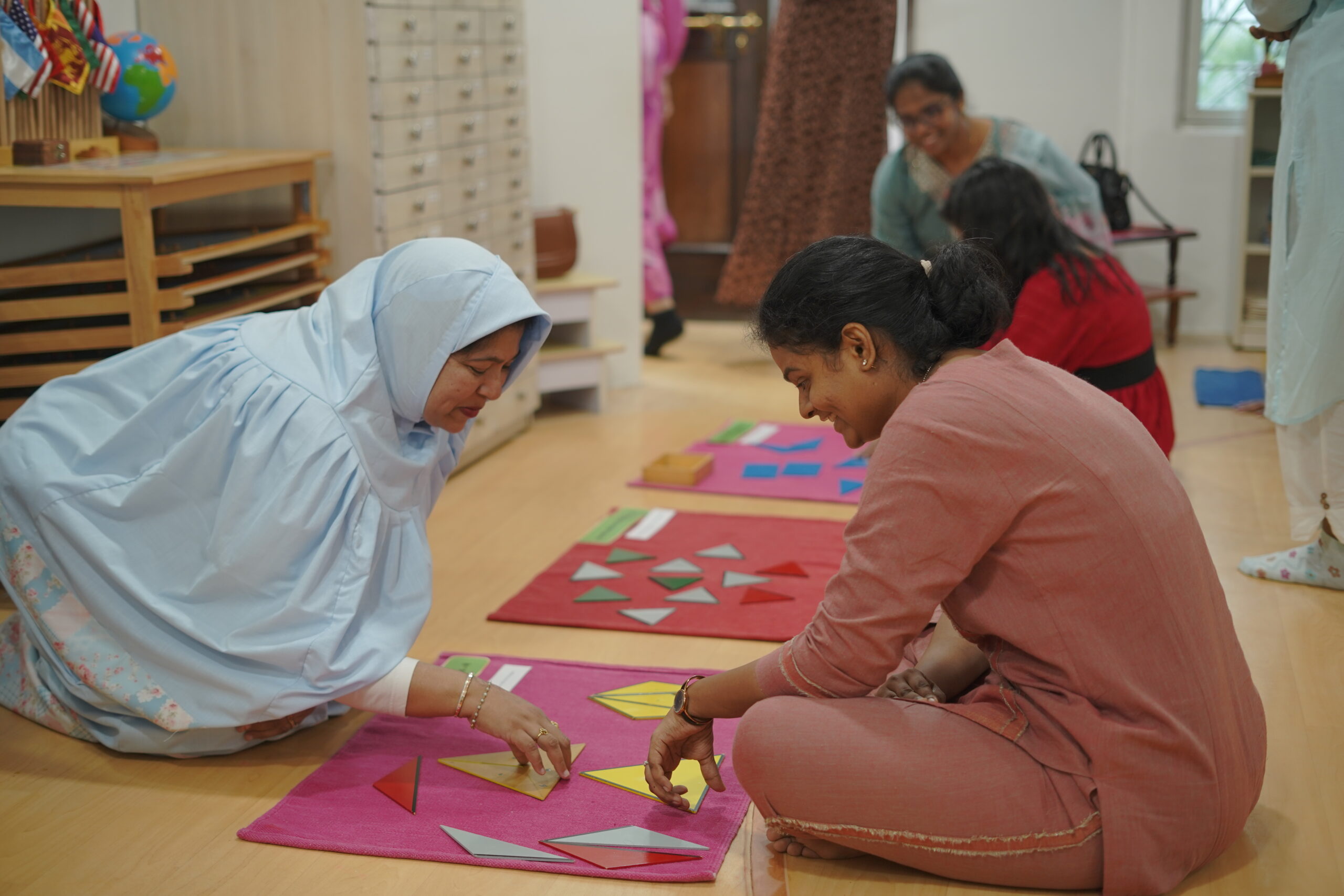
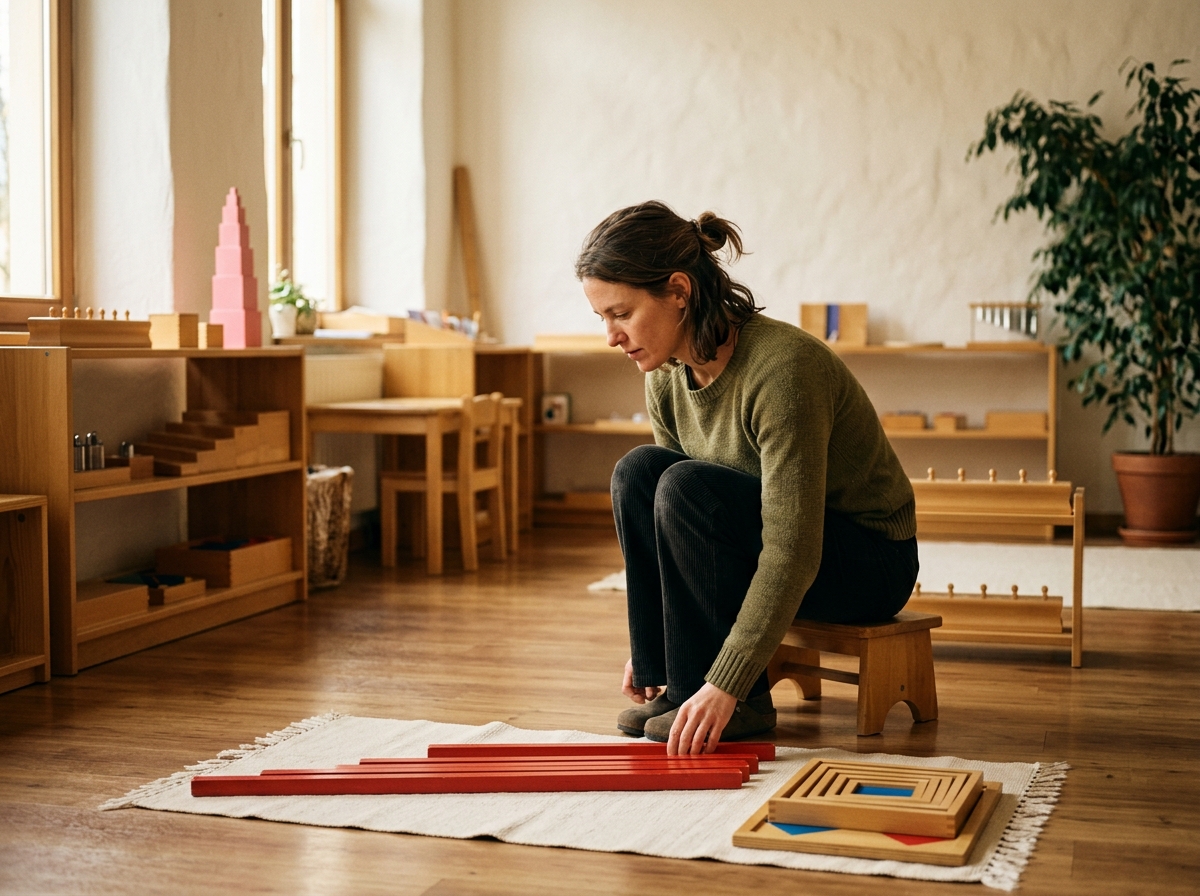
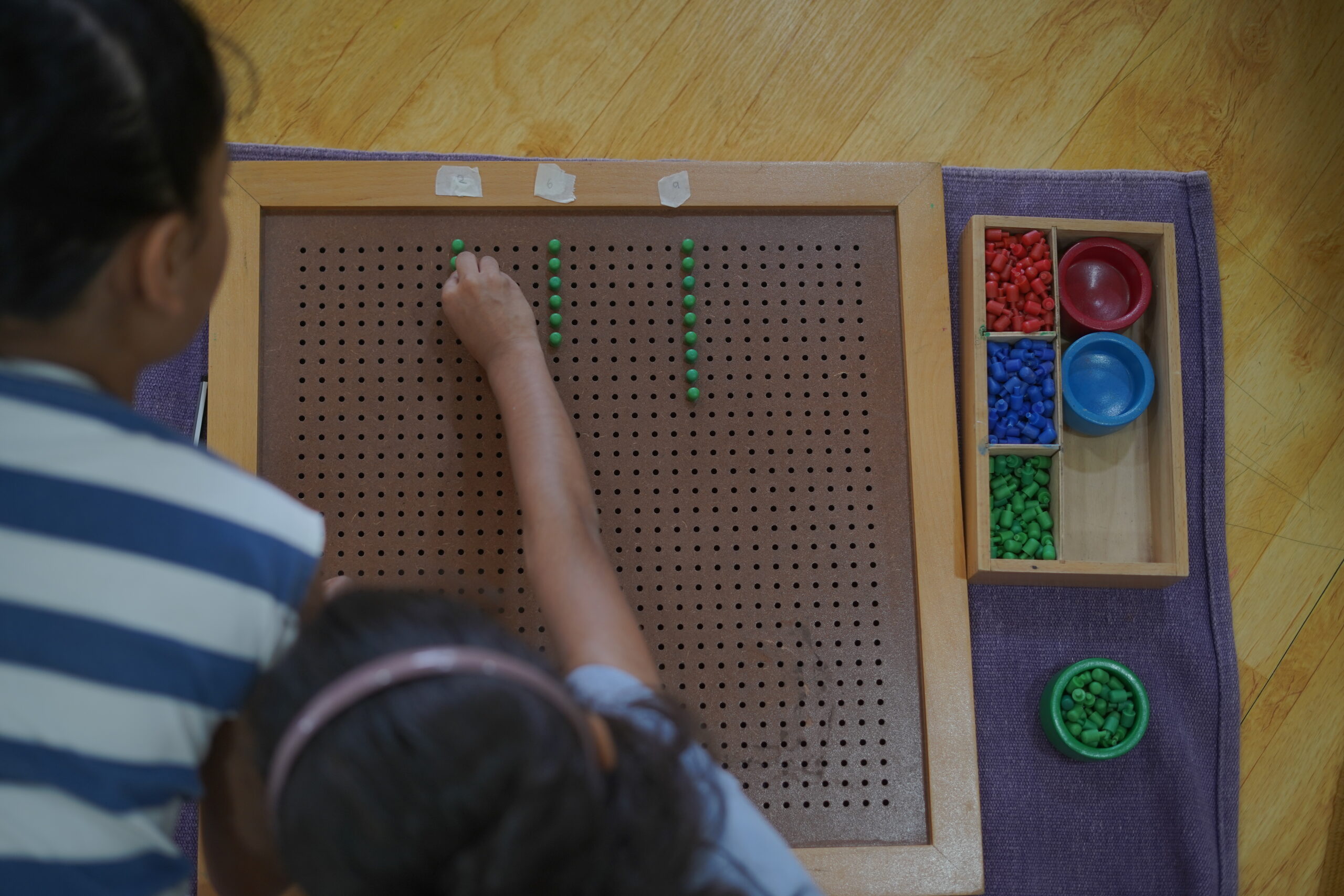
- A prepared environment calibrated to the developmental plane. The materials in each classroom are specifically designed for the age range and the developmental intensity of that plane. A 3-6 Children’s House carries sensorial materials, practical life work, and early language and mathematics. A 6-12 Elementary carries the Great Lessons, timelines, and impressionistic materials for cosmic education. A 12-18 Adolescent environment addresses occupation, economic independence, and social responsibility. Each material isolates one concept, provides immediate feedback through self-correction, and leads the child forward through a sequence Dr. Montessori designed for that specific stage of development.
- No grades, no tests, no extrinsic rewards. Motivation comes from the work itself. The child’s internal measure of progress replaces the external measure of comparison.
- Formative, observational assessment. The teacher watches, records, and notes. Progress is tracked through observation, not through examinations.
- Explicit grace and courtesy instruction. Children are taught how to greet, interrupt politely, resolve conflict, and participate in community life as part of the curriculum, not as an afterthought.
A classroom that preserves all six is an authentic Montessori school. A classroom that preserves only two or three is Montessori-flavored conventional schooling.
What to look for when you visit
A good school welcomes a parent observation. Spend some stipulated time in a classroom during a normal working day, not during a tour. Look for the structural features above as observable phenomena:
- Mixed ages. You should see three ages in one room, not two.
- The three-hour work period. Children should be able to work on one activity for as long as they choose without being called to a group lesson.
- Shelves of authentic materials. The pink tower, the brown stair, the number rods, the moveable alphabet. These should dominate the room.
- Children at work, teachers observing. The teacher should be moving quietly, giving individual lessons, or sitting back and watching. She should not be at the front of the room directing the whole class.
- No grades on the walls, no stickers, no gold stars. If you see any of these, you are not looking at an authentic Montessori school.
- Children transitioning calmly. They put work away, choose the next activity, help younger children. There are no bells or whistles organizing them.
If the classroom you observe has three or four of these but is missing the rest, the school is practicing supplemented Montessori. Lillard’s study tells you what that means for outcomes.
What to ask the admissions team
Four questions separate real from nominal:
- What credential does the lead teacher hold, and from where? AMI diplomas, AMS credentials, and credentials from recognised national associations are the gold standard. A credential from an unaccredited local course is a flag.
- How long is the lead directress’s training? AMI primary training is a full academic year. Shorter courses rarely build the depth required to run a fully authentic classroom.
- What percentage of each day is uninterrupted work? The answer should be at least two and a half hours, ideally three. If it is “we have Montessori in the mornings and traditional classes in the afternoons,” the school is supplemented, not classic.
- How often are parents invited to observe the classroom in session? Authentic Montessori schools welcome parent observation but structure it to protect the children’s concentration. Expect a scheduled window, typically once a term or on request, with a clear protocol: a seat at the side of the room, a set duration, no interaction with children at work. A school that offers no observation window at all, or refuses one when asked, is the one worth questioning. That gap is usually where the brochure and the classroom part ways.
Authentic Montessori at the secondary plane
The six structural features define authentic Montessori within each developmental plane. In the foundational planes (0-3, 3-6, and 6-12), the evidence base is strongest and the method operates at full fidelity. The secondary plane (12-18) is more complex.
The Goyal 2026 review documents that the global research base on Montessori secondary outcomes is thin. Fewer rigorous studies exist. In India specifically, the examination system creates additional structural pressure. As the paper notes, high-stakes testing at Class 10 and Class 12 determines access to higher education and employment, and this creates pressure against the no-grades, no-tests Montessori model at secondary levels.
Many authentic Montessori schools respond by associating with an external certification pathway for the secondary years while preserving Montessori principles in pedagogy. At Blue Blocks Montessori School, we adopt the Cambridge syllabus from Class 7 (age 12) alongside our Montessori approach to learning. This is consistent with Maria Montessori’s own encouragement that schools engage with the world’s syllabi and certification systems where this supports the child’s integration into society.
For a parent evaluating a Montessori secondary programme, the authenticity question is not whether an external syllabus is used.
It is whether the Montessori pedagogy, the self-directed work, the uninterrupted work periods, the materials-based learning, the observational assessment, remains intact alongside the syllabus.
The fidelity test: what Lillard 2012 showed
In 2012, educational psychologist Angeline Lillard conducted a study that answered the question definitively. She compared three groups of preschool children:
- Children in classic Montessori classrooms, where only authentic Montessori materials were used
- Children in supplemented Montessori classrooms, where authentic Montessori materials sat alongside commercial additions, worksheets, and conventional teaching methods
- Children in conventional preschools
At the start of the school year, the three groups performed similarly. By spring, the results had split in two.
Classic Montessori children significantly outperformed the others across five developmental domains: executive function, reading, mathematics, vocabulary, and social problem-solving. Supplemented Montessori children performed no better than children in conventional preschools.
The supplemented group had Montessori-trained teachers. They had authentic materials. They had the Montessori name. What they didn’t have was fidelity.
The dilution of the method by commercial additions neutralized the advantage.
The implication for a parent: the authenticity of the materials and the discipline of the method are not optional refinements. They are the active ingredient. Without them, you have a classroom that calls itself Montessori but produces conventional outcomes.
Why this matters more in India than anywhere else
India has the longest Montessori history outside Europe and one of the fastest-growing Montessori school networks today. It also has the hardest fidelity problem.
The commercial appeal of the Montessori brand has outpaced the teacher training infrastructure. Authentic AMI and AMS training is still scarce and concentrated in urban centers. Meanwhile, the Montessori name is unregulated.
The result: a Montessori sign on a school tells you very little in India about what happens in the classroom.
The Goyal 2026 review names this as one of the structural challenges Montessori faces in India. Until regulatory frameworks or association-led quality control close the gap, the responsibility falls on the parent.
Visit the school. Observe the classroom at work. Ask the four questions. That is the only reliable filter available, and the most important one you have.
The honest Montessori school welcomes your observation. The one hoping you won’t look too closely is the one you need to see.
Related reading
- Is Montessori Right for Your Family? What the Research Actually Says
- Maria Montessori’s Seven Years in India
- How to Keep Children Connected to Nature: Six Small Habits at Home