






What Is AMI Montessori Teacher Training? Understanding the Basics
Would you rather spend your working day with a toddler discovering language, a five-year-old exploring numbers, a nine-year-old investigating the universe, or a teenager learning to contribute to society?
Your answer is a useful starting point for Montessori teacher training. Each age calls for a different understanding of development and a different kind of educational work. Choosing a course begins with deciding which children you want to work with, followed by what role you want to play and how you can complete the training.
So, what is AMI Montessori certification? It is not a single badge. It covers age-specific teaching diplomas as well as shorter orientation, assistants’ and certificate courses for adults who want to understand or support Montessori work rather than lead it.
What is AMI Montessori Teacher Training?
One distinction clears away most of the confusion: no single AMI certificate covers every Montessori role. The Association Montessori Internationale (AMI), founded by Dr Maria Montessori in 1929, offers age-specific teaching diplomas, shorter orientation programmes, classroom assistant training and specialist certificates. An AMI Diploma is the comprehensive route for someone preparing to guide children at a particular developmental stage. It is an individual educator qualification, not institutional AMI accreditation of the school where that person works.
AMI diplomas are internationally recognised qualifications, issued to common standards across AMI’s global training network. Their international recognition is valuable when exploring Montessori schools in other countries, although some countries or employers require additional teaching credentials.
“We can put beautiful Montessori materials on shelves, but the materials alone do not create a Montessori environment. It is the guide who must learn to observe the child, recognise their developmental needs, prepare an environment that responds to those needs, and know when to offer a presentation and when to allow the child to work independently. This requires more than knowledge of the materials. It calls for intellectual, physical and spiritual preparation, sustained observation, practice and the humility to question our own assumptions. To me, this is the essence of becoming a Montessori guide.” (Munira Hussain, Co-founder, Blue Blocks Montessori School)
Which of the five AMI diploma levels would suit you?
The AMI qualifications directory describes five diploma pathways. Their age ranges overlap in one place, but their preparation is not interchangeable.
0–3 years: Assistants to Infancy
This diploma focuses on the child’s first three years: movement, emerging language, relationships, care routines, and growing independence. Guides learn to support infants and toddlers in environments such as the Nido and Infant Community, while working closely with families. Choose 0–3 if the beginnings of human development interest you and you enjoy careful, responsive work with very young children. Despite its name, Assistants to Infancy is a full diploma, not the shorter classroom assistant qualification.
3–6 years: Primary or Children’s House
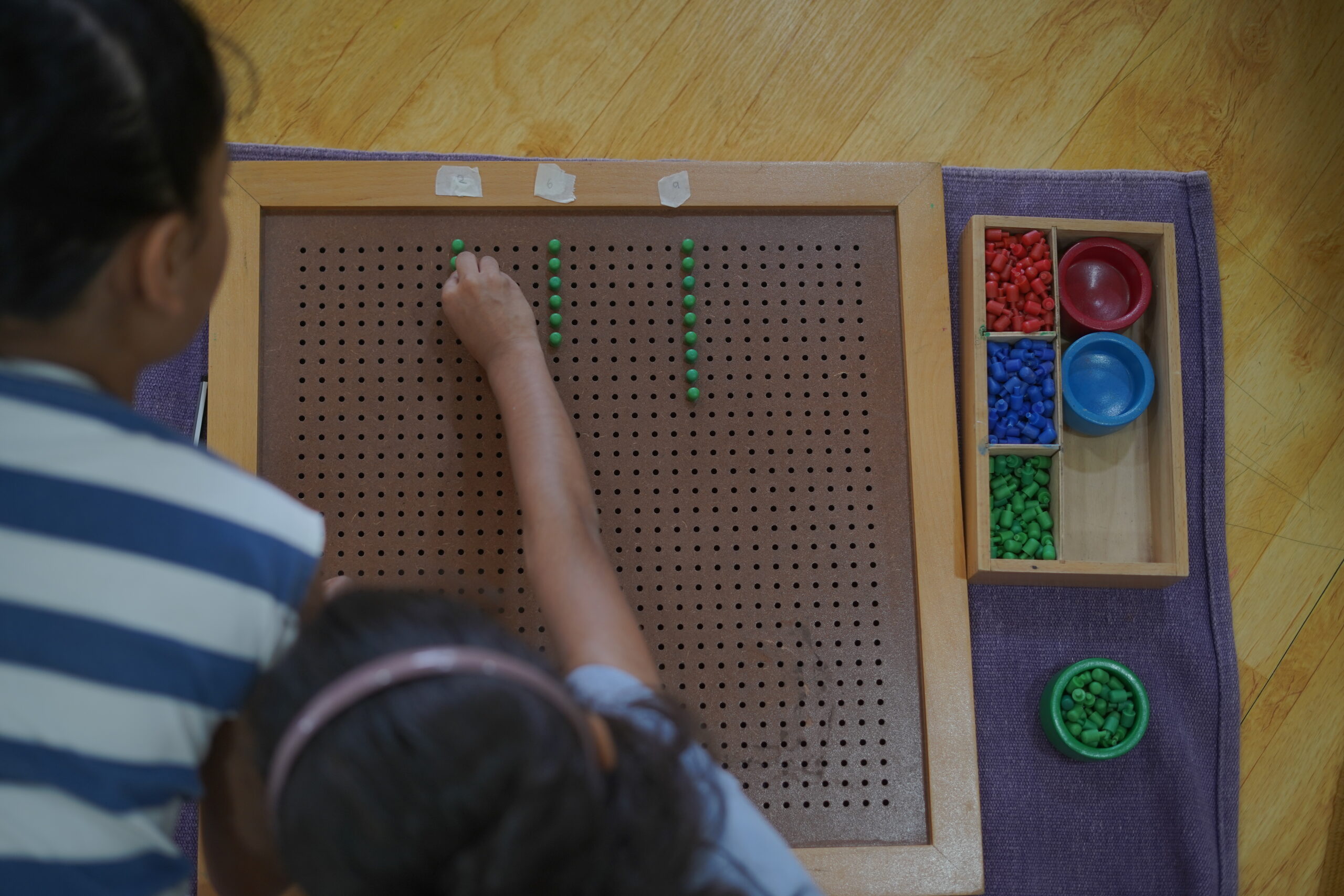
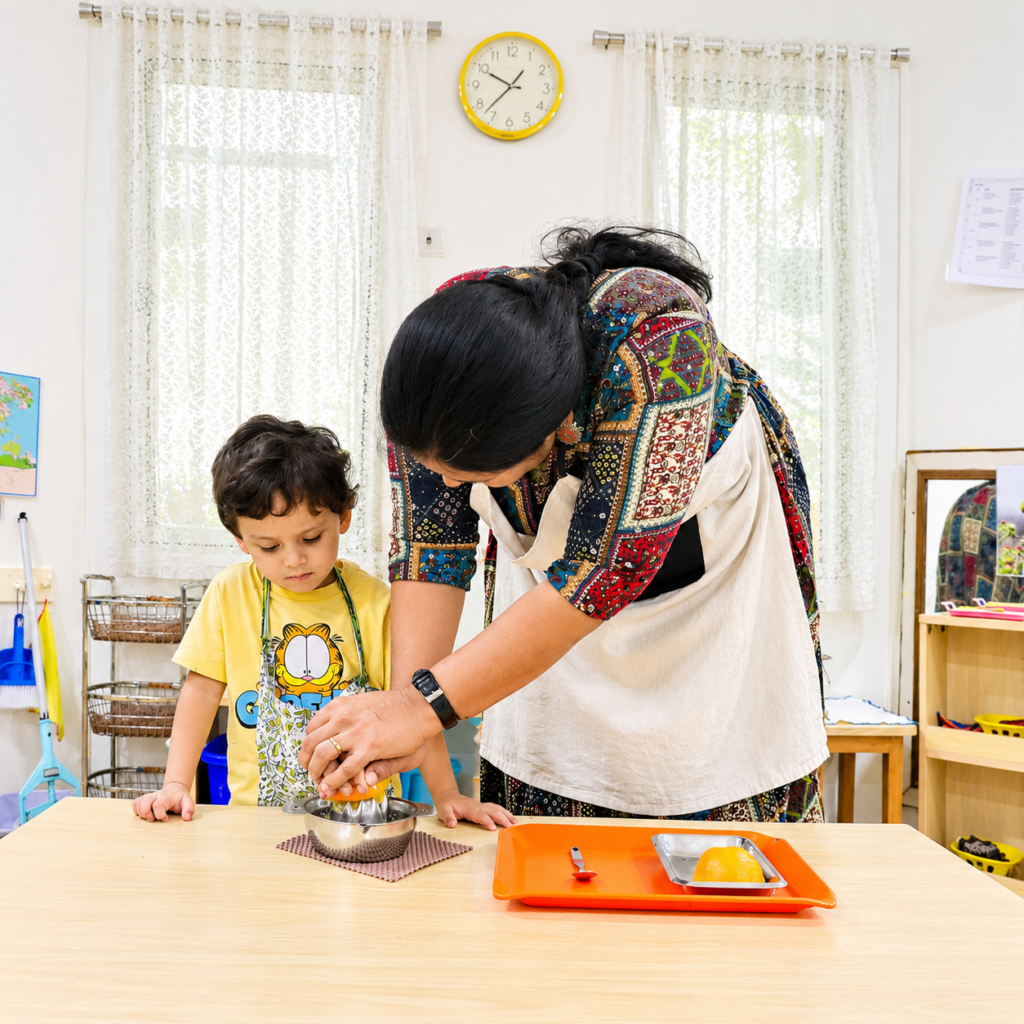
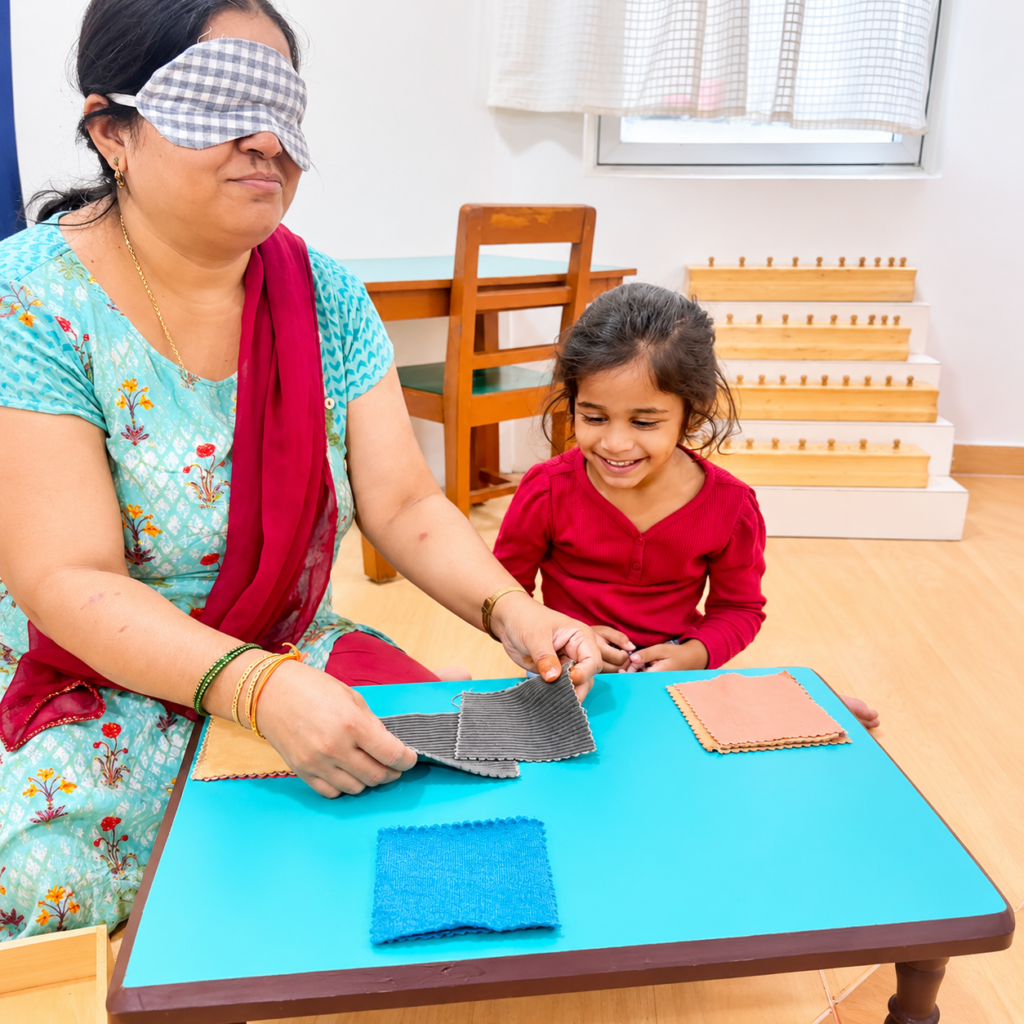
Here, training centres on the Montessori Children’s House, also called the Primary level. Trainees study Practical Life, Sensorial education, language, mathematics and cultural activities, together with the sequence of material presentations and the organisation of a mixed-age community. Parents searching for a Montessori nursery or pre-primary school are often referring to this age group. Choose 3–6 if you are drawn to purposeful hands-on activity and the extraordinary developments in language, coordination and independence during these years.
0–6 years: First Plane
The 0–6 diploma studies development across the entire first plane, linking the years of infancy with the Children’s House period. Consider 0–6 if you want a broad understanding of early childhood from birth to six. It is its own AMI diploma pathway, not an automatic award of two separate diplomas. Availability is more limited, so check which centres currently offer it.
6–12 years: Elementary
Elementary training follows the reasoning, imagination and social interests of children from six to twelve. It introduces Cosmic Education, connecting history, geography, science, mathematics and language through expansive questions about the world. Choose 6–12 if you enjoy investigation, interdisciplinary thinking and helping children pursue substantial questions rather than studying isolated subjects.

12–18 years: Adolescents
Adolescent training focuses on young people’s developing identities, social responsibilities, and need for meaningful work. Community participation, enterprise, collaboration and purposeful projects become central. Choose 12–18 if you are interested in mentoring adolescents as they find their place in society and learn through real responsibilities. It is a specialised qualification, not simply an advanced version of Elementary.

“Completing the AMI diplomas for 0–3, 3–6, 6–12 and 12–18 did not simply give me four sets of educational methods. Each training challenged something I thought I already understood.
The 0–3 course taught me to notice development long before a child can explain it. At 3–6, I began to understand how easily unnecessary adult help can interrupt independence. At 6–12, I saw why children’s questions need room to grow beyond our ready answers. And at 12–18, I came to appreciate that responsibility must be experienced through real work and real decisions. The most important thing I learnt across all four diplomas was not a technique. It was to question my own assumptions about what a child needs.” (Pavan Goyal, Founder, Blue Blocks Montessori School)
Each diploma stands on its own, so begin with the age group that draws you most, and check the course’s entry requirements.
Diploma, orientation, assistant course or certificate: What should you choose?
The AMI Diploma is for someone intending to become a Montessori guide at the relevant age level. Training includes theory, material presentations where applicable, guided practice, observation, assignments and assessment. The depth of preparation is one of the key benefits of Montessori teacher training: the adult studies the developmental stage and the professional responsibilities associated with it. For a summary of what research has found about Montessori outcomes across developmental stages, including in India, see Blue Blocks Micro Research Institute’s global review of academic outcomes.
In Lining the Nest, Chapter 12: Education: Aid for Life, we describe Montessori education as helping the child to “act, will and think for himself”. The point is not that the adult becomes unnecessary. It is that the adult must learn to observe, prepare and offer the right help so the child can increasingly act independently. That is why observation and practice are central to AMI diploma preparation.
“Before my AMI 3–6 training, I believed discipline meant restricting a child’s freedom. During a classroom observation, I was shocked to see a three-year-old cutting a cucumber with a knife. My immediate thought was, ‘What if she hurts herself?’ I would probably have taken the knife away.
But as I observed her carefully cutting the cucumber, completely absorbed in her work, something changed in me. She was being trusted to develop a real skill within carefully prepared limits. I realised how often our fears, even when they come from love, prevent children from discovering their own capabilities. For the first time, I understood that freedom and discipline are not opposites. The right limits make meaningful freedom possible.
I am deeply grateful to my trainer, Teenaz Reporter, AMI 3–6 Trainer at Montessori Training and Research Trust (MTRT), for transforming the way I understand children and my role as an adult. My love for learning and working with children has grown immensely.” (An AMI 3–6-trained Children’s House guide, Blue Blocks Montessori School)
An AMI Orientation Course introduces Montessori principles for a chosen age group. It can be a sensible beginning for parents, prospective educators and school staff. The 0–3 and 3–6 orientations involve at least 60 hours of engagement and nine hours of observation, while shorter formats exist at other levels. It offers understanding, but is not equivalent to a teaching diploma.
An AMI Assistants Course prepares adults to support a diploma-qualified guide. AMI’s current pathway builds on the corresponding orientation through an Assistants Course Adjunct, involving at least 20 additional hours of practical engagement, including onsite work. Supporting the environment and children is a distinct and valuable role. It does not confer the same qualification as a diploma.
A specialist certificate, such as AMI’s Core Principles programme, may interest educators, school leaders or parents wanting to explore broader ideas including the planes of development, human tendencies and the prepared environment. The exact certificate and its purpose should be checked against the current course description.
The decision is straightforward. To lead an environment, explore a diploma. Support a guide: consider assistant training. Understand Montessori before committing: begin with orientation.
Can you pursue an AMI Diploma while working?
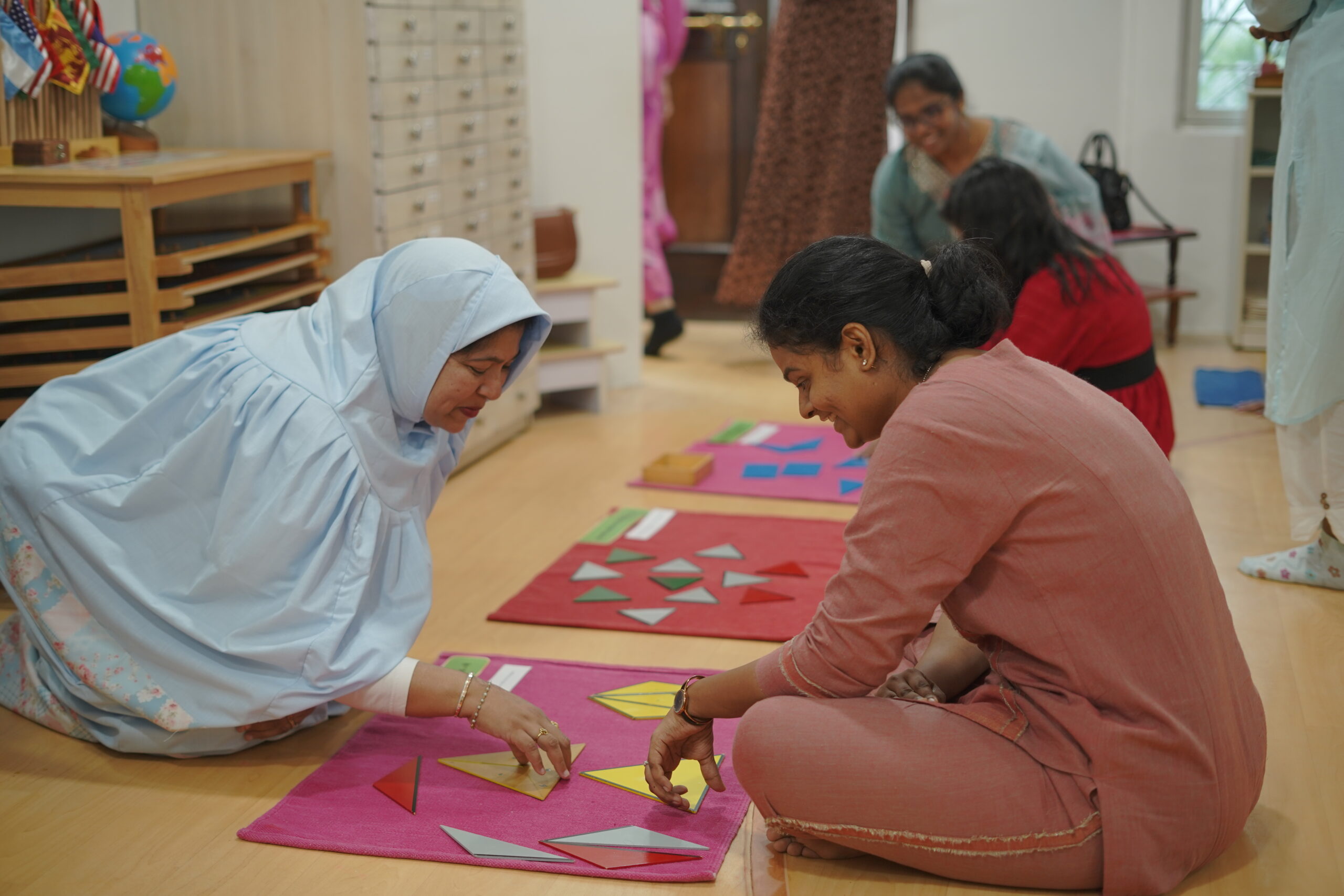
AMI diplomas may be organised as academic-year, summer or modular programmes. A modular diploma divides training into scheduled blocks. It is not a shorter qualification, and completing a single module does not earn the diploma. Some courses combine online learning with in-person sessions, but substantial supervised onsite preparation remains part of diploma training.
For example, the Montessori Training and Research Trust (MTRT) has published a 3–6 summer diploma delivered across three six-week onsite blocks in successive years, with online sessions between them. AMI also lists a modular 12–18 diploma in Hyderabad. These illustrate different ways to organise a complete course, not guarantees of a particular future intake. Before applying, ask about total duration, onsite attendance, observation and teaching-practice requirements, examinations and any work expected between modules.
What is the difference between AMI and other Montessori certifications?
AMI was established by Maria Montessori and follows its own international training standards and assessment system. Other organisations, including the American Montessori Society (AMS), offer Montessori education credentials through their own pathways. Their course structures and recognition arrangements may differ.
Rather than assuming all Montessori certifications are equivalent, compare the awarding organisation, age range, theoretical and practical requirements, and qualification awarded. Also check what prospective schools or local education authorities require. No Montessori training credential should be described as automatically licensing a teacher in every country.
Where can you find AMI Montessori training in Hyderabad?
For Montessori teacher training in Hyderabad, begin with AMI’s official listing for the Montessori Training and Research Trust (MTRT) in Jeedimetla. The directory lists a Hyderabad 3–6 diploma, a 12–18 modular diploma, and a 6–12 diploma associated with Moinabad. MTRT also publishes information about orientation, assistant and other certificate courses, including a 0–3 orientation pathway and 3–6 orientation options, with a Telugu-language option. Not every age level is necessarily available for diploma study locally in each intake, and courses already in progress may not be accepting new students.
For a broader overview, visit Blue Blocks Montessori School teacher training information. To understand how Montessori principles appear in an actual educational environment, explore the Montessori approach at Blue Blocks Montessori School. Blue Blocks Montessori School shares information and opportunities to learn about Montessori training. AMI diplomas are awarded through authorised AMI programmes, not by attending a Blue Blocks Montessori School information session. For school-related enquiries, use Blue Blocks Montessori School contact details.
How do you make the decision?
Ask yourself three questions. Which age group would I enjoy working with every day? Do I want to become a guide, support a guide or first understand the philosophy? Which training format can I realistically complete? Then speak with the training centre about course requirements and, if possible, spend time observing the age group that interests you.
The right Montessori qualification begins with the children you want to understand, not simply the next course available for registration.
Frequently Asked Questions
What is AMI Montessori certification?
It usually refers to AMI’s professional Montessori preparation, offered through AMI-authorised training pathways. AMI offers diplomas for five age ranges, plus orientation, assistant and specialist certificate programmes. A diploma is the principal route for becoming an age-specific Montessori guide.
Can I train for more than one age group?
Yes. Each AMI diploma is a separate qualification, so an educator who wants to work across stages completes each diploma in turn. Many guides begin with one age group and add another later, once they have worked with children and know where their interest lies.
Do I need teaching experience before starting AMI training?
Not necessarily. Diploma courses are open to people from many backgrounds, but each course sets its own academic, age and language requirements. Ask the training centre what it expects from applicants before you plan your timeline.
What does observation involve during AMI training?
Trainees spend set hours observing children in Montessori environments, recording what they see without stepping in. The aim is to learn to read a child’s development and concentration before guiding it, a habit that stays central to the work after qualifying.
How can I prepare before applying for an AMI diploma?
Read Maria Montessori’s own writing, such as The Absorbent Mind, and spend time observing a Montessori environment for the age group you are considering. Attending an orientation course or an information session also helps you test your interest before committing to a full diploma.