



Montessori and Cambridge: How the Two Can Work Together
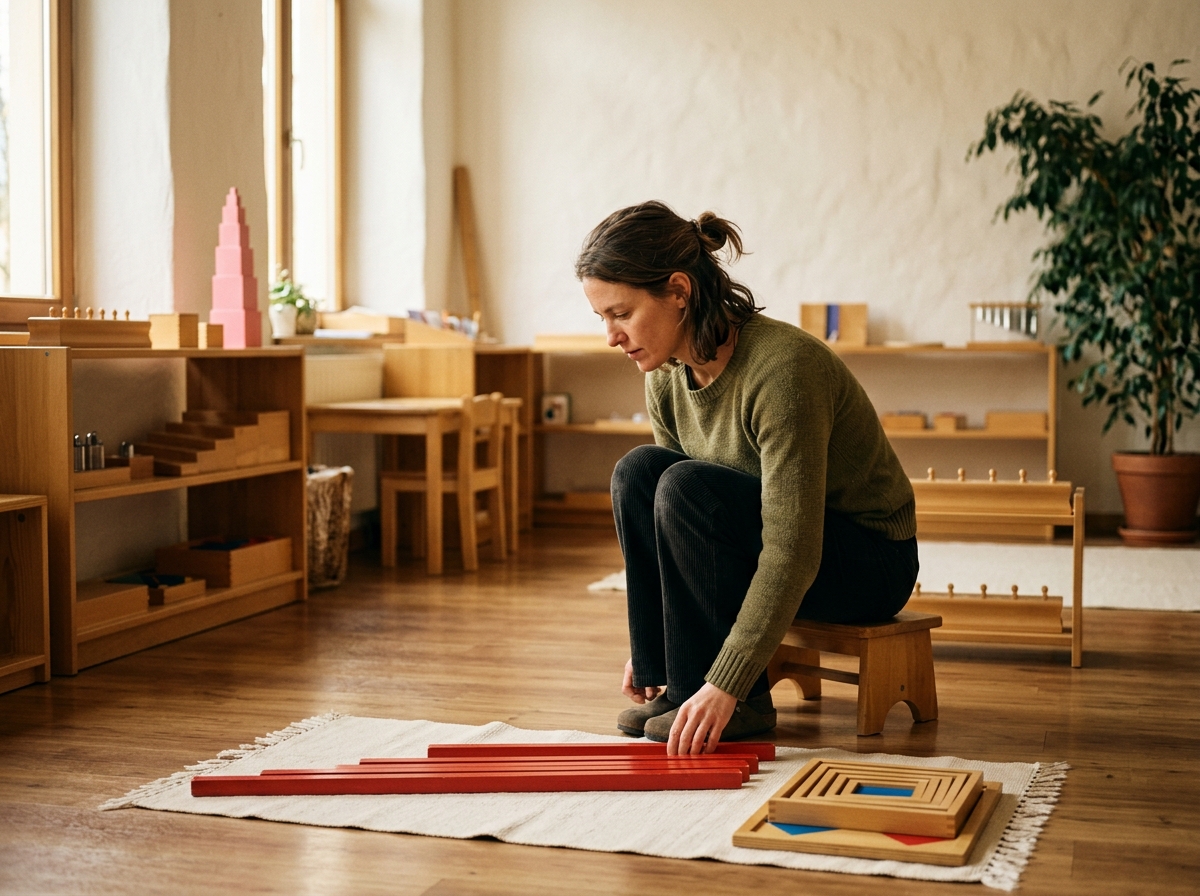
When parents explore the difference between Montessori and Cambridge, it is natural to see them as two options to choose between. It can help to see them differently, because each answers its own question. Montessori is an educational approach: it describes how a child learns and how the adult and the environment support that learning. Cambridge is a curriculum and assessment framework: it describes learning objectives at different stages and offers ways to evaluate progress against international standards. These descriptions are useful starting points, not absolute opposites: Cambridge also encourages inquiry, and Montessori has a rigorous curriculum of its own.
For families, the useful question is not simply Which one is better? It is What kind of learning experience does my child need at each developmental stage, and when will an external benchmark become useful?
The difference between Montessori and Cambridge, in short
Montessori organises learning around development, mixed-age communities, purposeful work, concrete experience and ongoing observation. Cambridge offers subject frameworks, learning objectives and assessment options, including externally marked assessments at designated points. A school can use Montessori as an educational approach and Cambridge as an academic framework, either together or at different stages. Neither label alone tells parents what an ordinary school day will feel like.
Three differences
- Who sets the pace. In a Montessori Elementary environment, a child follows an individual plan, within the responsibilities and expectations of the community, with an AMI-trained guide. Our Elementary guides hold the individual AMI Elementary Diploma (6–12), an educator qualification distinct from institutional AMI school accreditation. Cambridge specifies learning objectives for a stage, while schools decide how to organise teaching and support different learners. A Cambridge curriculum does not, by itself, require a single teaching pace for every child.
- How progress is measured. Montessori guides use observation, the child’s work journal, portfolios and individual conferences to understand the child’s work and development. Cambridge provides flexible school-based assessments, and at certain stages, optional external Checkpoint assessments or qualifications such as IGCSE. Not all Cambridge assessments are external examinations.
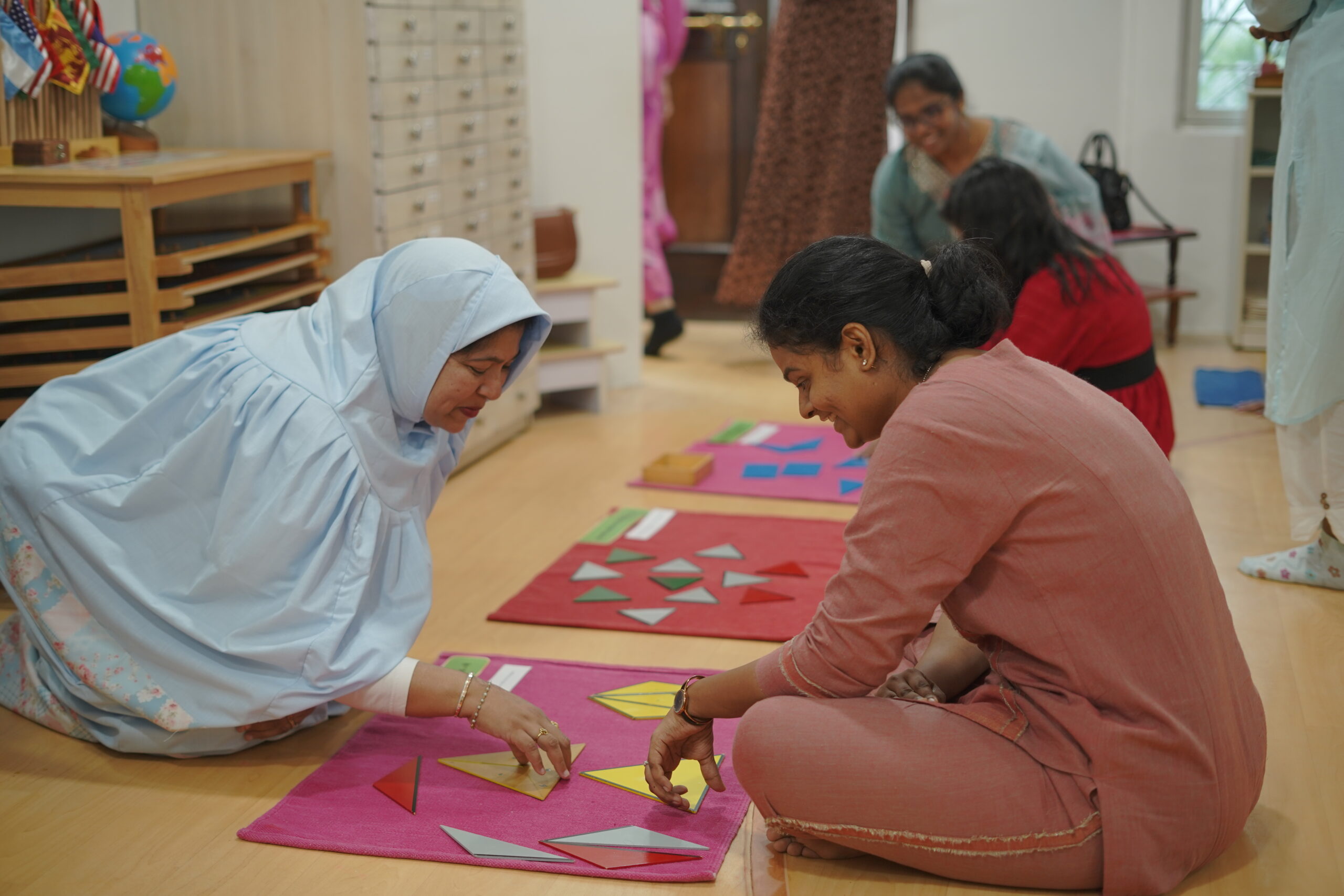
- How subjects are organised. Montessori Elementary uses Cosmic Education to reveal relationships across disciplines. A question about rivers may become a study of geography, biology, history and mathematics. Cambridge provides distinct subject frameworks, but thoughtful teachers can still connect disciplines through projects and inquiry.
Three meeting points
Inquiry: a question can outgrow the subject that began it
Both approaches can support investigation. At Blue Blocks Montessori School, Elementary children plan research trips, known as Going Outs, and contribute to projects associated with the Micro Research Institute, as described in our guide to Montessori elementary education in Hyderabad. A question begins with curiosity; the work that follows calls for observation, evidence and explanation.
Self-assessment: knowing why an answer is weak
Both approaches can give learners feedback on their progress. An especially revealing practice at Blue Blocks Montessori School is the adolescent exercise in which students design their own examination questions and compare three assessments of their responses: their own, their peers’ and their mentors’. This is a practice we use in our adolescent community, rather than a formal requirement of the Cambridge syllabus.
Consider what happens when a student awards themselves a high score but a peer identifies an unsupported assumption. The useful learning is not merely the difference in marks. The student must ask whether their reasoning was clear, what evidence they omitted and whether they could defend their answer. This is one way independent thinking and preparation for formal assessment can reinforce each other.
Depth in mathematics and science
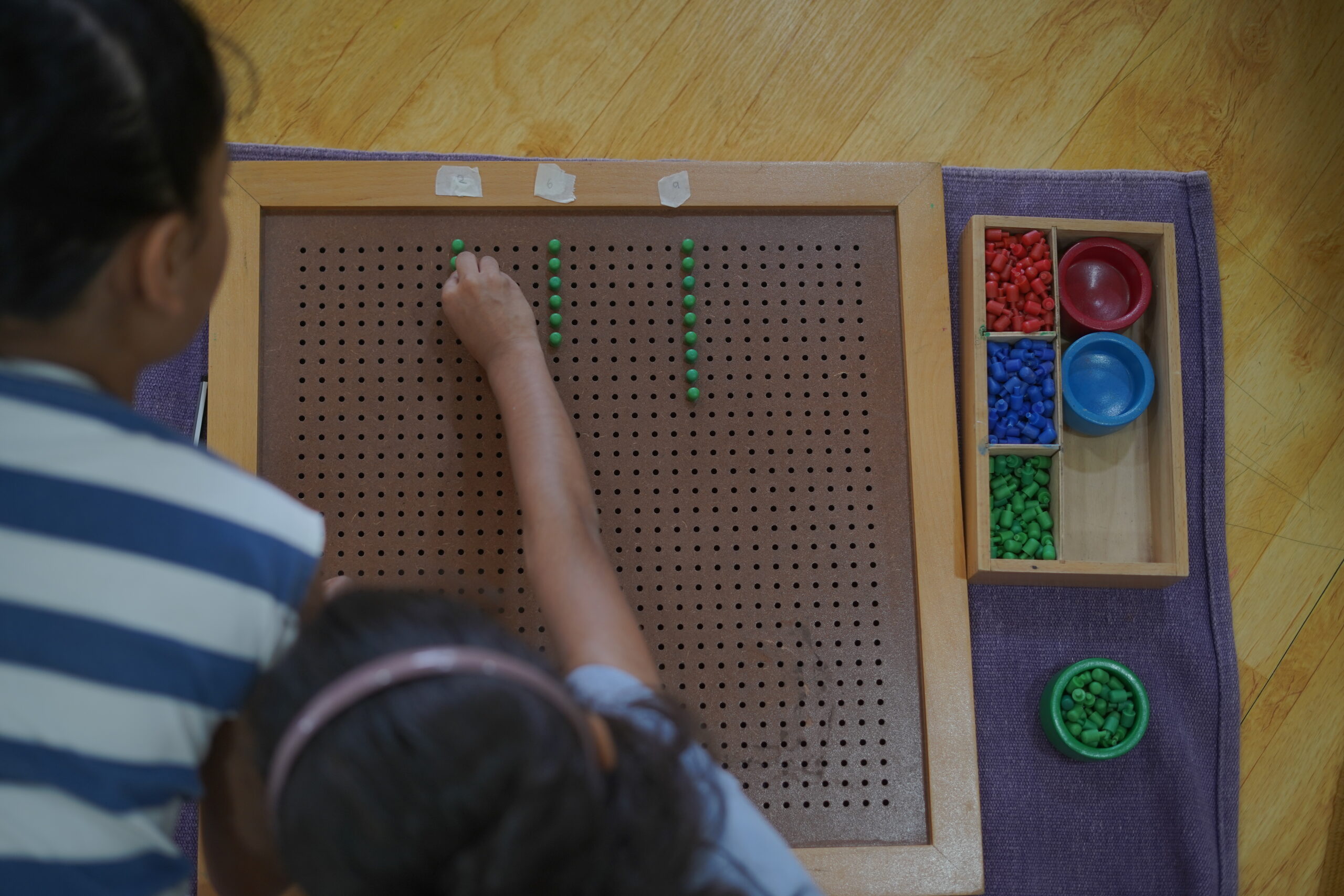
Montessori uses materials and investigations to help children build and test concepts before relying entirely on notation. Cambridge subject frameworks require learners to apply and explain their understanding. The connection is strongest when a child can move from manipulating a concrete quantity to representing it accurately, and from conducting an investigation to defending a conclusion.

Why Blue Blocks Montessori School chose Montessori, not Cambridge Primary, for ages 6–12
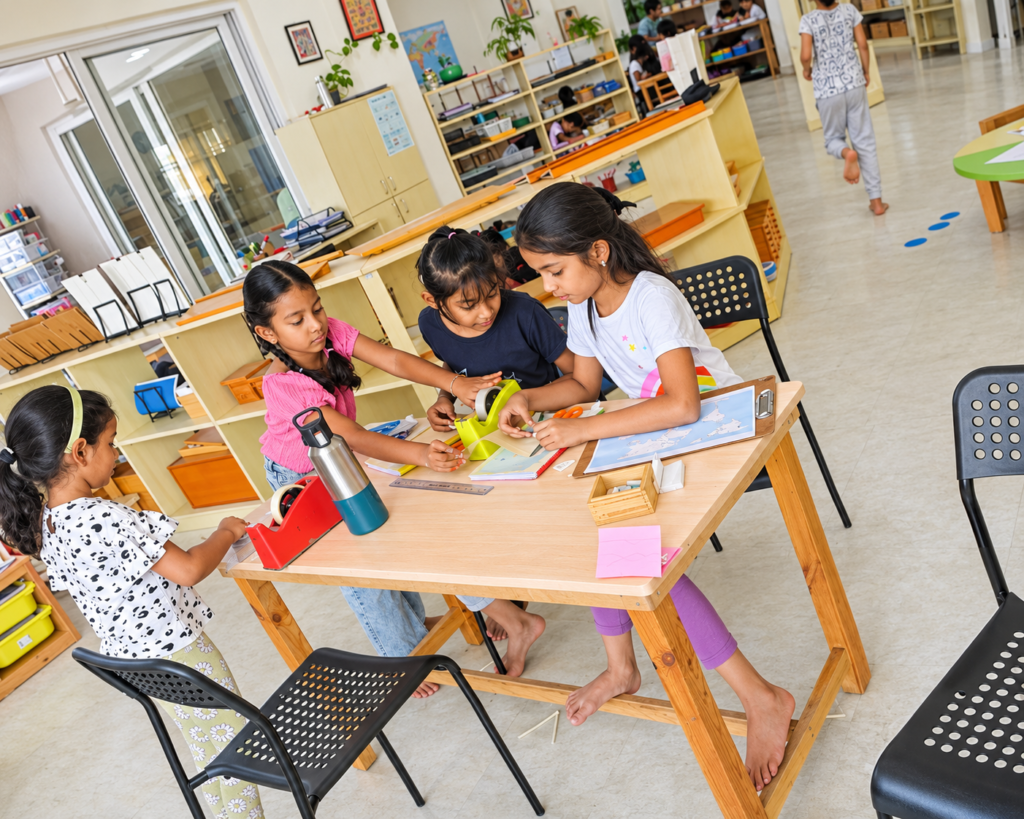
At Blue Blocks Montessori School, Classes 1 to 6 follow Montessori Elementary rather than the Cambridge Primary curriculum. It is a developmental choice, not a criticism of Cambridge Primary. Between six and twelve, children increasingly reason, imagine, question fairness and collaborate. Their questions rarely arrive neatly labelled mathematics, geography or history. Montessori’s six-year Elementary community and Cosmic Education are designed to make space for those connections.
Munira Hussain, co-founder of Blue Blocks Montessori School, reflects:
“We often ask whether a child is ready for an examination. I think we should also ask whether the child has learnt to recognise what they do not understand. An examination can reveal a gap in knowledge, but only a thinking mind can turn that gap into a question worth investigating. For me, the two have to grow together.”
This is why the distinction between preparing for an examination and preparing a mind to think matters. External benchmarks can provide useful information without becoming the organising purpose of every experience that precedes them.
The idea is consistent with a passage in Lining the Nest, Chapter 12, “Education: Aid for Life”, by Pavan Goyal and Munira Hussain. They describe the Montessori educational aim as helping the child “to act, will and think for himself.” The passage addresses the deeper preparation of the person, rather than the successful completion of any one test.
Our research institute has reviewed how self-directed learning environments relate to executive function, including planning, attention and self-control. Another review examines hands-on and lecture-based learning. These reviews inform our approach; they are not presented as proof that a Montessori-to-Cambridge sequence automatically guarantees higher examination scores.
How does Montessori prepare children for the Cambridge curriculum?
Montessori Elementary can give children practice in planning work, researching questions, writing reports, explaining ideas, using mathematical representations and discussing their progress with a guide. Those habits can support later Cambridge learning, though students must also be taught the particular syllabi, examination conventions, command words and time-management demands of formal assessment.
The transition is not automatic. A child who has written a thoughtful research report may still need to learn how to give a concise answer in a timed examination. Likewise, a student who can solve a mathematics problem using materials may need explicit practice expressing the same reasoning in the notation required by a syllabus. A well-designed bridge honours what the child already knows while teaching these new forms of communication.
One practical question for parents is: Does the adolescent programme teach examination technique as an additional skill, or does examination technique begin to replace curiosity and independent work? The difference matters more than the presence of a Cambridge textbook.
How does Blue Blocks integrate the Montessori and Cambridge approaches?
At Blue Blocks Montessori School, Montessori remains the core educational approach as Cambridge syllabi are introduced in the adolescent years at our Tellapur campus:
Ages 6–12, Classes 1–6: The Blue Blocks primary school follows Montessori Elementary, with the Great Stories, long work periods, Going Outs, journals and individual conferences, rather than Cambridge Primary.
Ages 12–14, Classes 7–8: The adolescent programme, informed by Montessori’s Erdkinder ideas, integrates Cambridge Lower Secondary subjects with work in the community and real-world projects. Students sit the Cambridge Lower Secondary Checkpoint at the end of the Lower Secondary stage.
Ages 14–16, Classes 9–10: Students follow the Cambridge IGCSE pathway, with Cambridge examinations at the end of the course. Cambridge IGCSE assessment varies by subject and may include written examinations, coursework, oral work or practical components. See the official Cambridge IGCSE qualification overview.
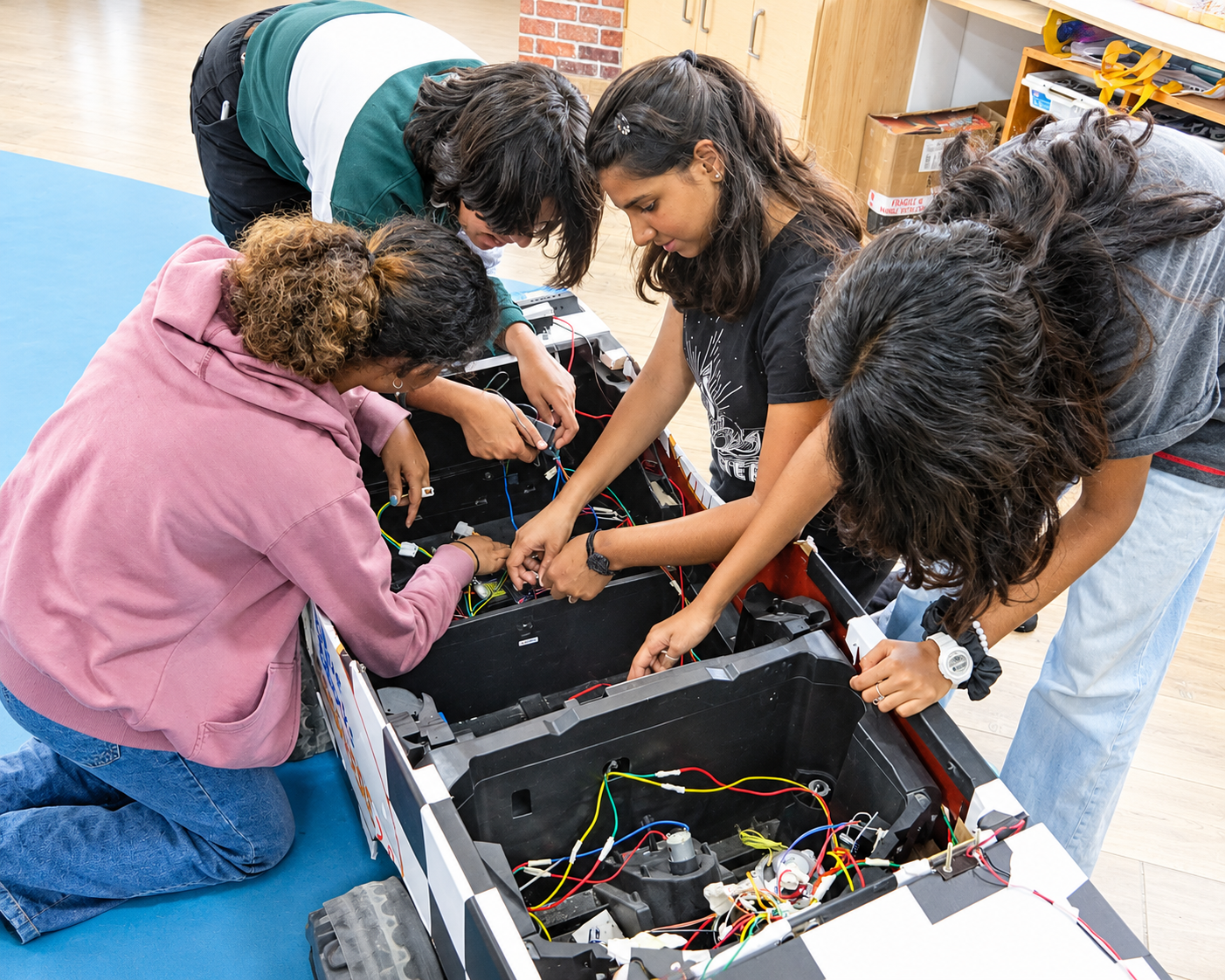
The Blue Blocks secondary curriculum describes how we bring together adolescent learning and academic preparation. Alongside syllabus-based study, students undertake field investigations, engineering, lab work and research. Examples include the Flipside case study, the palaeontology project When Children Enter Deep Time and a Structured Debate case study. These show the breadth of work in our adolescent programme.
Looking for a Cambridge primary school in Hyderabad?
Families comparing a Cambridge primary school in Hyderabad with a Montessori primary should ask what is actually offered, rather than relying on a curriculum label. Some schools teach Cambridge Primary, others describe themselves as Cambridge-aligned, and others, including Blue Blocks Montessori School, introduce Cambridge at a later stage. A Cambridge Primary programme is a distinct curriculum stage and should not be confused with Cambridge Lower Secondary or IGCSE.
Questions worth asking include which Cambridge programme starts in which class, which assessments are school-marked or externally marked, how students develop independent thinking, and what transition support exists before formal examinations begin.
For families in Gachibowli and the Financial District, the school’s toddler and Children’s House provision is at Gachibowli, while Elementary and Secondary programmes operate at Tellapur. Enquiries about Cambridge primary schooling, elementary provision and adolescent admissions can begin through the Blue Blocks admissions process. Parents should verify the current campus arrangements, entry requirements and specific Cambridge assessment sequence directly with the school.
Frequently asked questions
Is Montessori compatible with Cambridge exams?
Yes. Montessori can inform how children learn while Cambridge provides subject frameworks and formal assessment pathways. The combination needs deliberate planning, especially when students move from sustained projects to time-limited examination responses.
Does Blue Blocks offer Cambridge in the primary years?
At Blue Blocks Montessori School, Classes 1 to 6 (ages 6–12) follow Montessori Elementary rather than Cambridge Primary. Formal Cambridge subject frameworks begin in the adolescent years from Class 7 (Cambridge Lower Secondary) and lead into Cambridge IGCSE in Classes 9 and 10.
Can a child move from Montessori Primary or Elementary into Cambridge Lower Secondary?
Yes, although a successful transition requires more than familiarity with the subject matter. The school should help students understand Cambridge syllabi, command words, written assessment formats and time management while continuing to build the research and reasoning habits developed in Montessori.
When do Cambridge assessments begin at Blue Blocks?
Cambridge Lower Secondary learning begins in Class 7, and students sit the Cambridge Lower Secondary Checkpoint at the end of that stage. Cambridge IGCSE follows in Classes 9 and 10, with assessment at the end of each course.
Which campus runs the primary and secondary programmes?
The Tellapur campus serves the Montessori Elementary and Secondary programmes. The Gachibowli campus serves the Toddler Community and Children’s House. Contact the school to confirm any programme or location changes before visiting.