



Montessori Materials That Build Independence in the Early Years
A drinking glass in a Montessori classroom asks something of a child. It has a real weight, must be carried with care and serves a genuine purpose. The same quiet invitation to act with increasing independence runs through the entire Montessori environment.
Independence does not come from a handful of special activities. Montessori materials for nursery children offer opportunities for it throughout the curriculum. Their preparation and use follow interconnected principles: real purpose, accessibility, order, completeness, meaningful choice, repetition and respect for others. A child does not become independent overnight, but every area offers opportunities to practise.
What kind of materials are used in Montessori nursery?
First, a distinction about names. In Montessori terminology, the Children’s House serves children aged 3–6. Families unfamiliar with Montessori often search for a Montessori nursery. At Blue Blocks Montessori School, the programme is described as a Self-Interpretive Environment for children aged 2½–6, encompassing Nursery, PP1 and PP2. The parent search term and the school’s programme name should not be mistaken for different categories of materials.
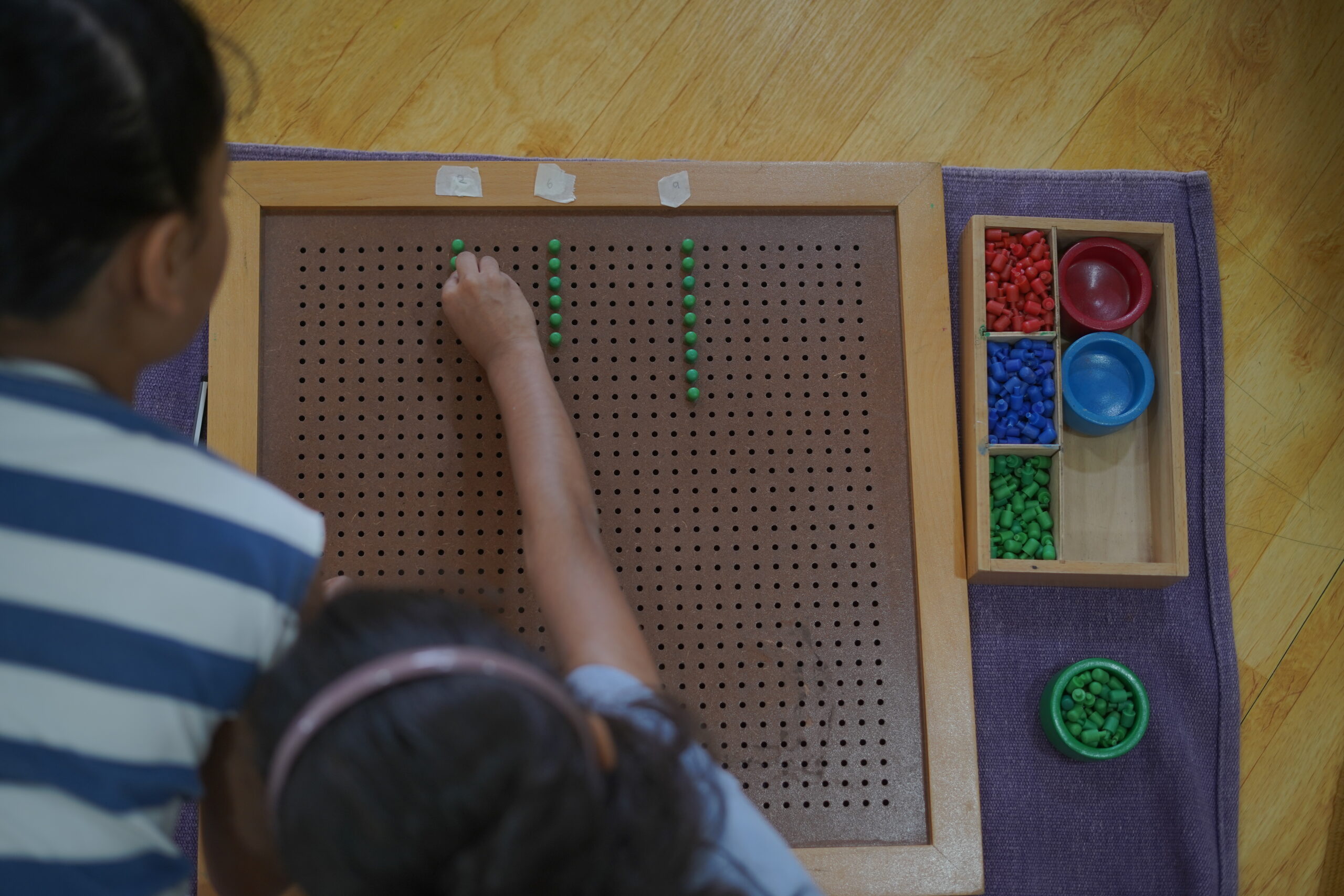
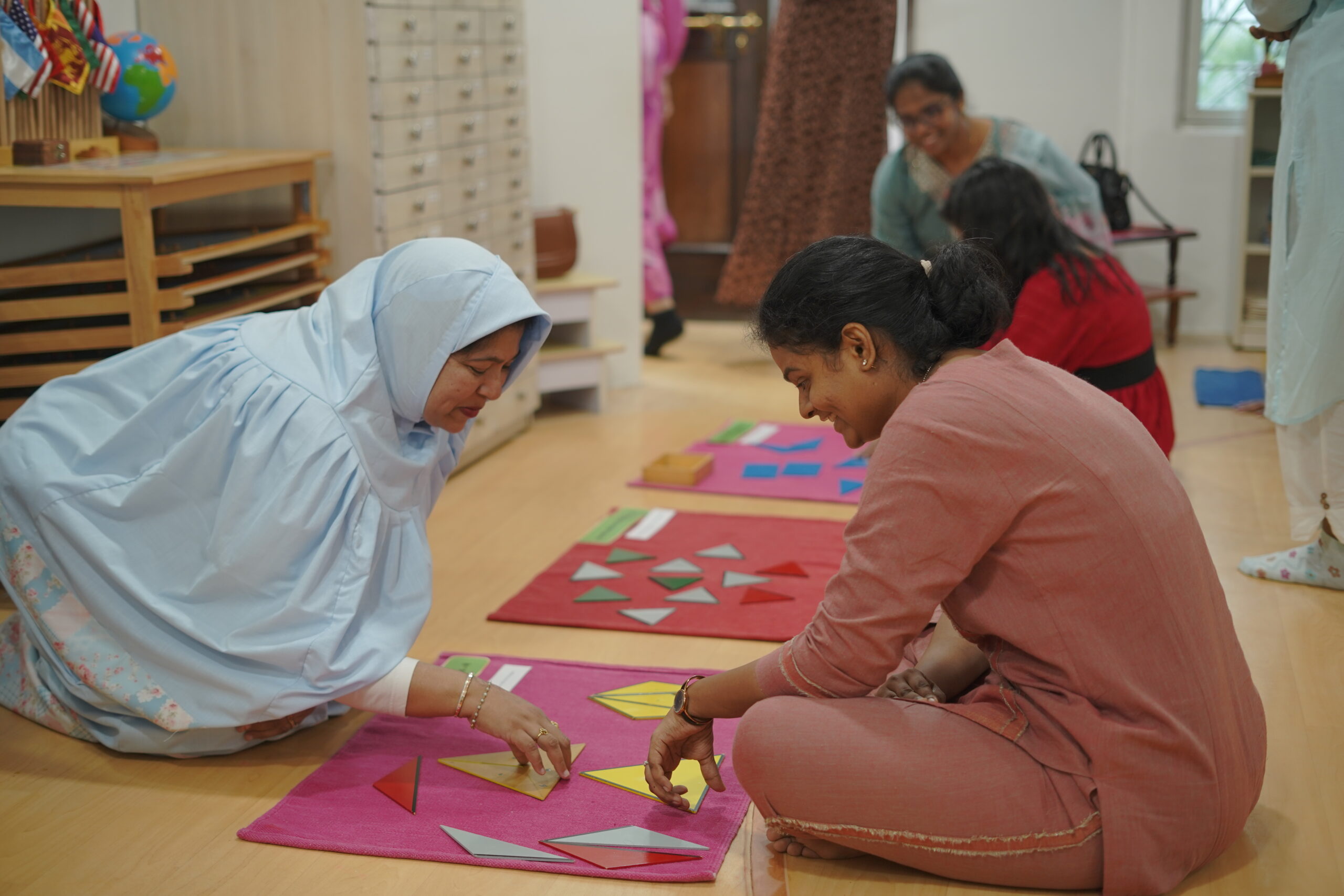
The Children’s House spans five interconnected areas. The practical life activities Montessori nursery classrooms offer, from dressing and food preparation to caring for plants, give the child command of everyday life. Sensorial materials sharpen the senses so the child can compare, judge and organise without asking an adult. Language materials lead to expressing thoughts and, later, reading them for oneself. Mathematics develops an understanding of quantity and relationships, and Culture opens questions about the natural and human world. Practical life activities in a Montessori nursery are only one part of an integrated curriculum. Independence is supported across all five areas.
Montessori materials for nursery children: the principles behind independence
Real, not pretend
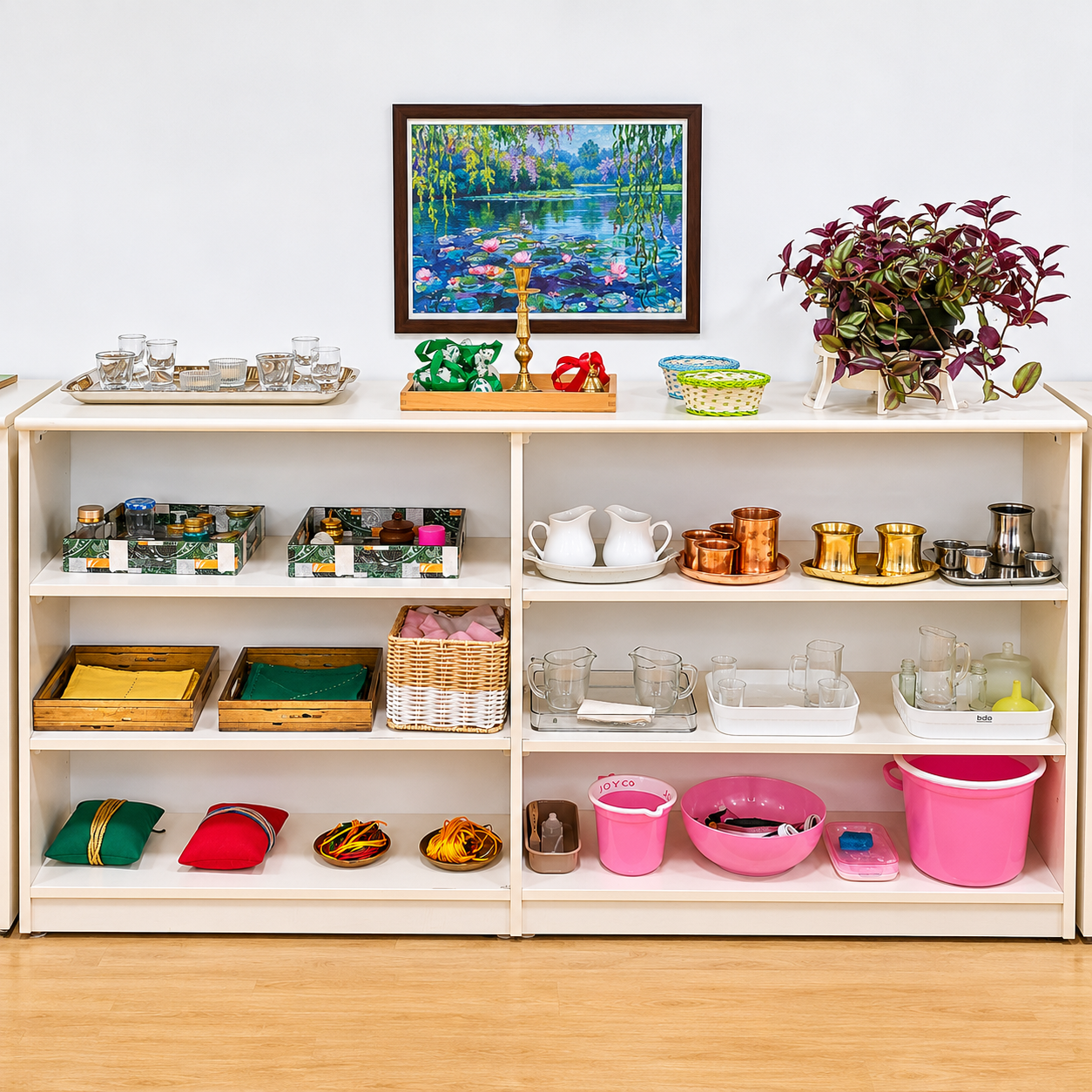
Montessori offers meaningful contact with real objects where developmentally appropriate: a drinking glass, a tool suitable for preparing food, or a cloth that really cleans. These objects have weight, texture and purpose, so children experience the consequences of what they do, within sensible safety limits.
A study by Blue Blocks Montessori School’s Micro Research Institute Rhythm, Environment, and Autonomy shows how much thought many families already put into independence at home: parents most often changed child-sized furniture and crockery. It also points to a natural next step. Once a home fits the child, it can begin to trust the child: a real glass at the table (Blue Blocks Montessori School’s guide to creating a positive mealtime environment shows how), a small knife for soft fruit, a cloth and a corner the child looks after. If your home has already made the first change, you are halfway there.
A separate study by Taggart, Heise and Lillard (2018) asked 100 preschool children to choose between real and pretend versions of activities. Real activities were generally preferred, increasingly so between ages three and four.
Proportioned to the child
Chairs, tables and practical tools are suited to a child’s size and strength. A jug that can be lifted or a cloth that fits small hands makes participation more possible without an adult performing every step. Suitable size gives the child control over the action.
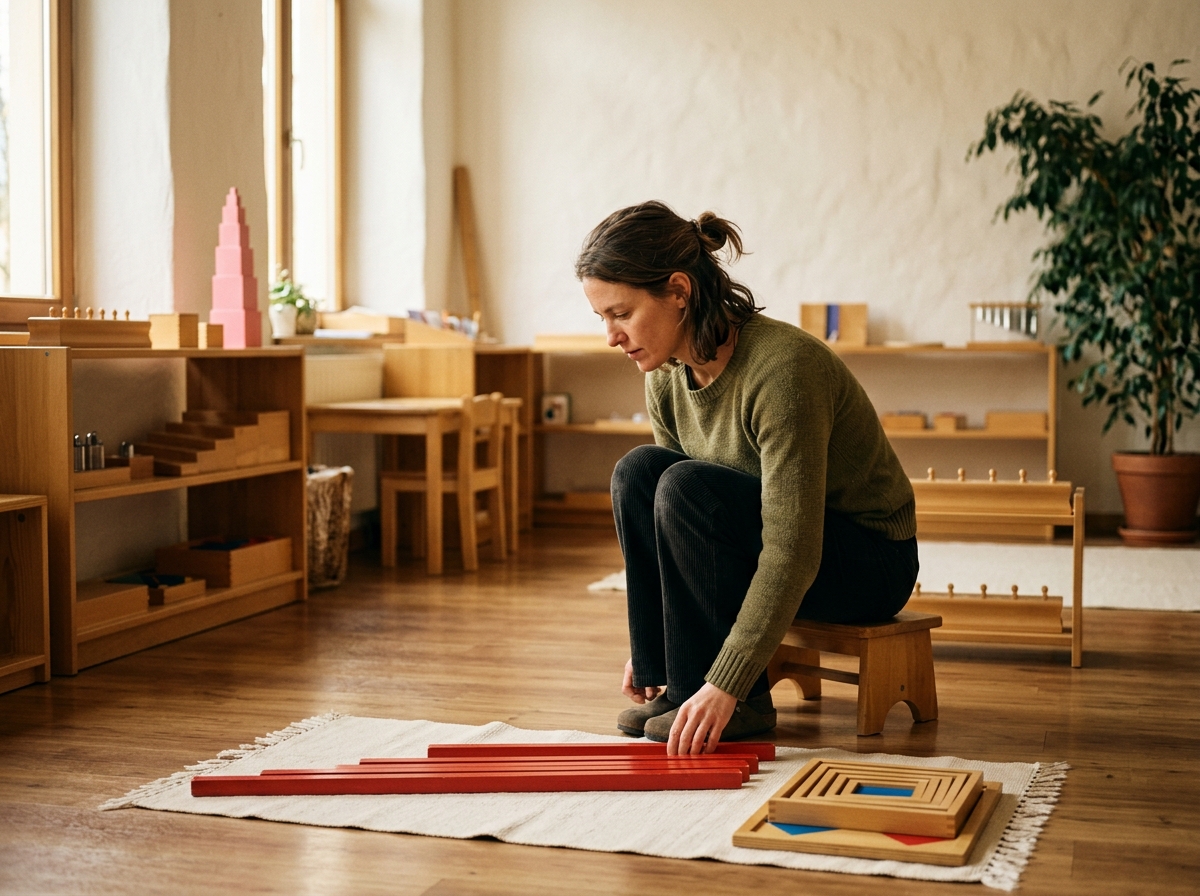
A fixed place for everything
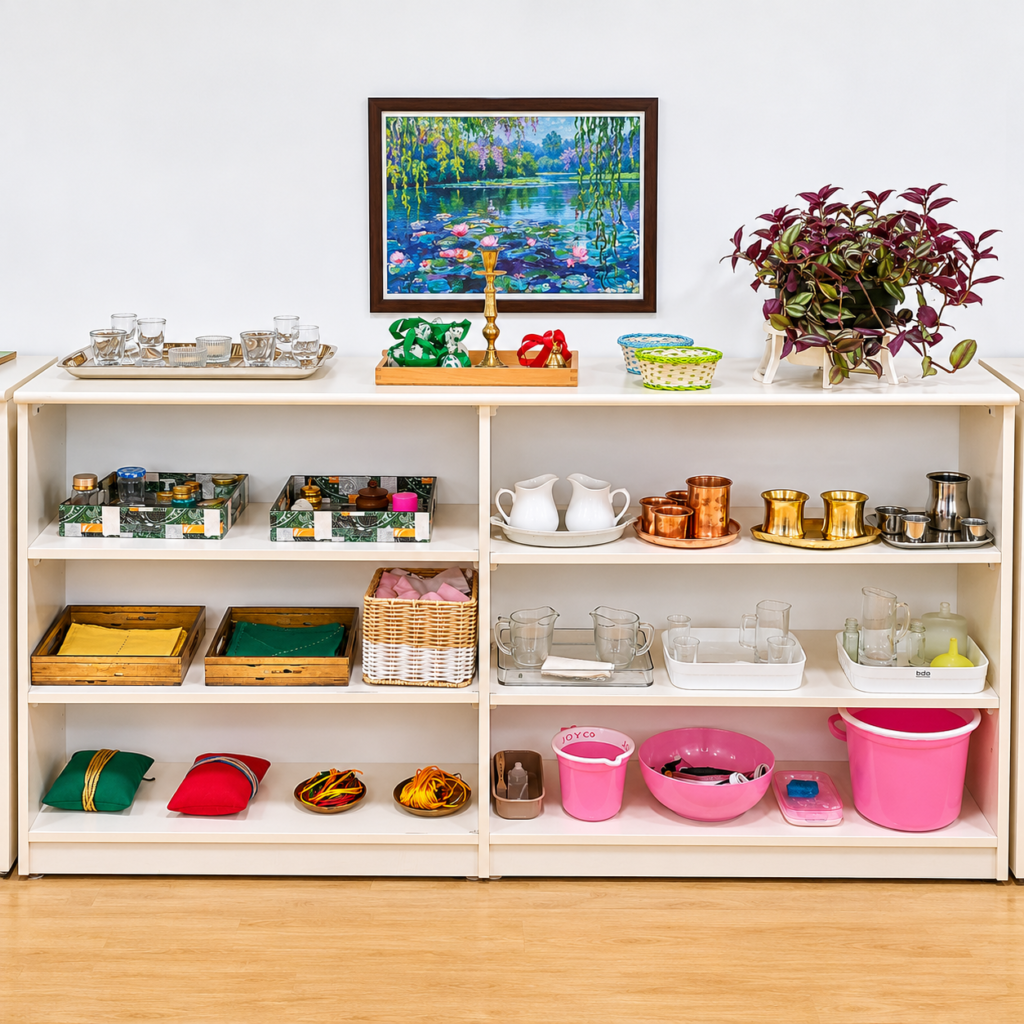
Every material has an established place on accessible shelves, organised according to the Montessori progression rather than rearranged for an individual child. Each day, the guide checks that materials are complete, accurate, clean and correctly placed. A child can find familiar work and return it without repeatedly asking where it belongs. In the BBMRI home observation dataset, parents described children noticing when objects moved or familiar sequences changed, which shows how much young children rely on that consistency.
Complete and ready
An activity is prepared with what is required for its purpose, often brought together on a tray or in a basket. The child need not stop halfway because something is missing, so beginning, completing and restoring the work all belong to the child. A BBMRI observation study in a toddler environment, Return-to-Shelf Behaviour and Engagement Duration, looks closely at how often young children complete this cycle on their own.
During a washing cloth activity in our Children’s House, a child returned the basin and brush to their places, then stopped on the way to her next work. A little water was still on the floor beside the table. She went back for a cloth, dried the patch and returned the cloth before choosing something else. Her guide observed the sequence from a distance. The significant moment was not simply that the child could wash a table: she recognised that the work was complete when the shared space was ready for the next person.
One of each
Many Montessori materials are available as a single set. If someone is already using one, another child can wait, observe respectfully or choose different work. This natural limit lets children consider another person’s rights without an adult arbitrating every choice.
Freedom within limits
Children choose from activities they have been appropriately introduced to, decide where to work and have opportunities to return to familiar work. They are also expected to respect other children’s concentration, use materials as intended and care for the shared environment. Freedom makes initiative possible. Limits make shared freedom possible.
Grace and courtesy
Montessori treats social independence as something that can be practised. Grace and Courtesy presentations show children how to offer help, ask to join, pass someone at work or disagree respectfully. In a mixed-age community, children also cooperate and learn from one another. Independence is not isolation. It includes knowing how to seek help and how to contribute.
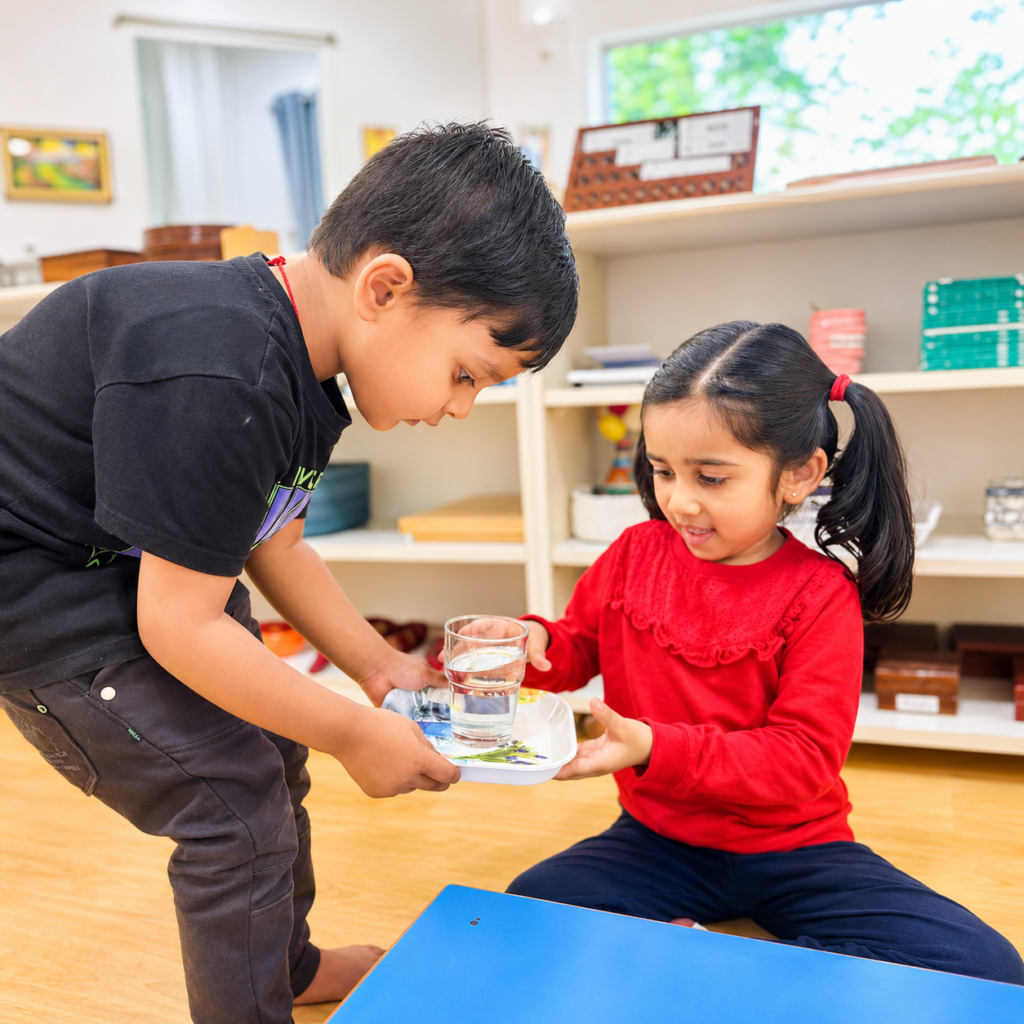
In Lining the Nest, Chapter 5: Social Development: Opening Wings to the Outside World, Pavan Goyal and Munira Hussain explain that grace and courtesy go beyond saying “please” and “thank you”. They also involve giving other people space and respecting their needs. In a Children’s House where materials are shared, this becomes a practical experience: a child can want something and, at the same time, learn to respect another child’s right to finish using it.
Feedback the child can notice
Some materials offer information through what happens during their use. A child may notice that an arrangement is incomplete or that a movement needs adjusting. This can give the child an opportunity to review their own work rather than depend immediately on adult judgement. BBMRI’s review of hands-on and lecture-based learning explores why learning through doing tends to last longer than learning by being told.
“When a child finishes an activity, it is tempting to tell them immediately whether they have done it well. But if we answer before the child has had time to look again, they can begin to depend on our judgement. I would rather a child learn to pause, notice what has happened and decide what to try next. The confidence that matters grows when children discover that their own thinking can guide them.” – Munira Hussain, Co-founder, Blue Blocks Montessori School
How does Montessori nursery encourage independence?
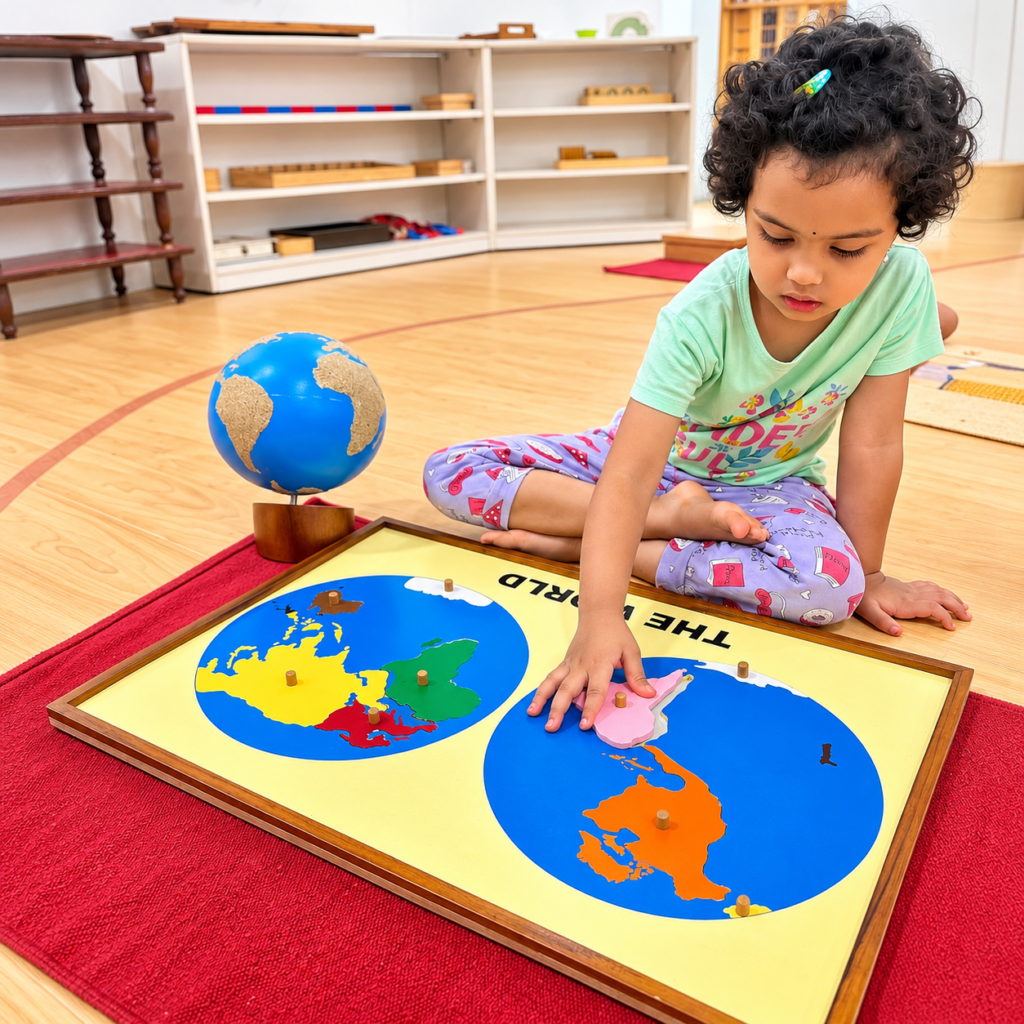
Through opportunities repeated across the day, not one ‘independence lesson’. The guide introduces an activity, observes the child’s readiness and supports its use. A child who knows the work can choose it again, refine a movement, complete it and return the material. Repetition the child chooses is an opportunity to build mastery, not a performance to rush. When help is needed, giving it is part of good Montessori practice, not a failure of independence.
The BBMRI paper adds a distinction from family life: parents reported established self-care abilities but more variable opportunities for children to initiate household tasks or manage wider sequences. Performing one action is not the same as having the chance to take responsibility for a complete activity.
One way to understand how Montessori builds confidence in kids is to consider what they discover through meaningful activity. A successful attempt, an imperfect attempt respected by an adult, or a task completed with some help can all strengthen a child’s growing sense of capability.
Finding a Montessori nursery near Gachibowli
Families looking for a Montessori nursery or pre-primary school near Gachibowli may not know the formal Montessori term. The Montessori name for this 3–6 environment is Children’s House. At Blue Blocks Montessori School, children aged 2½–6 attend its Self-Interpretive Environment, which corresponds to Nursery, PP1 and PP2. Our Children’s House guides hold the individual AMI Primary Diploma (3–6), a specialised educator qualification distinct from institutional AMI accreditation.
Explore the nursery programme at Blue Blocks Montessori School, read about the Montessori approach at Blue Blocks Montessori School, or see the Blue Blocks Montessori School campuses. When considering a school, look beyond the number of materials on display: notice whether children can find familiar work, make appropriate choices, protect others’ work and participate in restoring the environment.
One change to try at home
Before buying another activity, notice whether your child can reach, use and put away something they already need every day. A small cloth for spills or a designated place for a bag can build genuine responsibility. If your child is ready for a small real vessel or tool, demonstrate it carefully, supervise, keep its place consistent and welcome imperfect attempts. For further practical ideas, explore the Blue Blocks Montessori School parent resources.
A Montessori environment supports independence not by demanding that a child do everything alone, but by making meaningful participation possible throughout the day.
Frequently Asked Questions
Should parents buy Montessori materials for home?
Not necessarily. Many specialised materials are designed to be presented by a trained guide in a planned sequence. At home, everyday objects that fit a child’s hands, such as a small jug, a cloth or a basket for their things, often do more for independence than a purchased set.
What if my child breaks a real glass or plate?
Breakages happen, and they are part of learning to handle real objects with care. Stay calm, keep the child safe from sharp pieces, and involve them in clearing up what is safe to touch. Offer the object again once they are ready, with a slower demonstration.
How many activities should be on a shelf at home?
Fewer than most parents expect. A small number of complete activities, each with its own place, is easier for a child to choose from and put away than a crowded shelf. Rotate items when interest fades rather than adding more.
Do Montessori materials replace toys?
No. Books, open-ended play and outdoor time still matter. Montessori materials and real household tasks add something different: purposeful work a child can begin, complete and restore on their own.
Is there a Montessori nursery near Gachibowli?
Families exploring a Montessori nursery near Gachibowli can learn about Blue Blocks Montessori School’s Self-Interpretive Environment for children aged 2½ to 6, encompassing Nursery, PP1 and PP2. Parents can attend a Saturday admission workshop to experience the prepared environment without interrupting the children’s morning work.