
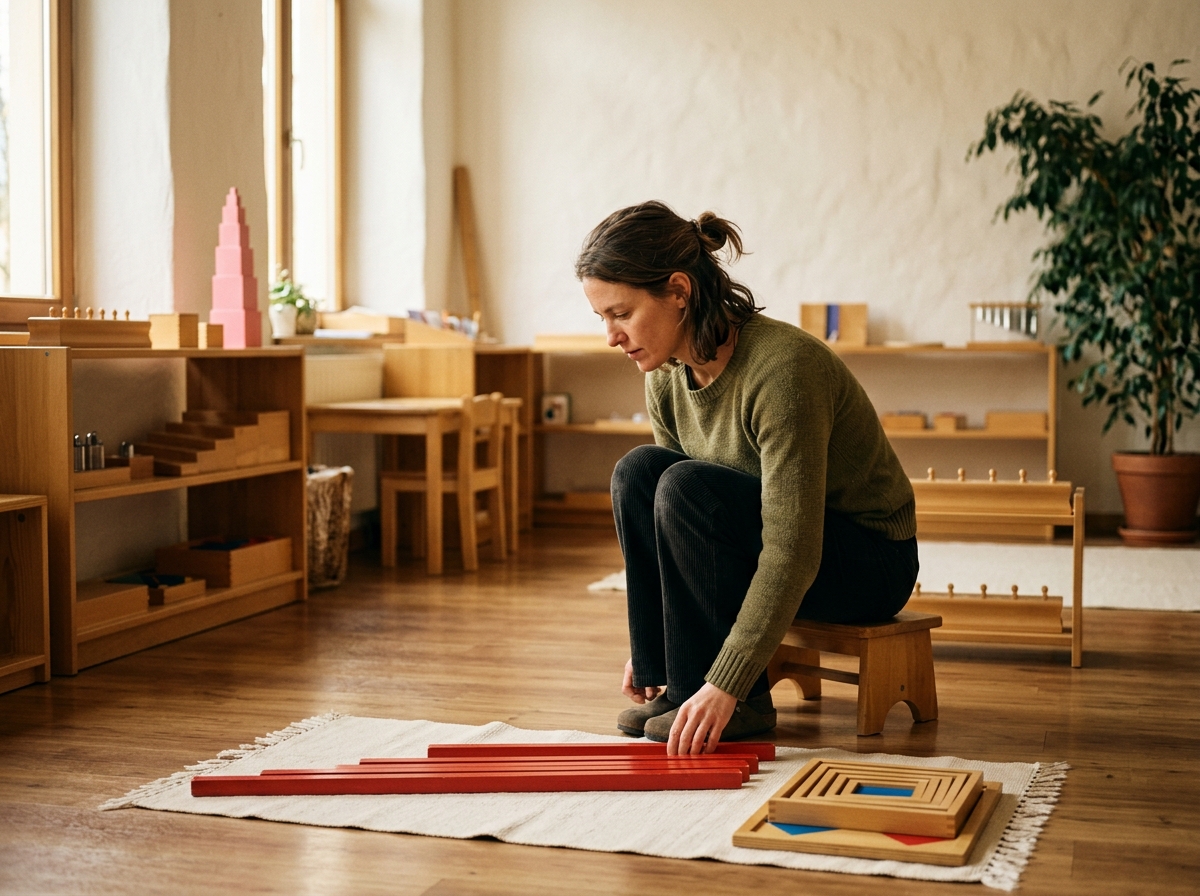




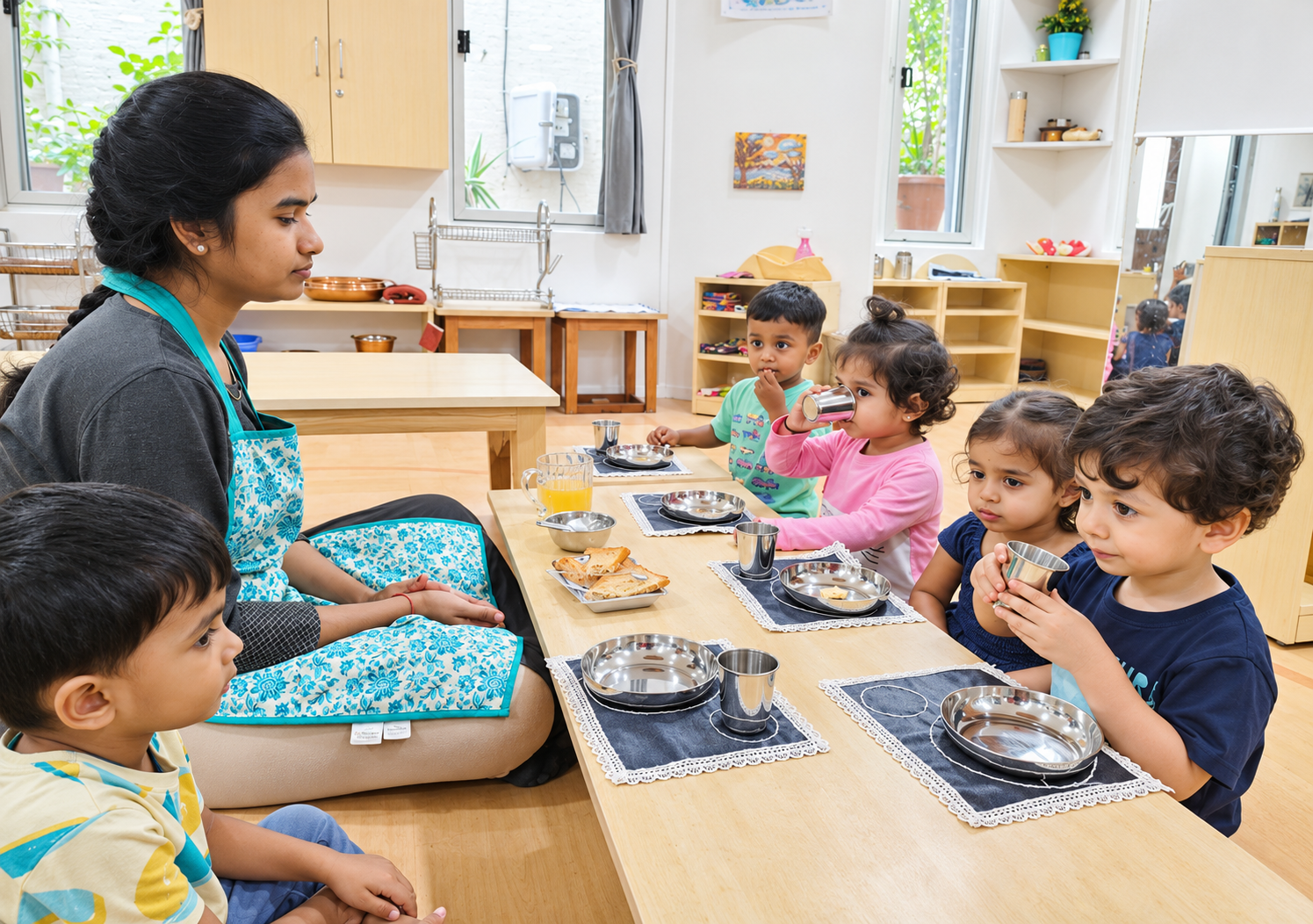
Helping Toddlers Become Independent at Home: Montessori Routines
“Me do it!” may be the most important sentence a two-year-old says. It tends to arrive at the least convenient moment, usually with one shoe on and the door already open.
Then comes “Again!” when the same story has just been read. And “No!” precisely when it is time to leave the park.
These are not three problems for a parent to solve. Each can be an invitation to understand what the toddler is trying to do: take part, make sense of something familiar, or have a voice in what happens next. That is where the question of how parents can support toddlers at home becomes more useful than another list of activities.
“Me do it!”: give the child a real part in the job
Dressing is complicated. A toddler might want to do everything, yet be able to manage only one movement. Rather than choosing between doing it all for the child and expecting them to do it alone, share the task.
Start with the last manageable step. You guide the sock over the toes, and your child pulls it up. You hold the trouser legs open, and they push a foot through. You steady the shoe, and they fasten the strap. As coordination develops, offer an earlier step too. This is sometimes called backward chaining, but it need not feel like a lesson.
Choose clothes your toddler can manage, such as elastic-waist trousers, loose T-shirts and shoes with simple fastenings. Keep them within reach and encourage your child to dress independently, offering help whenever needed. A Blue Blocks Micro Research Institute (BBMRI) preprint, Rhythm, Environment, and Autonomy, draws on parent-reported records from 99 Blue Blocks Montessori School families in Hyderabad, collected in January and February 2026. It describes a revealing gap: a child may demonstrate a dressing skill in calm conditions, yet need more adult direction on a rushed school morning. These are associations, not causal findings. The practical question is whether the home routine gives the child a genuine opportunity to use a skill they already have.
On an unusually rushed morning, the adult may need to finish the dressing. That does not undo the child’s growing ability. Ask instead, “What is one part my toddler can meaningfully do today?”
“Parents often ask me how to make their toddler more independent. But I sometimes wonder whether we are measuring the wrong thing. Picture a child trying to put on a shoe: one hand is pulling the strap while the other holds a parent’s arm for balance. That child is not failing at independence because they still need someone. They are finding the courage to try because someone they trust is nearby. To me, independence is not about how quickly a child stops needing us. It is about the confidence they develop to attempt something for themselves.”
Munira Hussain, Co-founder, Blue Blocks Montessori School
“Again!”: repetition is also a request to connect
A toddler asking for the same song or book again may be enjoying familiarity, anticipating what comes next, practising a movement or inviting another shared moment. Repetition offers opportunities to participate, not just to hear the same words.
The valuable part is often the exchange. While washing spinach, you might say, “The water is cold.” Then pause. Your child may look, point, say “cold”, or offer an expression you recognise. Respond to that contribution. If they notice a bird, follow the bird rather than returning immediately to your planned explanation. Name real objects naturally, and leave room for the child to respond.
A 2018 study in Pediatrics followed 146 children and found that conversational turns at 18–24 months predicted later language outcomes in that sample, even after accounting for family socioeconomic status. It was observational, so it does not establish that counting turns will cause a particular outcome. The practical message is simpler: talk with your toddler, not only to them.
Blue Blocks Micro Research Institute’s study of language and multilingualism in home environments describes rich conversation across languages in Hyderabad families. Its parent-reported sample included children approximately aged 2–6, so the results should not be presented as a toddler-only finding. They do, however, offer a reminder that families can speak naturally in English, Telugu, Hindi, Urdu or whichever languages belong to their daily lives. Conversation need not wait for one language to be mastered first.
For parents wondering about toddler communication development in playgroup, a useful thing to observe is whether adults notice a gesture or word, respond meaningfully and allow the child another turn.
“No!”: a child can have a voice without controlling the boundary
A toddler who refuses to leave the park may be deeply engaged in play. The adult still has to decide when it is time to go. The aim is neither to negotiate every boundary nor to make sure a child never becomes upset.
Connect the transition to something the toddler can understand: “Two more turns on the slide, then we put on our shoes.” Offer a real part in the next step: “Would you like to carry your hat or hold my hand?” If the child cannot choose, the adult follows through with appropriate help.
When the protest continues, a short acknowledgement can be enough: “You wanted to stay. It is hard to leave.” The feeling may remain, and the boundary can remain too. Transitions are not successful only when they happen without tears. Toddlers also learn through being helped with disappointment.
Different families will use different sequences. Grandparents, parents and other caregivers can agree on a few recognisable steps while allowing flexibility in who carries them out and how much help the child needs on a particular day.
In Lining the Nest, Chapter 7: “Independence: Help Me Help Myself”, the child’s imagined voice says, “Although I’m ready to put a small gap between us, I still need you and your reassuring smile.” The passage captures an important truth about toddler independence: wanting to act for oneself does not mean wanting to lose the security of a familiar adult. A child can be upset by a boundary and still need the relationship that makes that boundary feel safe.
How parents can support toddlers at home: invite a contribution before completion
Independence is sometimes confused with self-sufficiency. Yet a toddler who carries one napkin to the table, puts a used cloth in the basket or brings a sandal to the doorway has taken part in actual family life.
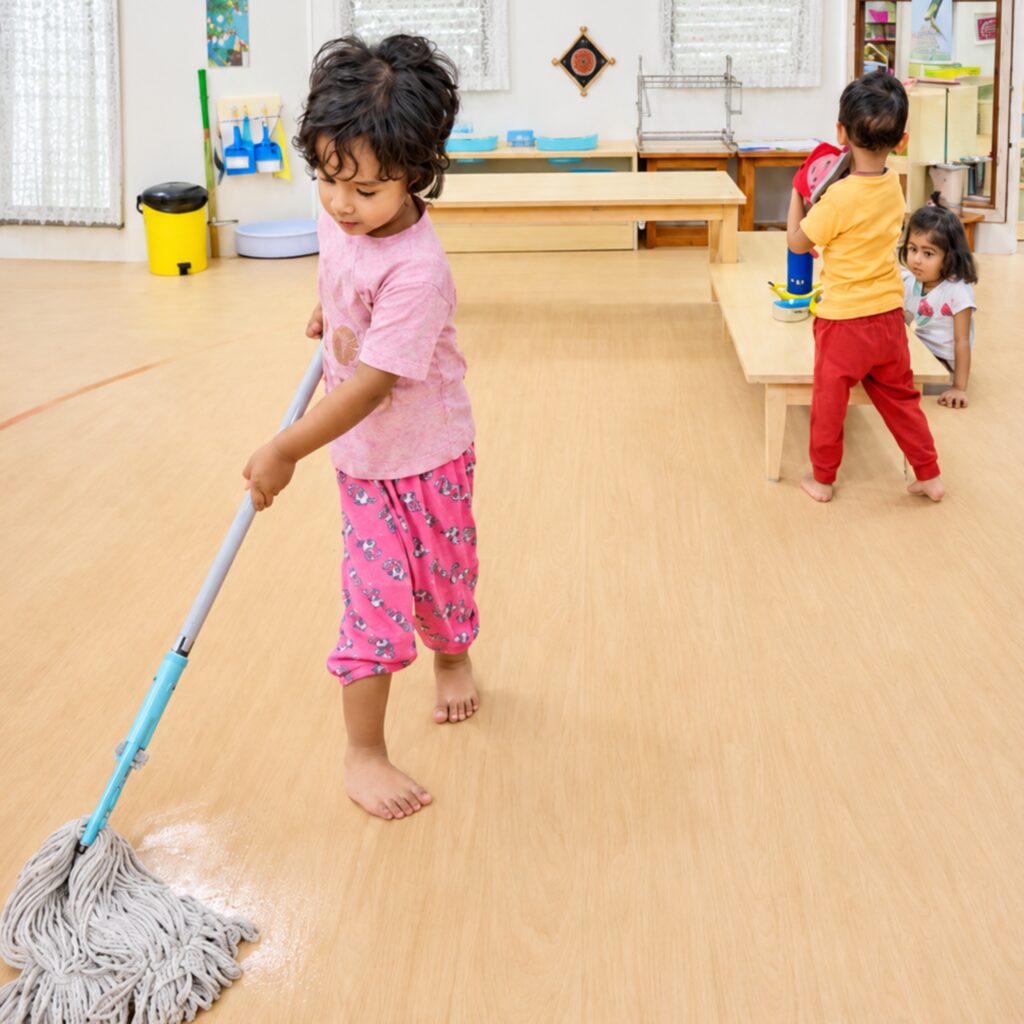
In a 2006 Science experiment, children as young as 18 months helped adults achieve simple goals. It was a laboratory observation, not proof that household chores produce independence. It does challenge the idea that adults must wait until children can perform a whole task before inviting them to contribute.
Keep the invitation safe and proportionate. A toddler might wash a sturdy vegetable while an adult uses the knife, or wipe a small spill while an adult manages anything slippery or hazardous. Participation should never require access to sharp tools, hot surfaces, cleaning chemicals or choking hazards.
A child’s contribution is real even when the adult completes the rest.
What happens after the activity matters too
In Montessori, children are introduced to a complete work cycle: choosing familiar work, engaging with it and returning materials so that the environment is ready for someone else. At home, that may mean putting a brush back in its basket or carrying a small cloth to its usual place. The adult may still need to help.
A particularly relevant BBMRI publication, Return-to-Shelf Behaviour and Engagement Duration in a Toddler Montessori Environment, examines toddler engagement and the completion of activity cycles. Its accompanying classroom observation dataset covers six toddlers and young children across three afternoon sessions, 24–26 March 2026. It records whether work was completed independently, left unfinished or followed an adult prompt. These are descriptive observations from a small group, not evidence that insisting on tidying will cause greater independence at home.
This reveals something a Montessori guide has to learn to see: a tidy shelf does not tell the whole story. One child may have chosen to return a material; another may have done so only after repeated adult instructions. The shelf looks the same, but the child’s experience of responsibility is different. At home, notice not just whether the cloth has been put away, but who remembered, initiated and completed that last step.
These observations encourage adults to notice the whole experience, not just the moment a child begins: How long does an activity hold interest? Does the child need help to finish? Can returning one object become part of the routine without turning it into a battle?
How does Montessori method support toddler independence?
Montessori supports toddler independence by preparing opportunities for movement, language, coordination, choice and participation within safe, predictable relationships. The guide observes each child, presents how to use a suitable material and allows time for repetition, stepping in when assistance is genuinely needed rather than completing the work on the child’s behalf.
At home, the same principle is less about buying Montessori materials than preparing ordinary routines for participation. A low hook makes it possible to put away a hat; a cloth within reach makes it possible to attend to a small spill. The adult remains responsible for safety and limits, while the toddler gains a real part in the work.
How do Montessori materials support early development?
Materials that encourage children to place objects into containers, explore shapes and use appropriately sized household tools support coordination, movement and discovery. Young children are also drawn to real tasks: a study in Developmental Science found that while three-year-olds chose real and pretend versions of activities about equally, by age four children strongly preferred the real thing, such as actually cutting vegetables or washing dishes. BBMRI’s review of hands-on and lecture-based learning looks at why doing tends to stay with children longer than being told. At home, simple arrangements such as a low hook, a stable stool, familiar books and safe everyday objects can provide meaningful opportunities for learning and independence.
For a closer look at one area of daily independence, Blue Blocks Montessori School’s article on helping toddlers eat by themselves explores self-feeding, while its article on creating a positive mealtime environment explores the setting around the meal. The school’s parent resources offer further guidance. Here, the focus is broader: making room for participation across an ordinary day.
Could movement be one of the earliest lessons in independence?
A toddler trying to put on trousers must briefly balance on one foot. Carrying a small jug or walking up a low step asks for coordination, balance and judgement. Before these actions look like independence, the child has to discover what their body can do.
At a gross motor workshop held at Blue Blocks Montessori School, toddlers and parents came together in the outdoor play area. Its significance for families lies beyond the playground itself. When a toddler hesitates at a step, changes direction or reaches for an adult’s hand, the question is not simply, “Can they do it yet?” It is also, “What are they learning to judge for themselves?” A child can be developing independence even while asking for support.
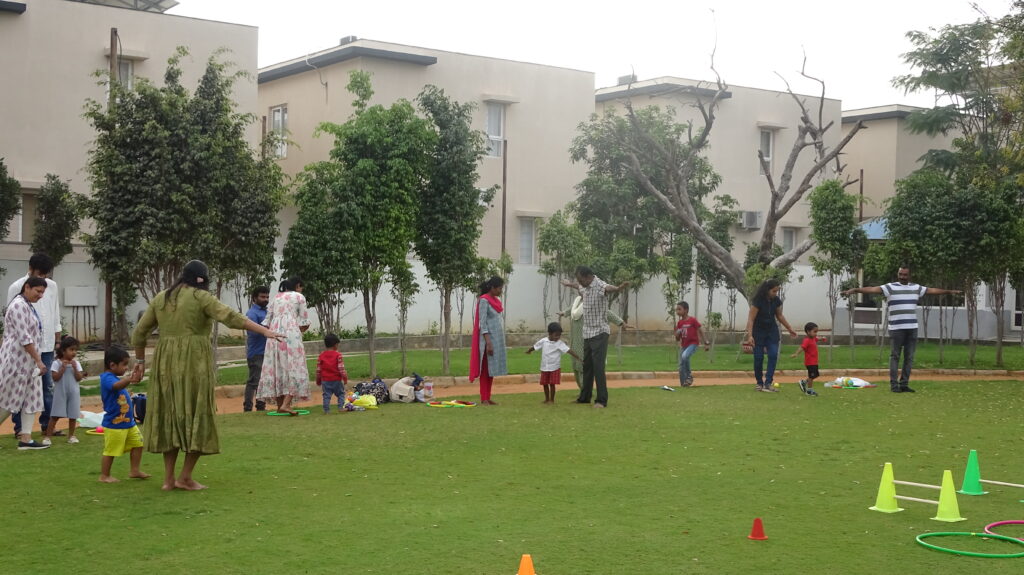
In a 2019 review of motor development, developmental psychologists Karen Adolph and Justine Hoch explain how acquiring motor skills opens new opportunities for exploration and learning. Their review does not evaluate this workshop or show that one event produces independence. It does help explain why movement belongs in the same conversation as dressing, language and practical life.
At home, invite your toddler to carry a light basket, navigate a safe low step or place something on a hook within reach. Stay close, judge risks carefully and offer a hand when necessary. The aim is not to make children complete physical challenges alone, but to let them discover what they can manage through repeated, supported attempts.
What this looks like in the Blue Blocks Toddler Community
At Blue Blocks Montessori School, the Toddler Community offers experiences in purposeful movement, language, care of self, care of the environment and shared life with other children. Fruit preparation is one example among many, alongside opportunities to handle materials, take part in daily routines, interact with other children and practise returning work to its place.
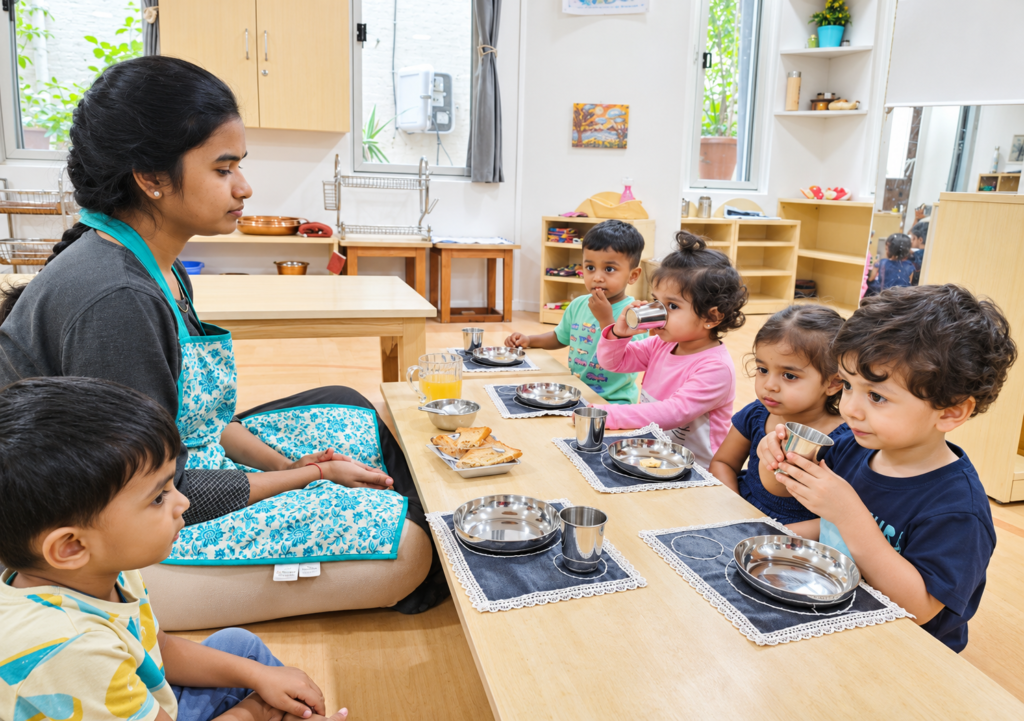
Families exploring a toddler playgroup in Gachibowli can learn more about the Blue Blocks Montessori Toddler Community at our Gachibowli campus. Children generally join from around 15 months, or when they begin walking independently, and move into the Children’s House at approximately two and a half years. The Montessori term Infant Community refers to a prepared environment for walking children under three; Blue Blocks Montessori School calls its programme the Toddler Community. Families should confirm the current entry criteria, session timings and admission arrangements with the school.
Frequently Asked Questions
How can parents support toddlers at home without preparing extra activities?
Invite your toddler into something the family already does: carrying a napkin, bringing shoes, putting away a cloth or helping with a loose sleeve. Offer one safe part of the task and complete the rest as needed. Participation is meaningful before independent completion is possible.
How long should a toddler stay with one activity?
There is no fixed duration. Attention varies with age, interest, tiredness and the activity itself. What helps most is not interrupting a toddler who is absorbed, and letting them return to a favourite activity later rather than pushing them on to something new.
Is it normal for a toddler to want to help one day and refuse the next?
Yes. Willingness changes with hunger, sleep, mood and what else is happening. Keep the invitation open without insisting, and offer the same small role again another day. Consistency in the routine matters more than any single attempt.
Is there a Montessori toddler playgroup near Gachibowli?
Blue Blocks Montessori School offers a Montessori Toddler Community at its Gachibowli campus. Its toddler and playgroup pages describe the environment and approach. Contact the school to confirm current ages, timings, visits and admissions details.
Listen for one phrase tonight
This evening, listen for “Me do it”, “Again” or “No”. Instead of responding automatically, ask what your child might be trying to participate in, practise or communicate. Choose one small adjustment: leave the last step of dressing, allow another turn in conversation, or offer a meaningful role during a transition.
The goal is not to make home life slower or turn every family moment into a Montessori lesson. It is to help a child discover, through ordinary relationships, “I have something to contribute here.”