




Primary School Admission Checklist: From Parent Questions to Campus Visit
Working out how to choose the right primary school in Hyderabad usually starts with a long list: schools recommended by friends, schools near home, schools that appear first in a search. Most families begin with fifteen or twenty names and end with one. What decides the outcome is often less the list itself than the order in which schools are ruled out.
This guide takes you through three filters, practical, approach and people, so that the schools left on your shortlist are the ones genuinely worth a closer look.
What is the age for Grade 1 admission in Hyderabad?
India’s National Education Policy places the start of Class 1 at six, and the central government has asked states to make six the minimum age for Class 1 admission. Telangana kept its existing five-plus rule for 2025–26 and has been reviewing it since, and rules can also vary by board. The safest step is to ask each school for its own Grade 1 age and cut-off date.
At Blue Blocks Montessori School, Grade 1 entry age is 6 years. In some cases, a child may be considered as early as 5 years 11 months, subject to observation.
Age, however, is only part of readiness. As children approach six, parents often notice physical changes too: the first baby teeth falling out, a leaner body and greater stamina, alongside a new stream of “why” questions. These are signs that a child is entering a new stage of development, the one the elementary years are designed for.
Because rules can change, it also helps to count backwards from Class 1 and see how many years your child will have before it, an approach we explain in our nursery admissions checklist.
How to choose the right primary school in Hyderabad: three filters
Filter 1: the practical
Start with the questions that rule schools in or out on their own, before you spend time on anything else.
- Age eligibility: Is your child eligible for Grade 1 in the year you are applying, under each school’s cut-off date?
- Campus: Which campus runs the primary years, and is it one your family can reach every day?
- The school day: Do the hours fit your family’s working day?
- What comes next: Does the school continue after Class 5 or 6, or will your child change schools again?
A school that fails one of these is unlikely to work, however much you like it. Clearing them first keeps the next two filters for schools that are genuinely possible.
Filter 2: the approach
This is the programme-fit question: does the way the school teaches suit your child and your family? It is worth answering honestly, because an approach that suits one child can frustrate another. For a Montessori primary, two short lists may help.
A Montessori elementary may suit your child if:
- they ask “why” constantly and follow their questions a long way;
- they like working with their hands and learning by doing;
- they enjoy working with other children, including older and younger ones;
- your family values depth of understanding over speed through a syllabus.
A Montessori elementary may not suit your family if:
- you want weekly tests, grades and class rankings as the main measure of progress;
- you want learning led mainly by textbooks;
- you want your child to cover a fixed syllabus for their class each year, at the same pace as everyone else.
Neither list is a judgement of the child or the family. It is simply a way of seeing whether the approach and your expectations point in the same direction. Our research institute has reviewed how self-directed learning environmentsrelate to planning, attention and self-control, and our guide to Montessori elementary school in Hyderabad explains what the six elementary years look like day to day. You can also read about Montessori elementary education at Blue Blocks on our programme page.
Filter 3: the people
The schools left on your shortlist now fit your family practically and in approach. The final filter is the people. Ask each school:
- Who will guide my child, and what training do they hold for this age group?
- How will my child’s progress be shared with us, and how often?
- How does a child who joins from another school find their place?
- What does a child do when they want to follow a question further?
- How does the school prepare children for what comes after Class 6?
For a fuller set of questions to compare schools side by side, see the twelve in our guide to choosing a nursery school near Gachibowli. Most of them apply just as well to the primary years.
Where is your child starting from?
From a Montessori nursery (Children’s House): Much carries straight over: the materials, the mixed-age community, choosing work and working independently. What changes is the scale of the questions. Children move from learning the names of things to asking how the world came to be the way it is. We treat the move from the Children’s House to the elementary years as a developmental passage in its own right: the guides observe each child, and some children move on quickly while others need a little more time.
From a regular preschool (LKG and UKG): Children who are used to a teacher leading the group may take a little time to get used to choosing their own work. The guide observes the child closely in the first weeks and presents materials that meet them where they are, so that they find their place in the community.
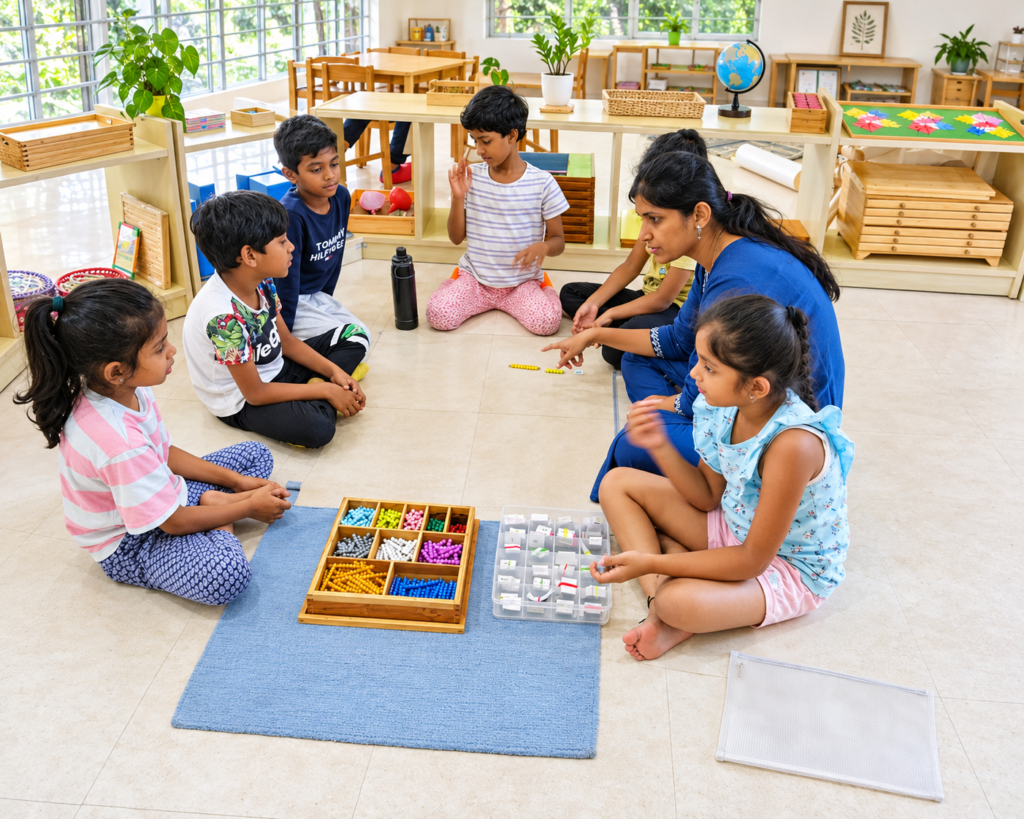
From another primary school, or joining us for the first time: A child joining the elementary years directly, whether in Class 1 or in Class 3 and above, spends 3 to 5 days in the Elementary environment for the full day, from 9 am to 3 pm. Seeing a complete day lets the guide understand how the child works, chooses and settles. Within 2 to 3 days of the observation, we let the family know whether we can offer a place.
What makes Blue Blocks different from other primary schools in Hyderabad?
Rather than compare ourselves with other schools, here is what our primary years offer.
A continuous path from 15 months to 16 years: Children can begin in our toddler community and continue through the nursery, elementary and adolescent years in the same approach.
A six-year elementary cycle: Classes 1 to 6 form one mixed-age community. A six-year-old watching a ten-year-old work on the Pythagorean theorem absorbs something of what it means long before studying it, and a twelve-year-old explaining a concept to a seven-year-old often finds they understand it more deeply than they thought.
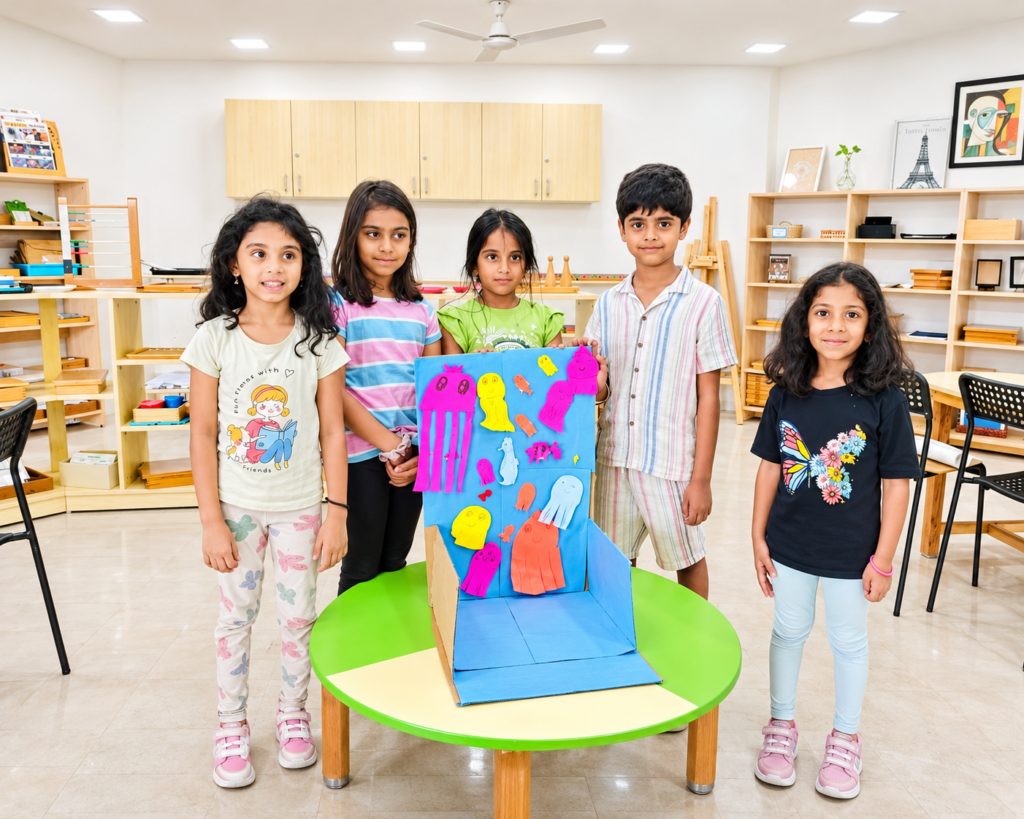
Progress without grades: Each child keeps a work journal and meets their guide one to one at least every two weeks. Progress is tracked through records, a portfolio and conferences, not tests or rankings.
AMI-trained Elementary guides: Our 6–12 guides hold the individual AMI Elementary Diploma (6–12), a specialised educator qualification distinct from institutional AMI school accreditation, and work alongside subject specialists in mathematics, the sciences, languages and the arts.
Going outs: Children plan their own research trips, writing letters, making phone calls and planning transport, then report back to the class.
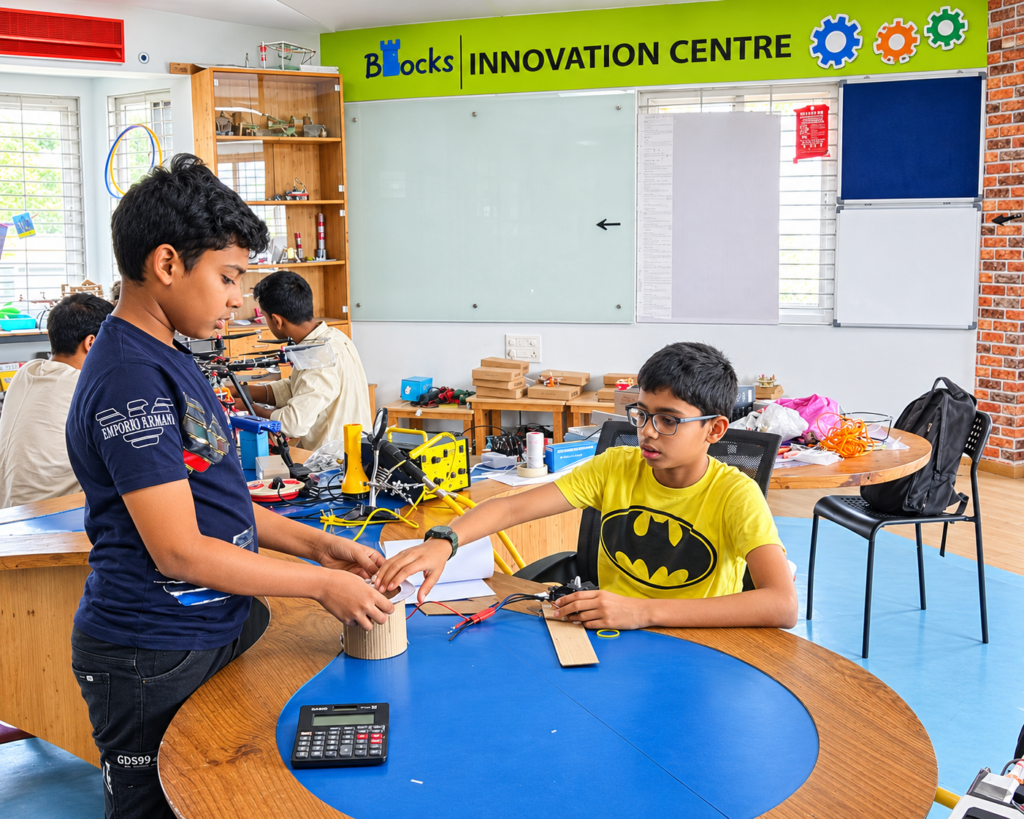
Research with children: Elementary children take part in studies with our Micro Research Institute, such as our Meerkat Model of Bio-Leadership, and children aged 8 to 12 in our drone lab have contributed designs to five filed patent applications.
Three languages: Children learn English, Hindi and Telugu.
Cambridge from Class 7: After the Montessori elementary years, our adolescent programme integrates Cambridge Lower Secondary and Cambridge IGCSE. Our guide to how Montessori and Cambridge can work together explains why we chose this order.
Primary school near Gachibowli: Grade 1 admission at our Tellapur campus
Families searching for a primary school near Gachibowli, or for Grade 1 admission in Gachibowli, should know that our primary years run at our Tellapur campus, Blue Blocks Complete School on Osman Nagar Road, Tellapur. Our Gachibowli campus, opposite DLF Road, runs our toddler community and nursery programme for children up to six, and children from there can continue into the elementary years at Tellapur. Maps for both are on our page of Gachibowli and Tellapur campus information.
For families looking for Montessori Grade 1 admission in Hyderabad, the elementary years at Tellapur are where that journey begins, from Class 1 through to Class 6.
Primary school admission checklist: before you decide
Keep this four-part list when comparing your shortlisted primary schools.
1. Practical shortlist
- Confirm your child’s date of birth against each school’s Grade 1 cut-off date.
- Check which campus houses Classes 1 to 6, and the daily commute.
- Check the school timings, and whether the school continues beyond Class 6.
2. Programme fit
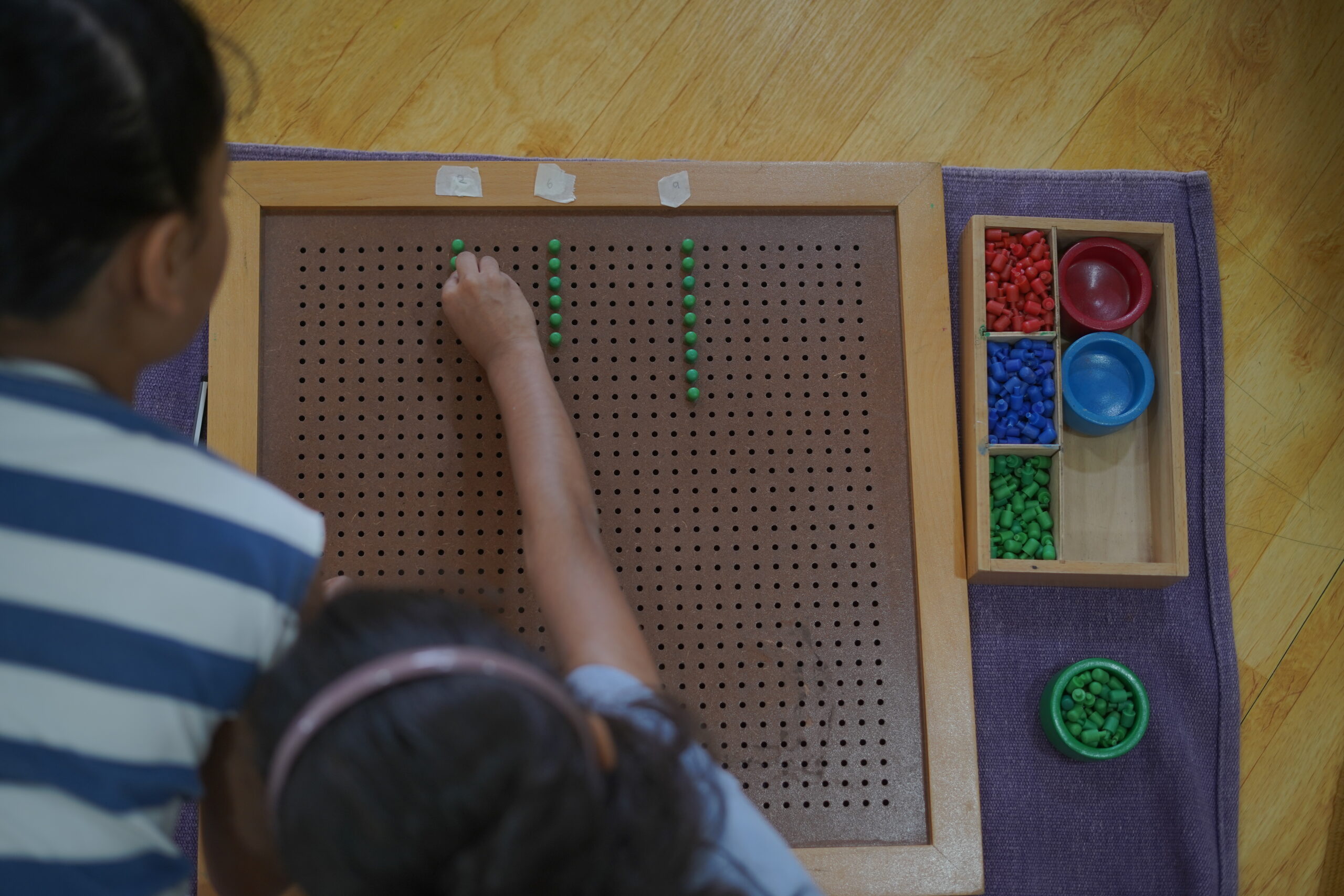
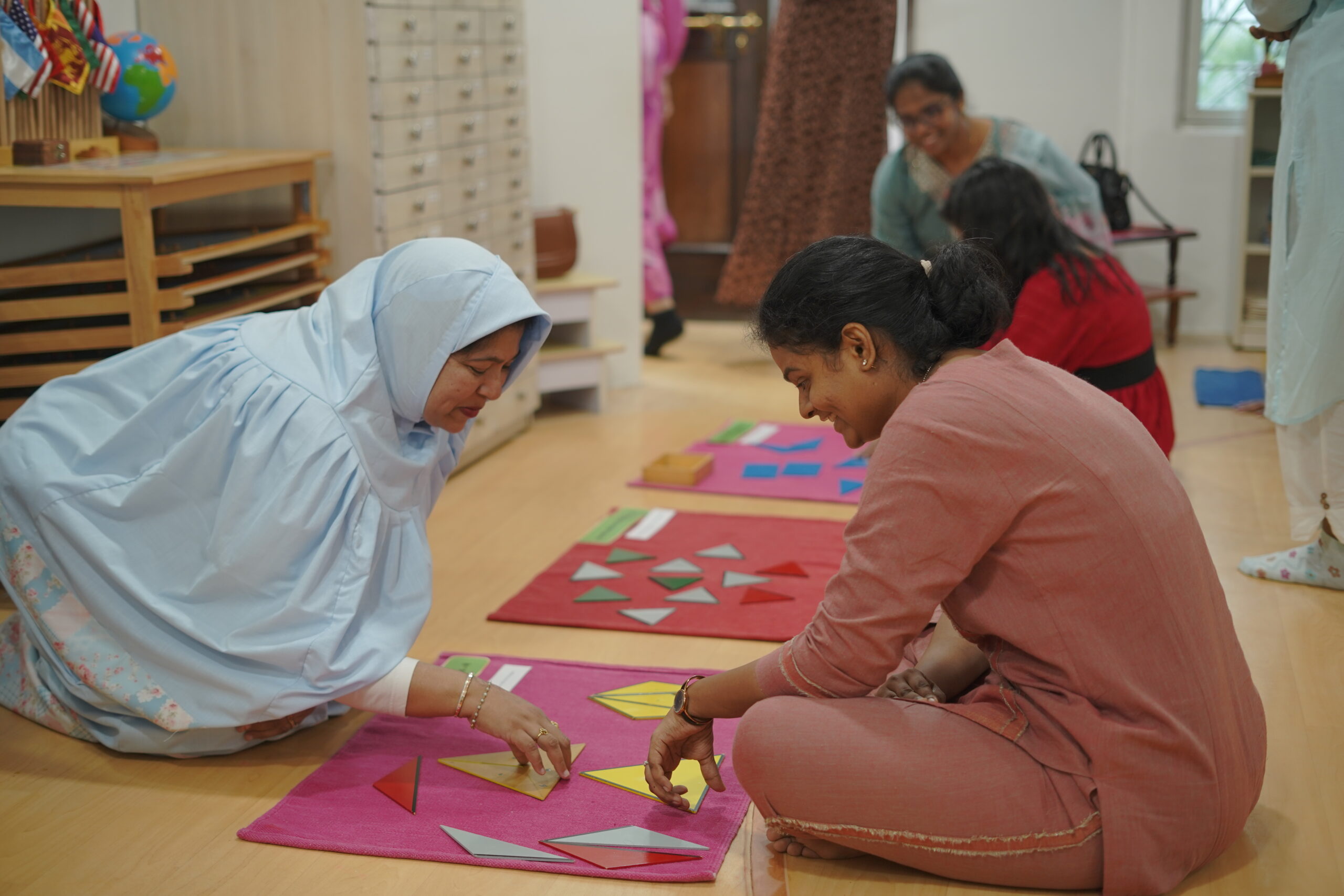
- Observe whether children work with hands-on materials or follow a single textbook pace.
- Ask how the school assesses learning: observation, portfolios and conferences, or weekly tests and rankings.
3. Guides and transitions
- Ask what age-specific training the primary teachers hold, such as the AMI Elementary Diploma for ages 6 to 12.
- Ask how children joining from a regular preschool or another primary school are supported in their first weeks.
4. Parent session and application
- Attend an orientation, workshop or open session to understand how the school works.
- Begin your enquiry and schedule your child’s observation.
See it for yourself: a one-to-one orientation
For children joining the elementary years, we do not hold group admission workshops. Instead, each family has a one-to-one orientation with our team: a conversation about your child, our approach and what the six elementary years involve, with time for all your questions. Your child then spends 3 to 5 full da
ys in the Elementary environment, and we share our decision with you within 2 to 3 days.
Every family begins with an enquiry. You can find each step on our page about the Blue Blocks admissions process. For the elementary years, the founder conversation takes place at our Tellapur campus.
Frequently asked questions
Can my child join in Class 3 or later?
Yes. Children can be considered for Class 3 or later, subject to observation. A child joining the elementary years spends 3 to 5 days in the Elementary environment for the full day, from 9 am to 3 pm, and we let the family know within 2 to 3 days whether we can offer a place.
Does my child need to have attended a Montessori nursery to join Grade 1?
No. Prior Montessori nursery experience is not required. Admission is subject to observation. Children who come from a regular preschool are helped to find their place in the first weeks, as the guide observes them and presents the materials they need.
Is there an entrance test for Grade 1 at Blue Blocks?
No. There is no entrance test. Instead, the child spends 3 to 5 full days in the Elementary environment, and the guide observes what they have learnt, how they approach work and how best to support them.
Do children take exams in Classes 1 to 6?
No. Progress in the elementary years is tracked continuously through the guide’s records, the child’s work journal, a portfolio of finished work and regular one-to-one conferences. Parents receive observation-based reports rather than grades or rankings. External Cambridge assessments begin later, after the Montessori elementary years.
Which campus runs Grade 1?
Our Tellapur campus, Blue Blocks Complete School on Osman Nagar Road, runs Grade 1 and the rest of the elementary years for ages 6 to 12, as well as our adolescent programme. Our Gachibowli campus serves children up to six.