





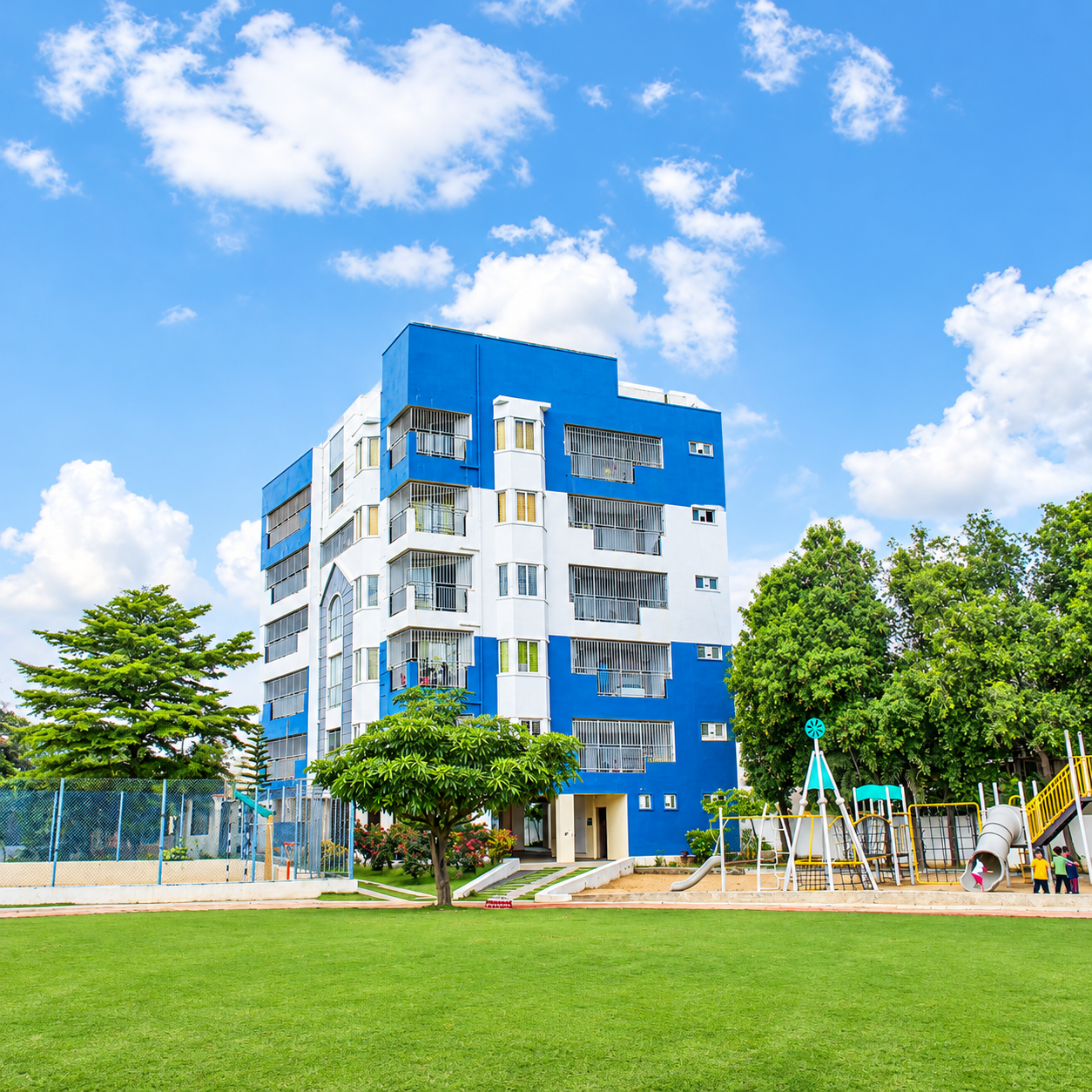
Nursery School Near Gachibowli: 12 Questions to Ask Before You Choose
Parents looking for a nursery school near Gachibowli often visit three or four schools and come away with three or four different impressions: a bright building, a friendly conversation, a well-produced brochure. Impressions are hard to compare. Answers are not. This guide gives you twelve questions to ask every school on your list, explains why each one matters and what a clear answer includes, and then shows how we answer the same twelve questions ourselves.
How to choose the right nursery school for my child?
Compare schools on the same criteria rather than on impressions. Ask every school the same questions about the programme, the adults, your child’s day and the partnership with your family, then set the answers side by side. Experience each environment during an organised parent session or open day, and pay attention to how clearly each school answers.
The twelve questions below are grouped into four parts. None of them asks which school is best. Each one asks something a school can answer plainly, so that you can judge the answer for yourself.
The 12 questions to ask any nursery school near Gachibowli
Part 1: The programme and the day
1. Which campus runs the programme your child’s age needs?
Why it matters: Many schools in west Hyderabad run more than one campus, and not every campus offers every age group. A school near your home may run its nursery somewhere else.
A clear answer includes: the ages each campus takes, and where your child would continue after nursery.
2. What does a typical day look like, and what are the hours?
Why it matters: A nursery morning can be built around a long period of focused work or around a series of short group activities. The hours tell you how the day fits your family; the shape tells you how your child will spend it.
A clear answer includes: arrival and pick-up times, and what happens in between.
3. How long is the uninterrupted work period?
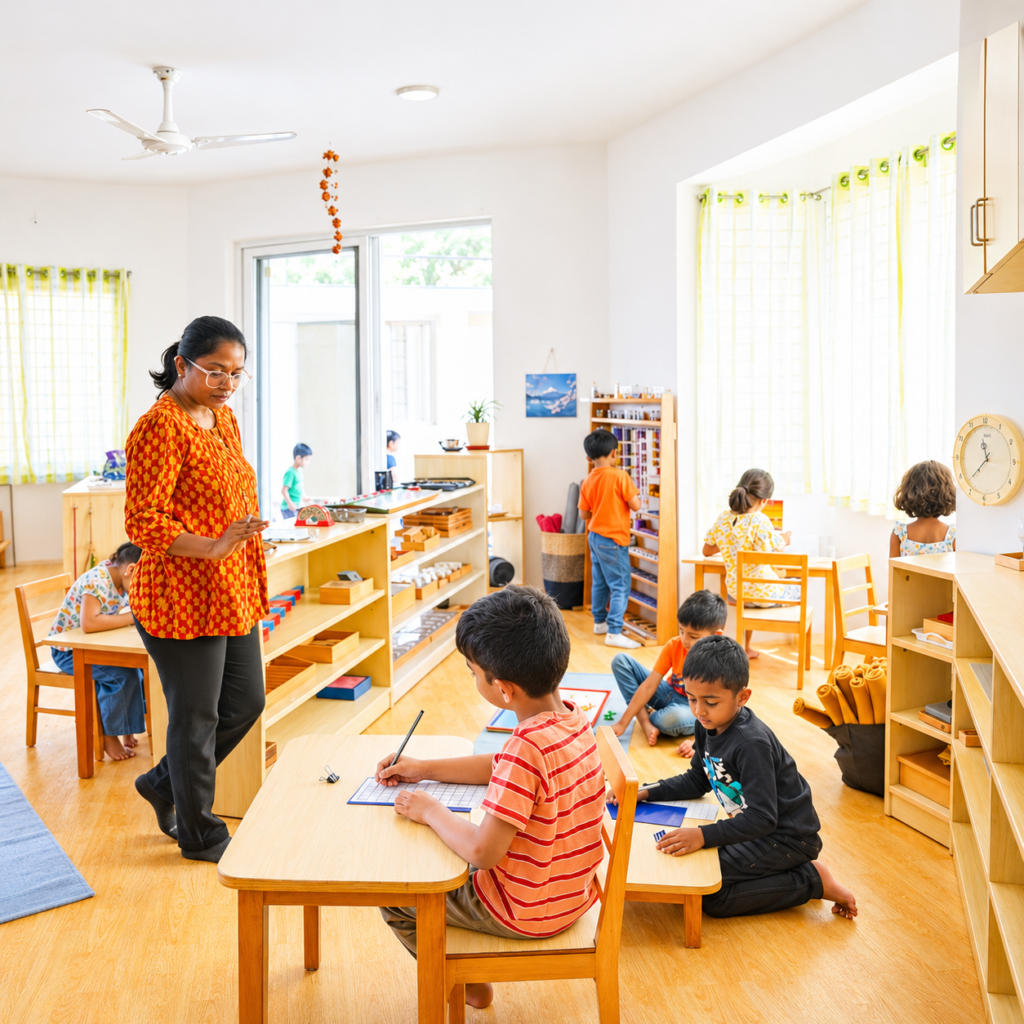
Why it matters: Young children concentrate most deeply when they are not moved on every few minutes. A long, protected stretch of time is what allows a child to choose a task, repeat it and finish it.
A clear answer includes: how long children work without interruption, and what stops them.
Part 2: The adults
4. Which training do the adults hold, and for which age group?
Why it matters: Training for early childhood is specific to age. In Montessori education, the training for children from three to six is separate from the training for younger or older children.
A clear answer includes: the name of the training, the age group it covers, and who awarded it.
5. Will the same adults be with my child every day?
Why it matters: Young children settle and learn through familiar faces. Frequent changes ask a child to rebuild trust again and again.
A clear answer includes: who your child will see each day, and how long the current team has worked together.
In Lining the Nest, Chapter 1: The World Through Your Child’s Eyes, the authors write, “Everything done or said by you is being absorbed by your baby.” Although they are addressing parents, the idea is also worth considering when choosing a nursery. Beyond the activities formally presented, children experience how adults speak, listen and treat one another. Familiar guides matter not only for the reassurance they offer, but because these daily relationships become part of the child’s earliest understanding of living with others.
6. How is each child’s work planned?
Why it matters: Some nurseries plan one activity for the whole group; others plan for each child individually. The difference shapes almost everything about your child’s day. Our research institute has reviewed how self-directed learning environments relate to skills such as planning, attention and self-control.
A clear answer includes: who decides what a child works on, and how the plan changes as the child grows.
Part 3: Your child’s experience
7. How much time do children spend outdoors and with nature?
Why it matters: Time outdoors and contact with living things give young children movement, close observation and a sense of responsibility that a classroom alone cannot. Habits of caring for nature formed in the nursery years tend to carry forward: our study of biophilia in the classroom, with children aged 6 to 16, looks at how this connection with nature continues to show in older children’s drawings.
A clear answer includes: when and how often children go outdoors, what they do there, and how nature is brought into the classroom through plants, animals and care of the environment.
8. Is my child’s home language welcome?
Why it matters: Many families in Hyderabad move between Telugu, Hindi, Urdu, English and other languages at home. A young child who is understood in their home language settles faster and speaks more freely. Our home observation study of language development and the literacy environment shows how much the home contributes to early language.
A clear answer includes: what the adults do when a child speaks to them in another language.
9. How is a new child helped to settle?
Why it matters: The first weeks shape how a child feels about school for a long time afterwards.
A clear answer includes: what the first days look like, who receives the child, and how the pace is set.
Part 4: The partnership with your family
10. How will you share my child’s progress with us?
Why it matters: Parents need more than a report card, and young children are not well served by grades. Our research on the school–home partnership looks at why regular, focused conversations between guides and families matter.
A clear answer includes: how often you will meet, in what format, and who you will speak to.
11. What is expected of parents?
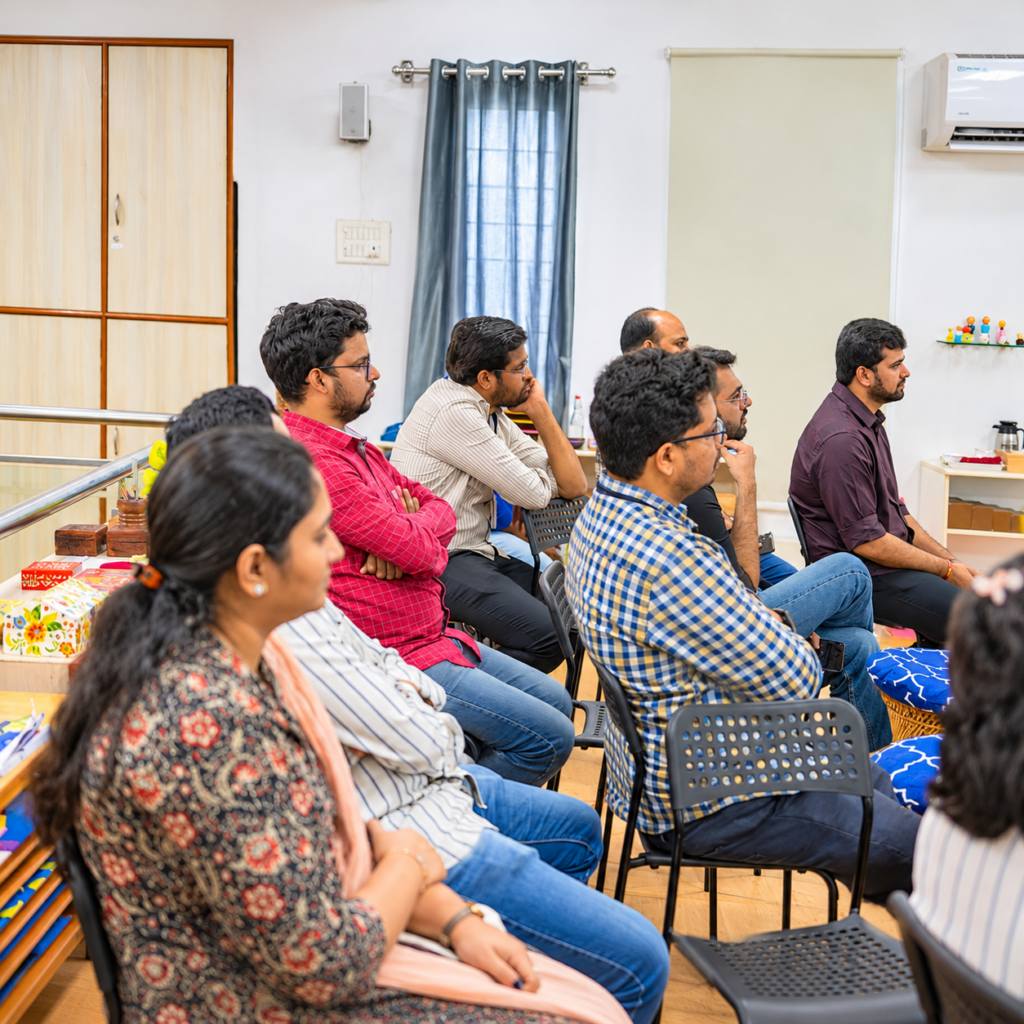
Why it matters: Some schools ask families to attend workshops and conferences across the year. Knowing this early helps you plan. Our research on parent workshops looks at why these sessions matter.
A clear answer includes: the sessions parents are asked to attend, and how often.
12. Does the school continue after nursery?
Why it matters: A child who moves schools at six faces a new building, new adults and a new approach at the same time. Continuity removes one of those changes.
A clear answer includes: what comes after the nursery years, and at which campus.
Make it a fair comparison: Ask every school the same twelve questions and write the answers down, school by school, in one notebook. Read them together at the end. A vague answer is itself an answer, and the differences that matter become much easier to see.
“When a young child enters school, they already carry something extraordinary within them: curiosity, the desire to explore, the courage to attempt things they have never done before. We naturally ask what the school is going to teach them. But I think we should also ask what the school will preserve. Will the child continue to ask questions freely? Will they still feel that their ideas matter? Will they retain the joy of discovering something for themselves? Education should help these qualities grow stronger as the child grows.”
(Pavan Goyal, Founder, Blue Blocks Montessori School)
Which are the best nursery schools near Gachibowli, Hyderabad?
There is no objective ranking of nursery schools, and the best nursery in Gachibowli for one family may not suit another. A more useful starting point is to know the kinds of nursery you will find in and around Gachibowli, and then compare individual schools with the twelve questions above:
- Montessori nurseries: mixed-age classrooms, child-chosen work with specially designed materials, and adults with Montessori training. Ask which training, and for which age group.
- CBSE-affiliated pre-primary sections: part of a larger school, usually organised into separate yearly classes that lead into Class 1 at the same school.
- ICSE-affiliated pre-primary sections: similar in structure to CBSE pre-primary, leading into the school’s own primary years.
- IB and Cambridge early-years programmes: inquiry-based programmes, often part of international schools.
- Standalone play schools and preschool chains: shorter or more flexible hours, often with no school attached beyond the nursery years.
Each type varies widely from school to school, so the type alone tells you little. The twelve questions tell you much more. If you are weighing a Montessori nursery against a regular preschool in particular, our guide to the difference between Montessori nursery and CBSE preschool sets them side by side.
How Blue Blocks Montessori School answers the same 12 questions
We think a school that asks parents to compare should be willing to be compared. Here are our own answers.
- Campus and programme: Our nursery programme, called the Children’s House, takes children from two and a half to six, through the Nursery, PP1 and PP2 years. It runs at both our Gachibowli and Tellapur campuses.
- A typical day: The school day runs from 8.30 to 1.30 at our Gachibowli campus and from 9.00 to 2.00 at our Tellapur campus. You can see how the day unfolds on our nursery curriculum page.
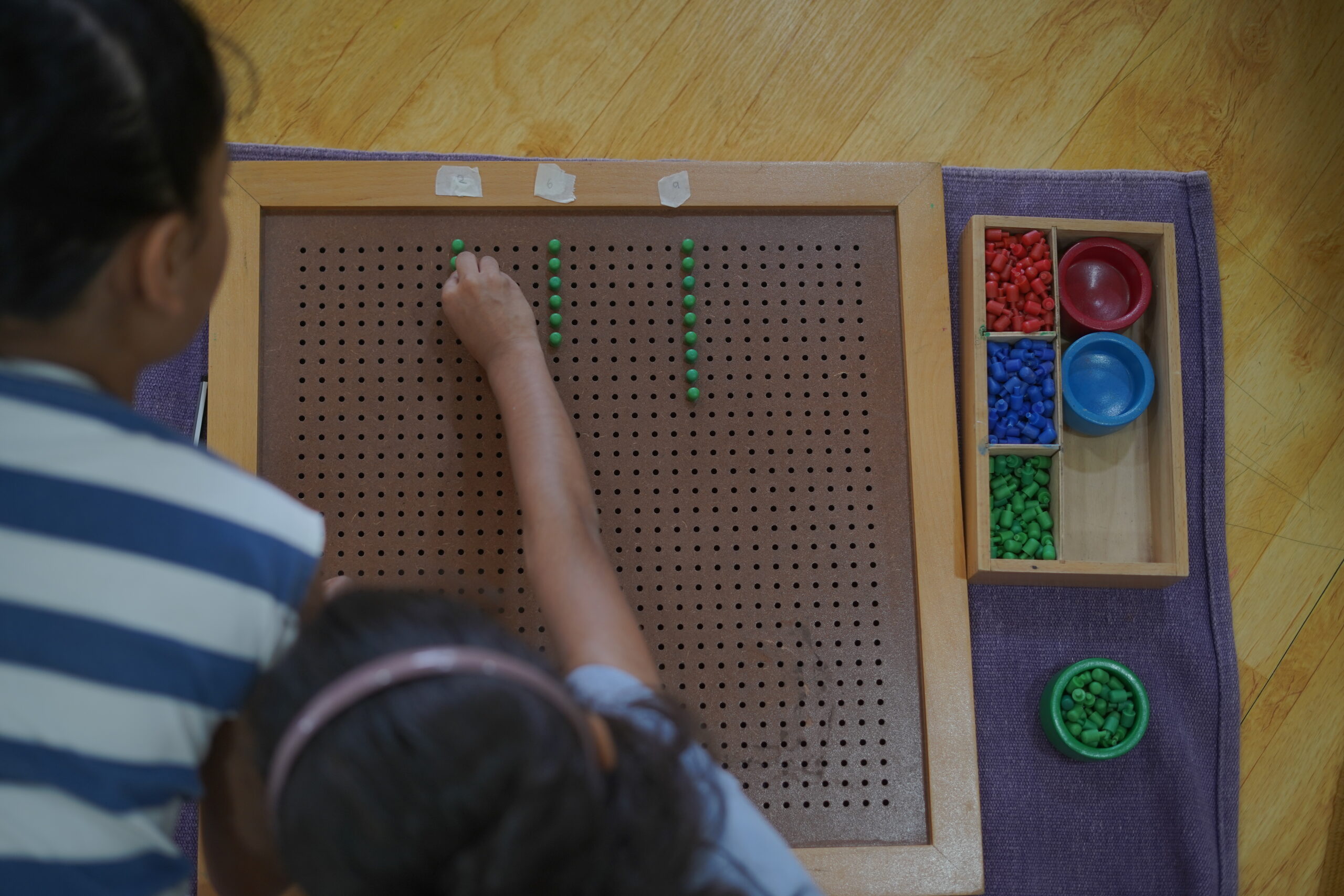
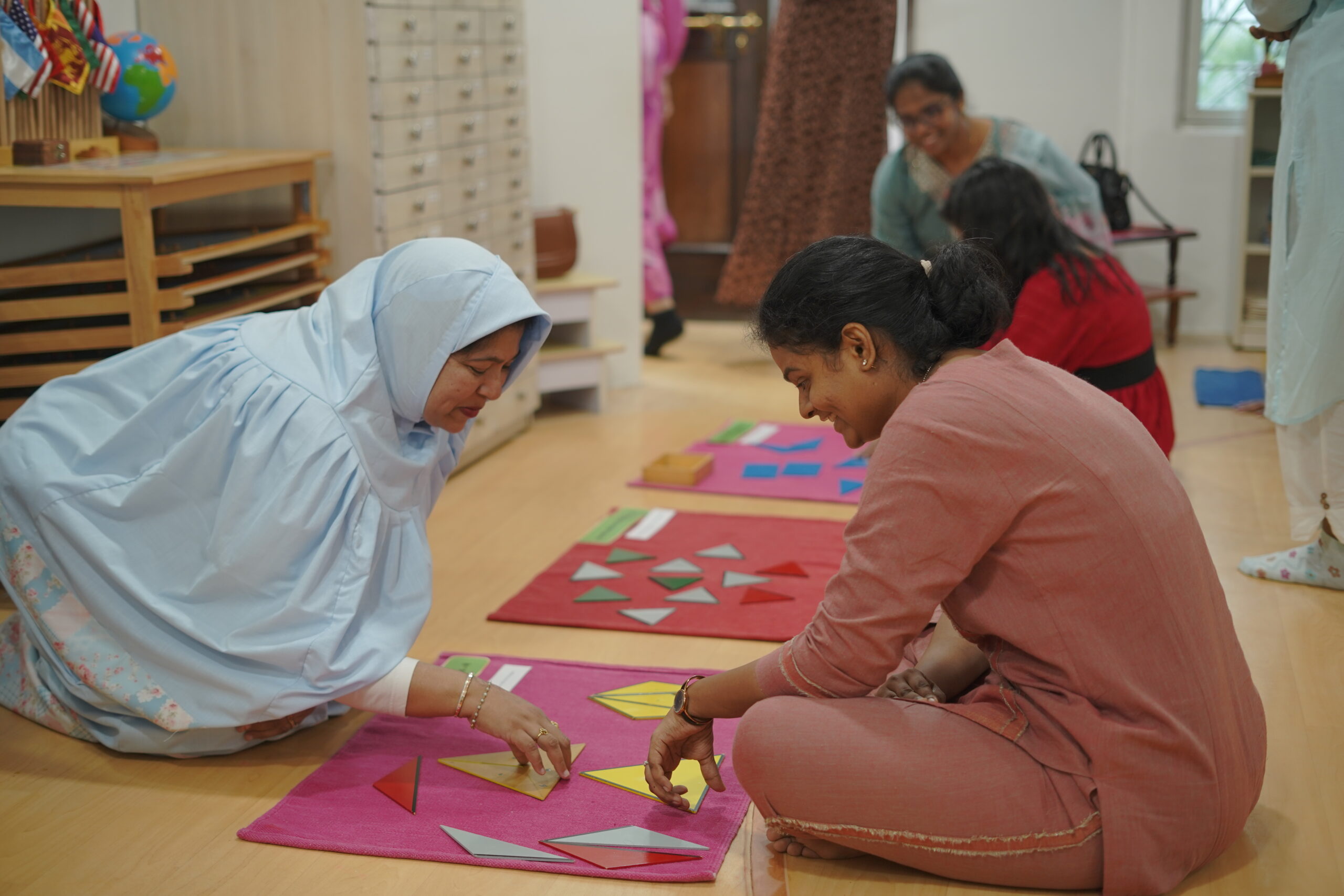
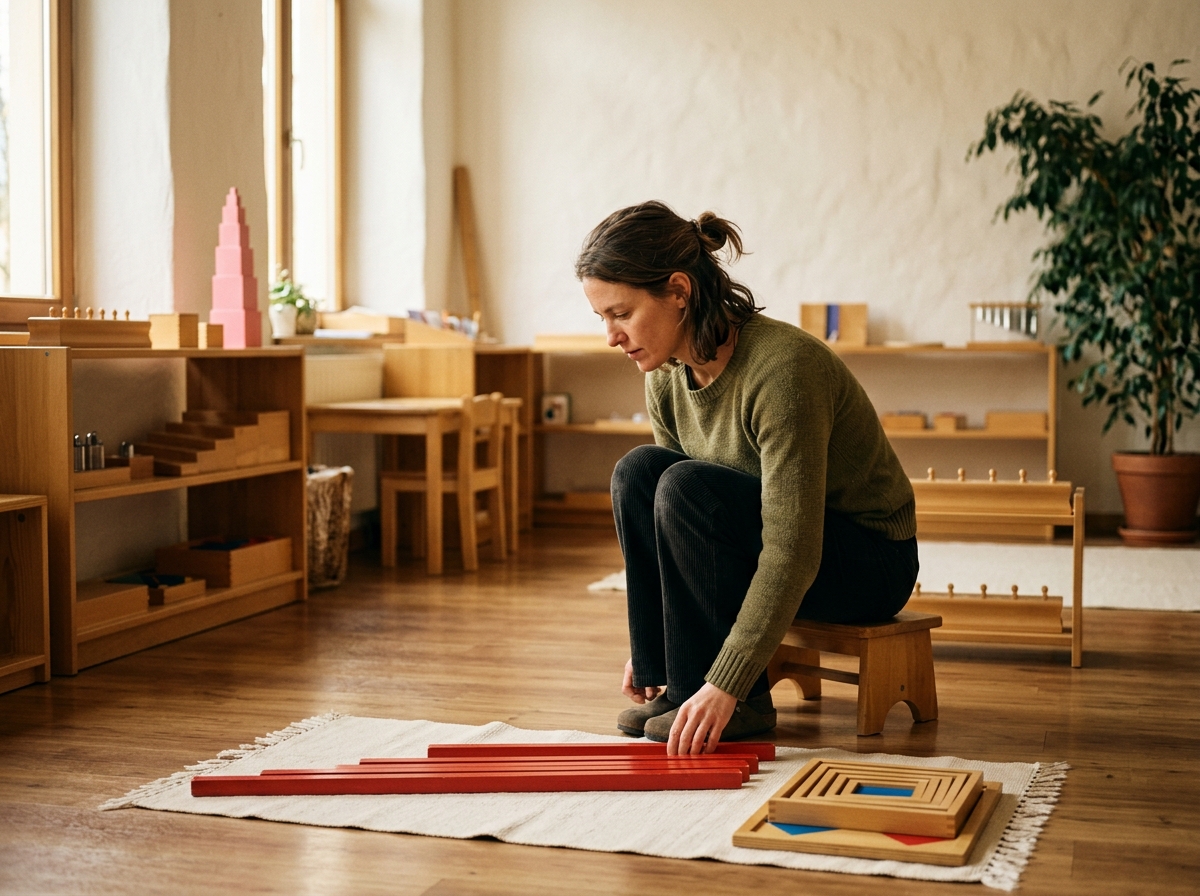
- The work period: Each morning centres on a long, uninterrupted work period in which children choose their work across five areas: practical life, sensorial, mathematics, language and culture. Snack is not a break: each child serves themselves when they are ready. Our guide to what children learn in nursery school shows what that work looks like.
- Training: Our guides hold the individual AMI Primary Diploma (3–6), awarded by the Association Montessori Internationale. It is a qualification held by educators, distinct from institutional AMI school accreditation.
- The same adults: The same team of guides works with the children every day.
- Planning: Each guide observes every child and plans their work individually, then presents an activity, invites the child to try it and steps back.
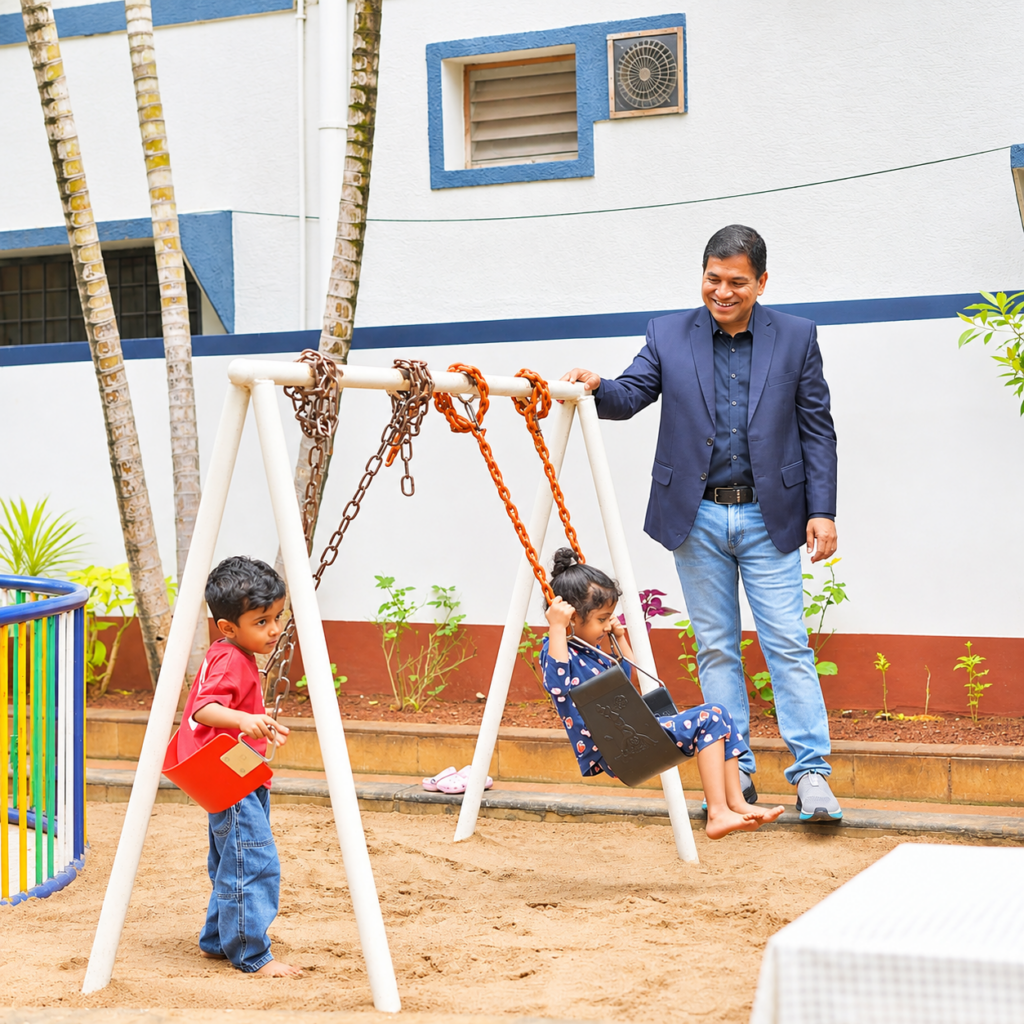
- Outdoors and nature: Nature is part of the daily work. Children water plants and arrange flowers as part of caring for their environment, identify leaves and dissect real flowers in botany, and learn the parts of a fish, a bird and a frog in zoology.
- Home language: Children are welcome to speak in their home language. Our guides listen for what a child is trying to say and respond warmly, while spoken English grows naturally through conversations, stories and songs across the morning. Families are encouraged to keep speaking their home language richly at home, because a strong first language supports every language that follows.
- Settling in: On arrival, each child is greeted by their guide, puts their bag away and chooses their first piece of work. Our guides support a new child’s transition gently, without rushing it, and most children who join from another preschool settle into the full morning within two weeks.
- Progress: Guides keep observation records for every child, and we share each child’s progress in individual parent–guide conferences held twice a year, rather than at the gate. A guide calls the parent if there is something to share in between. We do not use grades or rankings.
- What we ask of parents: Every family begins with our Saturday admission workshop, and parents meet their child’s guide at the parent–guide conferences twice a year.
- After nursery: At our Tellapur campus, children can continue through the 6–12 and 12–16 years in the same approach.
One useful distinction in admissions conversations is that continuity has two parts: where the child will study and how the learning approach will develop with them. A family may choose the Gachibowli campus for nursery today, while the 6–12 programme is offered at Tellapur. Understanding both the educational progression and the later change of campus allows parents to plan beyond the first admission without assuming that staying with the same school always means staying in the same building.
You can read more about the nursery programme at Blue Blocks Montessori School and its five areas of learning.
Nursery school near Gachibowli or in Tellapur: finding our campuses
Our Gachibowli campus is at MIG 3, opposite DLF Road, Gachibowli. It runs our Children’s House for children from two and a half to six, and our toddler community for younger children.
The Tellapur campus of Blue Blocks Montessori School is at Villa 87, 64A, Osman Nagar Road, Tellapur. It runs our Children’s House, along with our programmes for the 6–12 and 12–16 years.
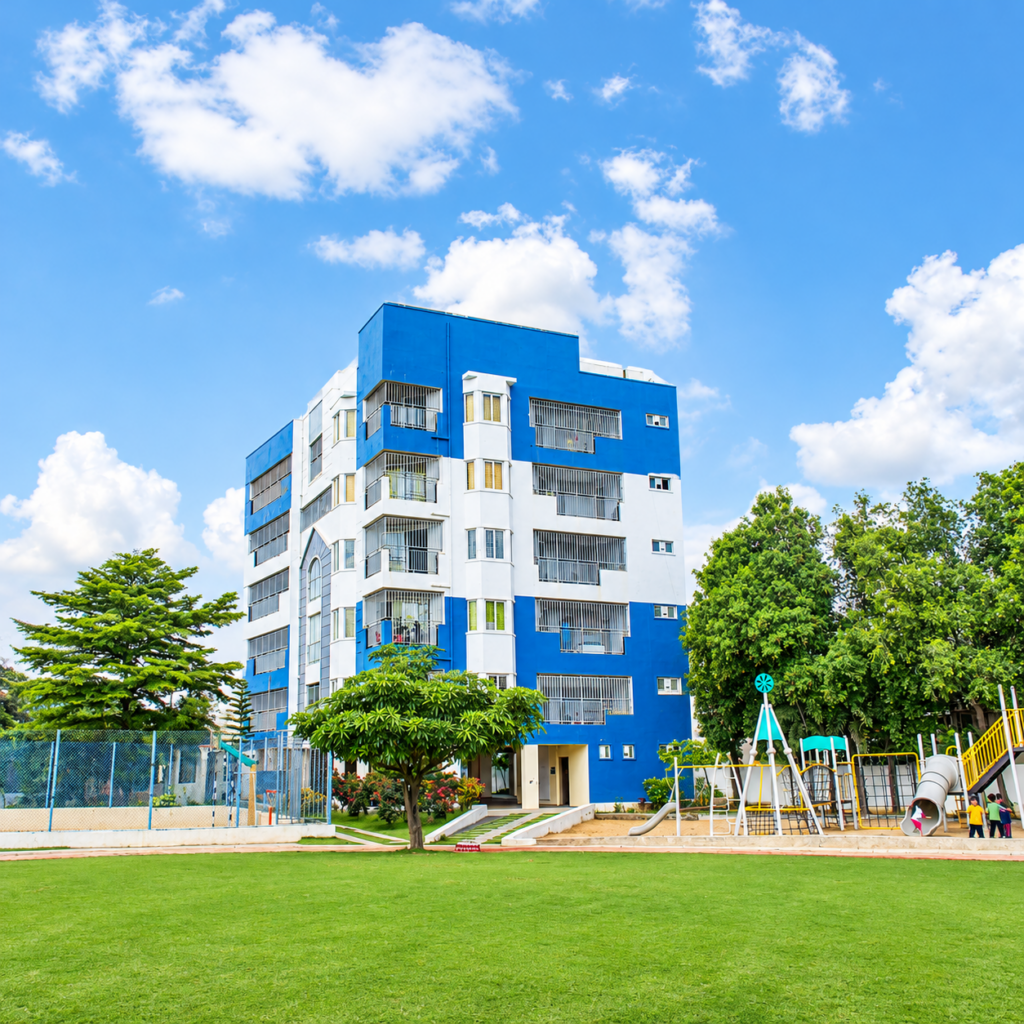
Maps for both, along with photographs of each environment, are on our page about Blue Blocks Montessori School campuses in Hyderabad. We do not hold tours while children are working, so families see the environment at our Saturday admission workshop. To begin, visit our page on school admissions at Blue Blocks Montessori School, and see our nursery admissions checklist for ages, readiness and the steps involved.
Frequently asked questions
Can my child join nursery in the middle of the year?
Yes. Blue Blocks Montessori School admits children throughout the year rather than only at the start of the academic year. Because each child’s work is planned individually, a child can join whenever they and their family are ready, without waiting for a fixed intake.
Do I need to attend a session before applying?
Yes. Every family begins with an enquiry and then attends our Saturday admission workshop. It gives parents time to see the prepared environment, handle the materials and ask questions without disturbing the children’s work. For children from two years and nine months, we also observe the child in the environment before the application is completed.
Does the school continue after nursery?
Yes, at our Tellapur campus, where children can continue through the 6–12 and 12–16 years in the same Montessori approach. Families at our Gachibowli campus can move to Tellapur for these years.
What age can my child start nursery?
Children join our nursery programme, called the Children’s House, from two and a half and stay until six, through the Nursery, PP1 and PP2 years. Montessori education treats three to six as one stage, and joining a little earlier gives a child time to settle before it begins.
Is there a nursery school in Tellapur as well as Gachibowli?
Yes. Our Children’s House runs at both campuses: in Gachibowli, opposite DLF Road, and at our Tellapur campus on Osman Nagar Road. Both follow the same programme, with guides who hold the AMI Primary Diploma (3–6).
What if my child is younger than two and a half?
Younger children can join our toddler community at our Gachibowli campus, from 15 months or as soon as they start walking, until about two and a half. Our guide to playgroup admission in Hyderabad explains how admission works for toddlers.