







Playgroup Admission in Hyderabad: Ages, Readiness and the First Visit
Playgroup admission in Hyderabad works differently from nursery admission. There is no board or national age rule for children under three, so each playgroup sets its own starting age, and most children begin once they are walking. At Blue Blocks, playgroup admission follows a simple path: an enquiry, a Saturday workshop for parents, two family conversations and a gentle, child-led settling-in period.
Parents searching for ‘playgroup admission Hyderabad’ often come to us after hearing three different answers from three different schools. One says twelve months, another says eighteen, and a third says ‘when your child is ready’. This guide explains why the answers vary, what readiness actually looks like in a toddler, how playgroup admission works at our school, and what the first weeks are like for a child and a family.
What is the right age to start playgroup in Hyderabad?
The short answer is that there is no single right age, and the reason is useful to know. India’s national framework for early education describes a foundational stage that begins at three, and school boards such as CBSE set their pre-primary admission rules from that age. Below three, there is no common rule. Each playgroup decides for itself when children may join, which is why parents hear such a wide range of ages.
The most useful starting point for any playgroup admission Hyderabad parents are considering is readiness, not a birthday.
At Blue Blocks, we take children into our toddler community from 15 months, or as soon as a child starts walking. Walking is the marker that matters most to us, because a toddler community is designed for children who can move around the room on their own: carrying a jug to a table, fetching a puzzle from a low shelf, choosing where to go next. Children stay in the toddler community until about two and a half, when they move into our Children’s House for the Nursery, PP1 and PP2 years.
Playgroup admission age: can a one-year-old join?
For parents of a child who is not yet walking, waiting is not a delay. The weeks at home spent crawling, pulling up, cruising along furniture and finally taking steps are exactly the work a one-year-old needs to be doing. When those first independent steps arrive, the child will be ready to enjoy everything a toddler community offers.
In Lining the Nest, Chapter 7, “Independence: Help Me Help Myself,” we write: “The rolling, the crawling and ultimately, the walking are all indicators of your baby’s independent side.” The chapter also recounts how nine-month-old Maya crawled to the front door after her father picked up his car keys. She picked up her shoe and tried to open its Velcro fasteners with her mouth. Although she could not yet put on her shoes, she had recognised the familiar routine and wanted to participate. Walking is an entry point for the toddler community, not the beginning of a child’s desire for independence.
Signs a toddler is ready for playgroup
Readiness in a toddler looks different from readiness for nursery. These signs are not admission tests, and a child does not need every one of them. They are simply ordinary things parents can notice at home.
The first is independent movement. A child who walks steadily, and who wants to keep moving, is ready for a room where moving with purpose is part of the day.
The second is the urge to use their hands. Toddlers who pull lids off containers, push objects through gaps or insist on holding the spoon themselves are showing exactly the interest a toddler community is built around. The wish to take part starts early: in a 2006 study published in Science, 22 of 24 children aged 18 months helped an adult who was struggling with a task in at least one of the situations tested.
“After nearly twenty years of working closely with parents and understanding the challenges they face in raising children, I’ve realised that one of the hardest things for adults is to see a child struggle and not immediately help. We want to make things easier for them. But when we solve every little difficulty, we may also be taking away the child’s opportunity to discover what they are capable of doing themselves.”
Pavan Goyal, Founder, Blue Blocks Montessori School
The third is the ability to be comforted by another adult while a parent is close by. A child who can be soothed by a grandparent or a familiar caregiver, even briefly, is beginning to learn that other adults can be trusted.
The fourth is a fairly predictable rhythm of eating and sleeping. When the day at home follows a familiar order, a child carries that sense of security into a new place. A Blue Blocks Micro Research Institute study, Rhythm, Environment, and Autonomy, looks at how predictable home routines relate to young children’s independence.
If you have a specific concern about your child’s hearing, movement or development, please speak to your paediatrician. That conversation does not need to wait for playgroup admission.
What are the playgroup admission procedures in Hyderabad?
Most playgroups in Hyderabad follow a broadly similar sequence: an enquiry, a chance for parents to understand the programme, some form of meeting with the family, the admission form and a start date. The details differ from school to school, so it is worth asking each one to describe its process from the first call to the first day. The steps of playgroup admission Hyderabad families go through are rarely complicated; what matters is that each one shows you clearly how your child’s day will look.
At Blue Blocks, the steps for our toddler community are as follows.
Step 1: Enquiry. Families begin by filling out our enquiry form or calling us.
Step 2: Admission workshop. Parents attend a Saturday workshop to experience the Montessori environment and understand the programme. This is where most of the questions parents bring are answered, and where the thinking behind the toddler community becomes visible.
Step 3: Application. Families complete the admission form. For children from 2.9 years, we first observe the child in the environment; for toddlers, families move directly to the application after the workshop.
Step 4: Family conversation. Parents meet our Director of Admissions online to talk about the family’s expectations and any remaining questions.
Step 5: Founder conversation. Families meet our founder to understand the child’s journey ahead and the Blue Blocks approach to education.
Step 6: Welcome to Blue Blocks. The process is completed, and the child’s journey with us begins.
The first visit: what happens and how to prepare
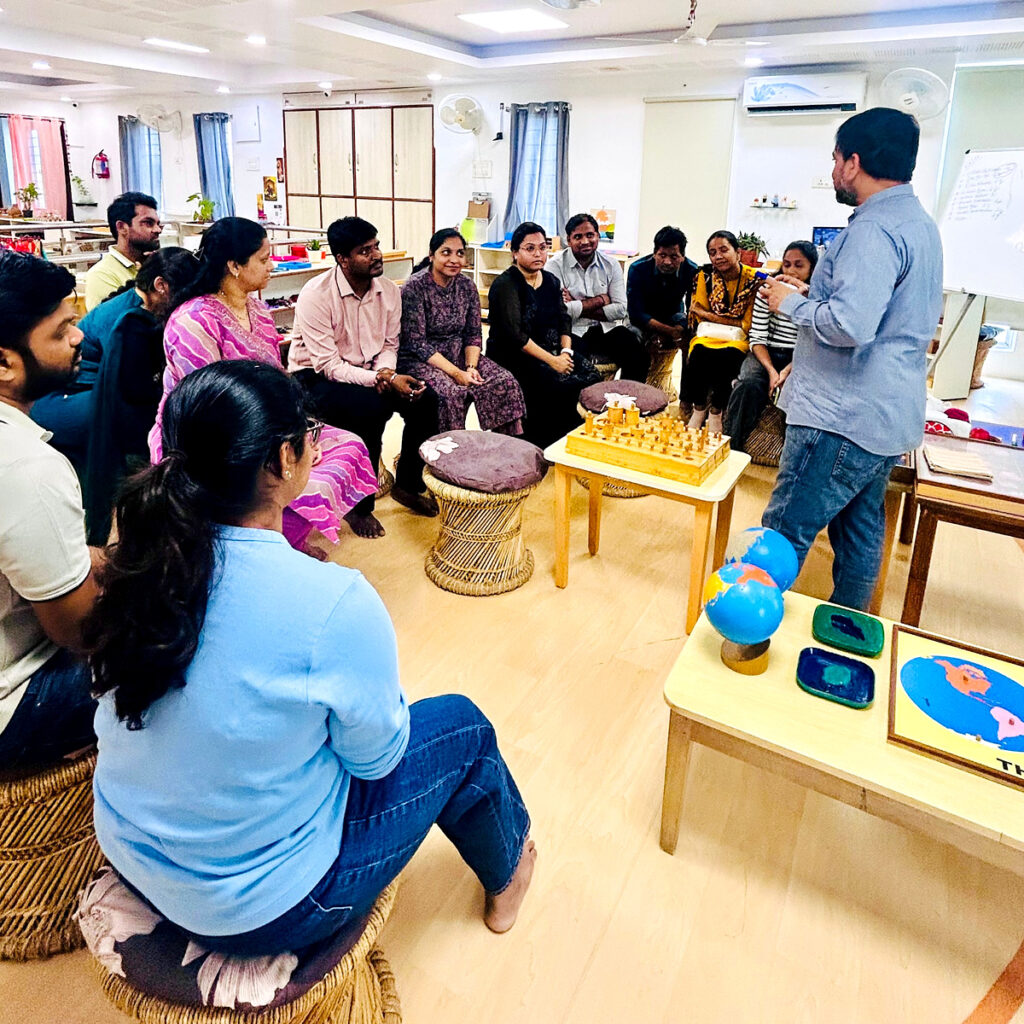
For parents, the first visit is the Saturday workshop. We do not hold tours while children are working. A toddler’s morning depends on calm and on familiar faces, and an unfamiliar adult walking through the room can unsettle children who are deeply absorbed in what they are doing. The workshop gives parents time to see the prepared environment, handle the materials and ask questions without disturbing anyone’s concentration.
It helps to come with a few specific questions rather than general ones. Instead of asking whether the programme is good, ask how a child is helped to settle, how the guides plan for each child, and how the school will share news of your child’s progress. The answers will tell you far more.
When the time comes for your child’s first day, prepare them simply. In the days before, talk briefly and often about where they will be going: the room, the shelf with their name for their bag, and the guide who will greet them. Young children have a strong need for order, a sense of predictability in places, people and routines, and hearing the same short description again and again makes the new place feel familiar before they arrive. On the day, make sure your child is rested and has eaten, then let them explore at their own pace.
Settling in: what the first weeks look like
Every child settles differently, and the pace follows the child rather than a fixed plan. In our toddler community, parents do not enter the working environment, including during settling. A familiar guide receives the child at the gate and offers reassurance inside the environment. Throughout this time, the same guide receives the child each day, so that trust is built with one familiar person.
What our guides observe during settling
One of our Toddler guides shared an observation of a child who arrived crying during his first few days at school. After entering the environment, he stayed close to the guide, holding her hand and quietly observing the other children. She did not rush him into an activity, allowing him time to become comfortable. Over the next few days, she noticed a small but meaningful change. He began showing interest in the materials around him. One morning, he voluntarily let go of her hand, approached a low shelf, picked up a basket and briefly explored its contents before returning to her.
What appeared to be a small moment was an important step towards independence. The child was beginning to feel secure enough to explore, at his own pace. Our guides also record observations like this systematically: a Blue Blocks Micro Research Institute study in a toddler environment looks at how long toddlers stay with a material and how often they return it to the shelf on their own.
It helps to know what is normal. Tears at parting are common and are not a sign that something is wrong. Some children cling at drop-off for a while; others settle quickly and then find a later morning harder. Many toddlers are more tired than usual in the early weeks, simply because so much is new. A good day followed by a difficult one is part of the process, not a step backwards.
Parents naturally want to know how the morning went. In our toddler community, drop-off and pick-up are kept brief and calm, and guides do not discuss a child’s morning at the door. This protects the children’s transitions and gives every parent the guide’s full attention when they do speak. Conversations about a child’s progress happen in scheduled one-to-one meetings with parents, and if a guide notices something she would like to share in between, she calls the parent herself.
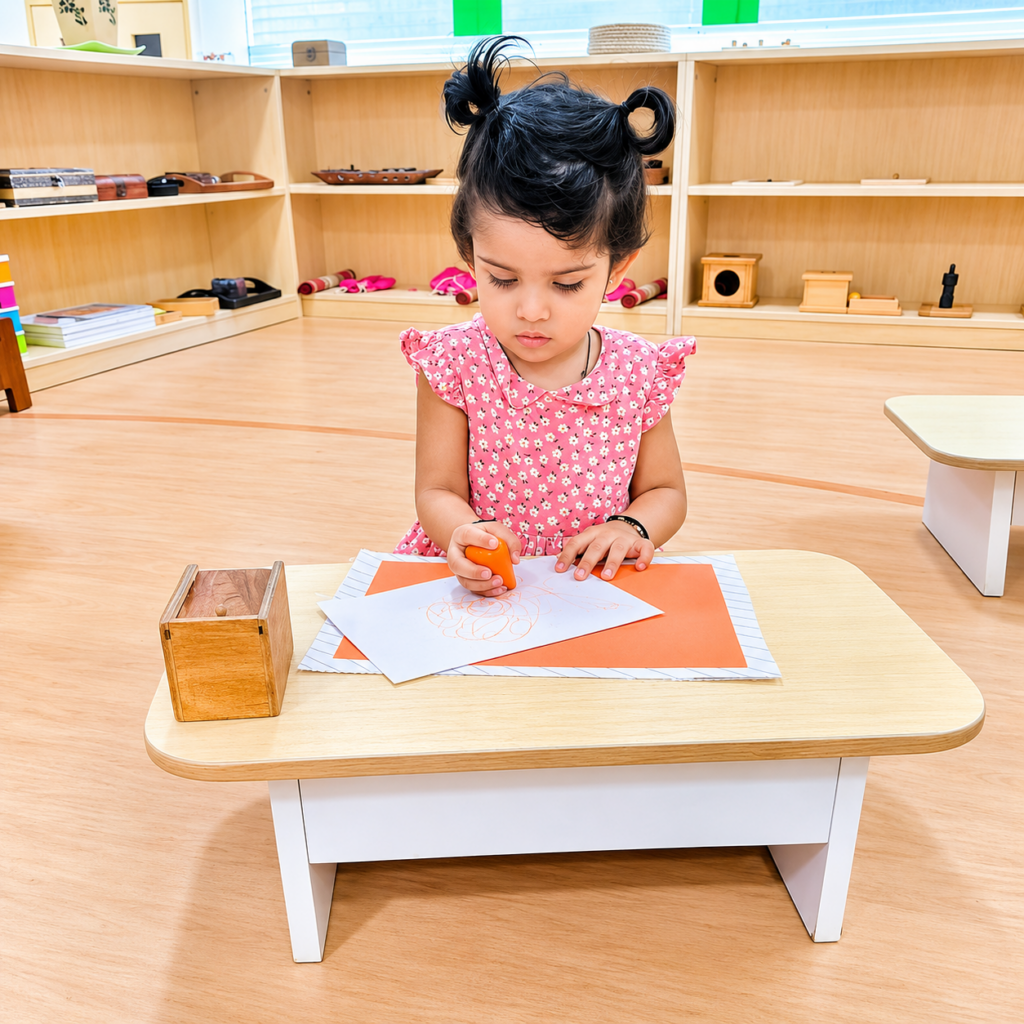
Playgroup admission in Gachibowli
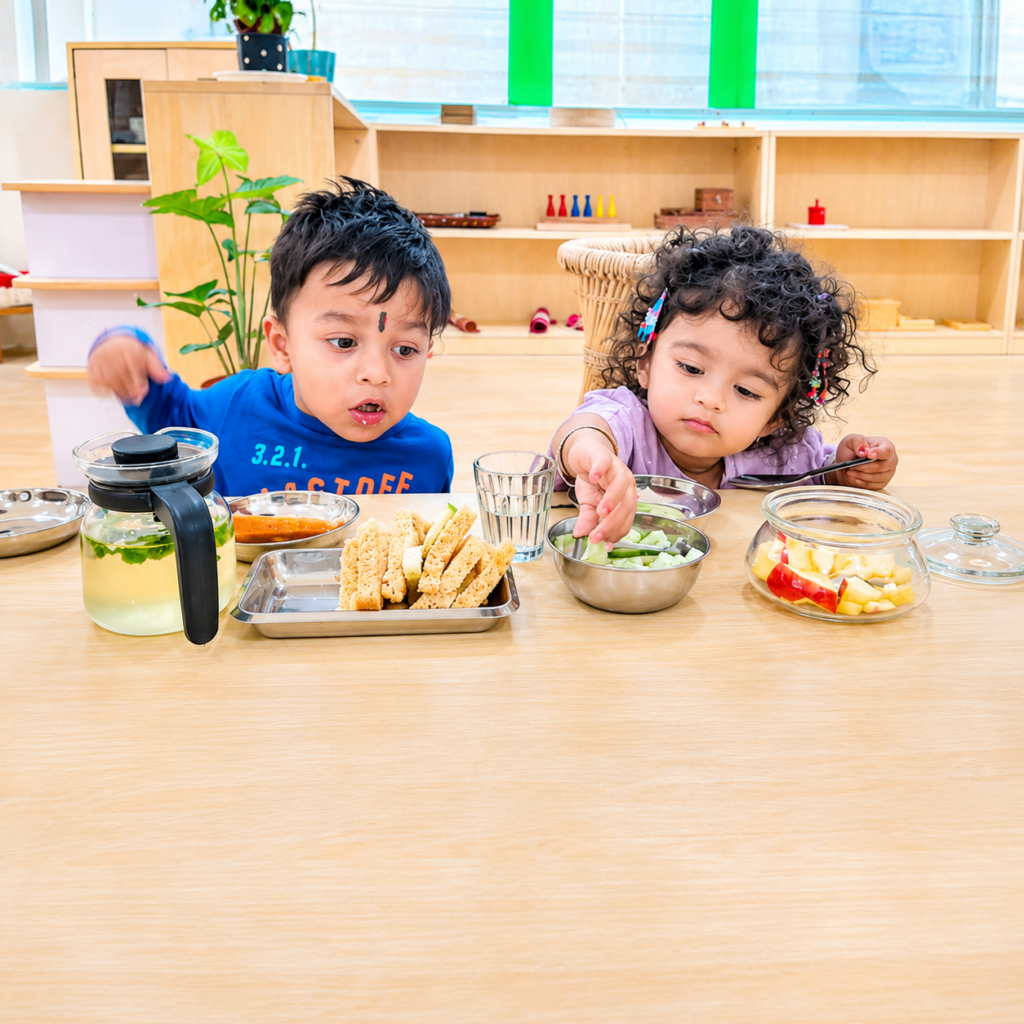
Our toddler community runs at our Gachibowli campus, opposite DLF Gachibowli, and serves families across west Hyderabad, including those living or working around the Financial District. Parents who would like to explore our locations can find more information about Blue Blocks campuses in Hyderabad. Children attend one of two morning sessions, from 9.00 to 11.00 or from 11.15 to 1.15. Each session includes a long period of individually chosen work, a shared snack that the children help prepare, songs and time outdoors, in an order the guide adjusts to the children’s needs.
Our toddler guides hold the AMI Assistants to Infancy (0–3) diploma, the Montessori training specific to children from birth to three. For families comparing options for a playgroup in Hyderabad, our playgroup page describes the toddler community and its daily rhythm in more detail.
Playgroup admission Hyderabad: a beginning, not a test
Playgroup admission is not an assessment of your child. It is the start of a relationship between a family and a school, built around a toddler who is just discovering what they can do on their own. The right time to begin is when your child is walking, curious and ready to explore, and the right school is one that will meet them exactly there.
Frequently asked questions
Can my child join playgroup in the middle of the year?
Yes. Blue Blocks admits children throughout the year rather than only at the start of the academic year. Because the toddler community follows each child individually, a child can begin whenever they are walking and the family feels ready, without waiting for a fixed intake.
Do toddlers need to be toilet trained before joining playgroup?
For children below 18 months, our team supports families as they begin toilet learning at home. Once a child is admitted, toilet training continues at school as part of the toddler programme, with the guides helping each child learn at their own pace in a calm, respectful way.
Can a parent stay with the child during the first days?
No. Parents do not stay inside the working toddler environment, including during settling. A familiar guide receives the child at the gate and supports the child inside the environment as trust develops at the child’s pace.